Thank you for visiting SNEWPapers!
Sign up free
Lynchburg Virginian
Lynchburg, Virginia
What is this article about?
Editorial praising President Fillmore's letter on enforcing the Fugitive Slave Law, clarifying Boston events' mistreatment of Hughes and Knight without needing federal action, contrasting with Whiskey Rebellion, and emphasizing his national leadership in Union preservation amid sectional tensions. (248 characters)
Clipping
OCR Quality
Full Text
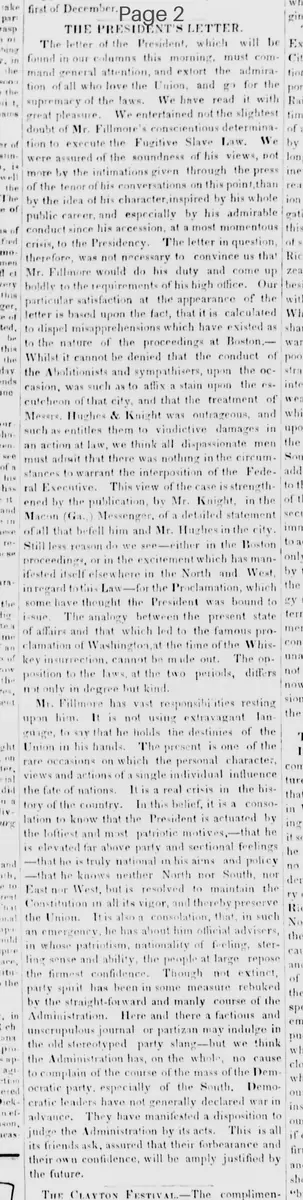
The letter of the President, which will be found in our columns this morning, must command general attention, and extort the admiration of all who love the Union, and go for the supremacy of the laws. We have read it with great pleasure. We entertained not the slightest doubt of Mr. Fillmore's conscientious determination to execute the Fugitive Slave Law. We were assured of the soundness of his views, not more by the intimations given through the press of the tenor of his conversations on this point, than by the idea of his character, inspired by his whole public career, and especially by his admirable conduct since his accession, at a most momentous crisis, to the Presidency. The letter in question, therefore, was not necessary to convince us that Mr. Fillmore would do his duty and come up boldly to the requirements of his high office. Our particular satisfaction at the appearance of the letter is based upon the fact, that it is calculated to dispel misapprehensions which have existed as to the nature of the proceedings at Boston.
Whilst it cannot be denied that the conduct of the Abolitionists and sympathizers, upon the occasion, was such as to affix a stain upon the escutcheon of that city, and that the treatment of Messrs. Hughes & Knight was outrageous, and such as entitles them to vindictive damages in an action at law, we think all dispassionate men must admit that there was nothing in the circumstances to warrant the interposition of the Federal Executive. This view of the case is strengthened by the publication, by Mr. Knight, in the Macon (Ga.) Messenger, of a detailed statement of all that befell him and Mr. Hughes in the city.
Still less reason do we see—either in the Boston proceedings, or in the excitement which has manifested itself elsewhere in the North and West, in regard to this Law—for the Proclamation, which some have thought the President was bound to issue. The analogy between the present state of affairs and that which led to the famous proclamation of Washington, at the time of the Whiskey insurrection, cannot be made out. The opposition to the laws, at the two periods, differs not only in degree but kind.
Mr. Fillmore has vast responsibilities resting upon him. It is not using extravagant language, to say that he holds the destinies of the Union in his hands. The present is one of the rare occasions on which the personal character, views and actions of a single individual influence the fate of nations. It is a real crisis in the history of the country. In this belief, it is a consolation to know that the President is actuated by the loftiest and most patriotic motives,—that he is elevated far above party and sectional feelings—that he is truly national in his aims and policy—that he knows neither North nor South, nor East nor West, but is resolved to maintain the Constitution in all its vigor, and thereby preserve the Union. It is also a consolation, that, in such an emergency, he has about him official advisers, in whose patriotism, nationality of feeling, sterling sense and ability, the people at large repose the firmest confidence. Though not extinct, party spirit has been in some measure rebuked by the straight-forward and manly course of the Administration. Here and there a factious and unscrupulous journal or partizan may indulge in the old stereotyped party slang—but we think the Administration has, on the whole, no cause to complain of the course of the mass of the Democratic party, especially of the South. Democratic leaders have not generally declared war in advance. They have manifested a disposition to judge the Administration by its acts. This is all its friends ask, assured that their forbearance and their own confidence, will be amply justified by the future.
What sub-type of article is it?
What themes does it cover?
What keywords are associated?
What entities or persons were involved?
Where did it happen?
Story Details
Key Persons
Location
Boston
Story Details
The article praises President Fillmore's letter affirming his determination to enforce the Fugitive Slave Law, dispels misapprehensions about Boston proceedings involving the outrageous treatment of Hughes and Knight, argues against federal interposition or proclamation, and highlights Fillmore's patriotic role in preserving the Union amid national crisis.