Thank you for visiting SNEWPapers!
Sign up free
Literary
January 2, 1847
New England Religious Herald
Hartford, Hartford County, Connecticut
What is this article about?
The essay refutes the notion that mystery ends religion, arguing that divine nature and dispensations are inherently mysterious, increasing with deeper religious knowledge and leading to endless intellectual and spiritual progression, even in heaven. Attributed to John Foster.
Merged-components note: These two components continue the same literary discussion on mystery, religion, and progress in knowledge, with direct textual continuation.
Clipping
OCR Quality
95%
Excellent
Full Text
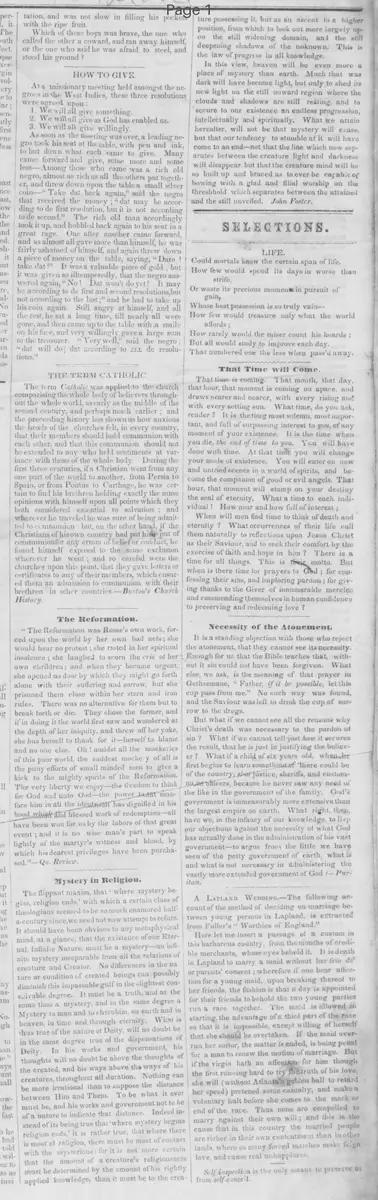
The flippant maxim, that : where mystery begins, religion ends.' with which a certain class of theologians seemed to be so much enamored half a century since, we need not now attempt to refute. It should have been obvious to any metaphysical mind, at a glance, that the existence of one Eternal, Infinite Nature, must be a mystery—an infinite mystery inseparable from all the relations of creature and Creator. No differences in the nature or condition of created beings can possibly diminish this impassable gulf in the slightest conceivable degree. It must be a truth, and at the same time a mystery, and in the same degree a Mystery to man and to cherubim, on earth and in heaven, in time and through eternity. What is thus true of the nature of Deity, will no doubt be in the same degree true of the dispensations of Deity. In his works and government, his thoughts will no doubt be above the thoughts of the created, and his ways above the ways of his creatures, throughout all duration. Nothing can be more irrational than to suppose the distance between Him and Them. To be what it ever must be, and his works and government not to be of a nature to indicate that distance. Indeed instead of its being true that 'where mystery begins religion ends,' it is rather true, that where there is most of religion, there must be most of contact with the mysterious: for it is not more certain that the amount of a creature's religiousness must be determined by the amount of his rightly applied knowledge, than it must be to the creature possessing it, but as an ascent to a higher position, from which to look out more largely upon the still widening domain, and the still deepening shadows of the unknown. This is the law of progress in all knowledge.
In this view, heaven will be even more a place of mystery than earth. Much that was dark will have become light, but only to shed its new light on the still onward region where the clouds and shadows are still resting, and to secure to our existence an endless progression, intellectually and spiritually. What we attain hereafter, will not be that mystery will cease, but that our tendency to stumble at it will have come to an end—not that the line which now separates between the creature light and darkness will disappear, but that the creature mind will be so built up and braced as to ever be capable of bowing with a glad and filial worship on the threshold which separates between the attained and the still unveiled. John Foster.
In this view, heaven will be even more a place of mystery than earth. Much that was dark will have become light, but only to shed its new light on the still onward region where the clouds and shadows are still resting, and to secure to our existence an endless progression, intellectually and spiritually. What we attain hereafter, will not be that mystery will cease, but that our tendency to stumble at it will have come to an end—not that the line which now separates between the creature light and darkness will disappear, but that the creature mind will be so built up and braced as to ever be capable of bowing with a glad and filial worship on the threshold which separates between the attained and the still unveiled. John Foster.
What sub-type of article is it?
Essay
What themes does it cover?
Religious
What keywords are associated?
Mystery
Religion
Deity
Eternal Nature
Spiritual Progression
Divine Dispensations
Theological Reflection
What entities or persons were involved?
John Foster
Literary Details
Author
John Foster
Subject
Refutation Of The Maxim That Where Mystery Begins, Religion Ends
Key Lines
It Should Have Been Obvious To Any Metaphysical Mind, At A Glance, That The Existence Of One Eternal, Infinite Nature, Must Be A Mystery—An Infinite Mystery Inseparable From All The Relations Of Creature And Creator.
Indeed Instead Of Its Being True That 'Where Mystery Begins Religion Ends,' It Is Rather True, That Where There Is Most Of Religion, There Must Be Most Of Contact With The Mysterious
Heaven Will Be Even More A Place Of Mystery Than Earth.
What We Attain Hereafter, Will Not Be That Mystery Will Cease, But That Our Tendency To Stumble At It Will Have Come To An End