Thank you for visiting SNEWPapers!
Sign up free
The Enquirer
Richmond, Henrico County, Virginia
What is this article about?
On January 31, 1806, the U.S. House of Representatives debated and voted on a Potomac River bridge resolution, which passed 61-50. Other actions included rejecting rules amendments, printing a 1791 commercial report, passing a public debt bill 89-0, and adjourning until Monday 64-54 amid calls for national priorities like non-importation with Britain.
Clipping
OCR Quality
Full Text
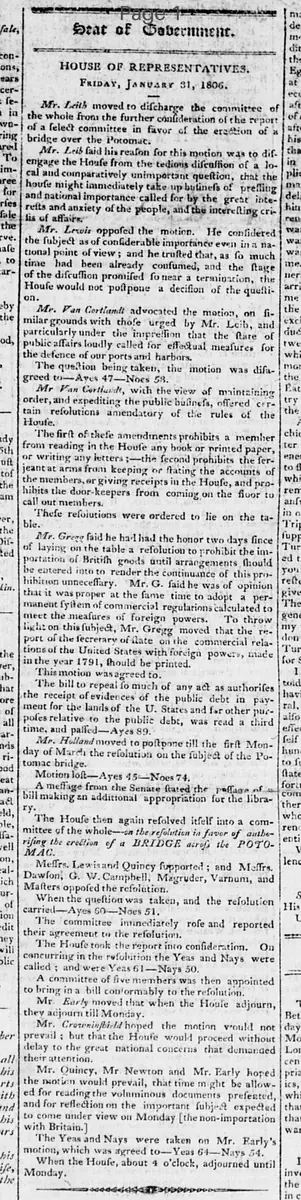
HOUSE OF REPRESENTATIVES.
FRIDAY, January 31, 1806.
Mr. Leib moved to discharge the committee of the whole from the further consideration of the report of a select committee in favor of the erection of a bridge over the Potomac.
Mr. Leib said his reason for this motion was to disengage the House from the tedious discussion of a local and comparatively unimportant question, that the house might immediately take up business of pressing and national importance called for by the great interests and anxiety of the people, and the interesting crisis of affairs.
Mr. Lewis opposed the motion. He considered the subject as of considerable importance even in a national point of view; and he trusted that, as so much time had been already consumed, and the stage of the discussion promised so near a termination, the House would not postpone a decision of the question.
Mr. Van Cortlandt advocated the motion, on similar grounds with those urged by Mr. Leib, and particularly under the impression that the state of public affairs loudly called for effectual measures for the defence of our ports and harbors.
The question being taken, the motion was disagreed to—Ayes 47—Noes 58.
Mr. Van Cortlandt, with the view of maintaining order, and expediting the public business, offered certain resolutions amendatory of the rules of the House.
The first of these amendments prohibits a member from reading in the House any book or printed paper, or writing any letters;—the second prohibits the sergeant at arms from keeping or stating the accounts of the members, or giving receipts in the House, and prohibits the door-keepers from coming on the floor to call out members.
These resolutions were ordered to lie on the table.
Mr. Gregg said he had had the honor two days since of laying on the table a resolution to prohibit the importation of British goods until arrangements should be entered into to render the continuance of this prohibition unnecessary. Mr. G. said he was of opinion that it was proper at the same time to adopt a permanent system of commercial regulations calculated to meet the measures of foreign powers. To throw light on this subject, Mr. Gregg moved that the report of the secretary of state on the commercial relations of the United States with foreign powers, made in the year 1791, should be printed.
This motion was agreed to.
The bill to repeal so much of any act as authorizes the receipt of evidences of the public debt in payment for the lands of the U. States and for other purposes relative to the public debt, was read a third time, and passed—Ayes 89.
Mr. Holland moved to postpone till the first Monday of March the resolution on the subject of the Potomac bridge.
Motion lost—Ayes 45 Noes 74.
A message from the Senate stated the passage of a bill making an additional appropriation for the library.
The House then again resolved itself into a committee of the whole—on the resolution in favor of authorizing the erection of a BRIDGE across the POTOMAC.
Messrs. Lewis and Quincy supported; and Messrs. Dawson, G. W. Campbell, Magruder, Varnum, and Masters opposed the resolution.
When the question was taken, and the resolution carried—Ayes 60—Noes 51.
The committee immediately rose and reported their agreement to the resolution.
The House took the report into consideration. On concurring in the resolution the Yeas and Nays were called: and were Yeas 61—Nays 50.
A committee of five members was then appointed to bring in a bill conformably to the resolution.
Mr. Early moved that when the House adjourn, they adjourn till Monday.
Mr. Crowninshield hoped the motion would not prevail; but that the House would proceed without delay to the great national concerns that demanded their attention.
Mr. Quincy, Mr Newton and Mr. Early hoped the motion would prevail, that time might be allowed for reading the voluminous documents presented, and for reflection on the important subject expected to come under view on Monday [the non-importation with Britain.]
The Yeas and Nays were taken on Mr. Early's motion, which was agreed to—Yeas 64—Nays 54.
When the House, about 4 o'clock, adjourned until Monday.
What sub-type of article is it?
What keywords are associated?
What entities or persons were involved?
Where did it happen?
Domestic News Details
Primary Location
Seat Of Government
Event Date
Friday, January 31, 1806
Key Persons
Outcome
potomac bridge resolution passed (yeas 61, nays 50); rules amendments ordered to lie on table; 1791 commercial report printing agreed; public debt bill passed (ayes 89); adjournment to monday agreed (yeas 64, nays 54).
Event Details
House debated discharging committee on Potomac bridge report (motion lost 47-58); Mr. Van Cortlandt's rules amendments tabled; Mr. Gregg's motion to print 1791 Secretary of State report agreed; public debt bill passed; postponement of bridge resolution lost (45-74); bridge resolution carried in committee (60-51) and House (61-50); committee appointed for bill; adjournment motion passed (64-54).