Thank you for visiting SNEWPapers!
Sign up free
Editorial
April 17, 1802
The Recorder, Or, Lady's And Gentleman's Miscellany
Richmond, Virginia
What is this article about?
Editorial criticizes U.S. government's failure to try Captain Samuel Sterret for murdering sailor Neale Harvey in 1799 naval battle, contrasts with British justice in cases like Governor Wall's hanging, and notes political appointments by Adams and Jefferson's praise of Sterret.
Clipping
OCR Quality
95%
Excellent
Full Text
TAKE NOTICE.
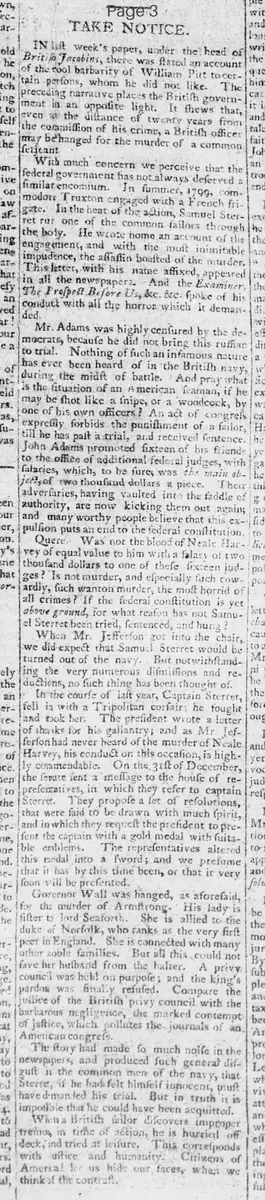
In last week's paper, under the head of British Jacobins, there was stated an account of the cool barbarity of William Pitt to certain persons, whom he did not like. The preceding narrative places the British government in an opposite light. It shews that, even at the distance of twenty years from the commission of his crime, a British officer may be hanged for the murder of a common soldier.
With much concern we perceive that the federal government has not always deserved a similar encomium. In summer, 1799, commodore Truxton engaged with a French frigate. In the heat of the action, Samuel Sterret run one of the common sailors through the body. He wrote home an account of the engagement, and with the most inimitable impudence, the assassin boasted of the murder. This letter, with his name affixed, appeared in all the newspapers. And the Examiner, The Prospect Before Us, &c. &c. spoke of his conduct with all the horror which it demanded.
Mr. Adams was highly censured by the democrats, because he did not bring this ruffian to trial. Nothing of such an infamous nature has ever been heard of in the British navy, during the midst of battle. And pray what is the situation of an American seaman, if he may be shot like a snipe, or a woodcock, by one of his own officers? An act of congress expressly forbids the punishment of a sailor, till he has past a trial, and received sentence.
John Adams promoted sixteen of his friends to the office of additional federal judges, with salaries, which, to be sure, was the main object of two thousand dollars a piece. Their adversaries, having vaulted into the saddle of authority, are now kicking them out again; and many worthy people believe that this expulsion puts an end to the federal constitution.
Quere. Was not the blood of Neale Harvey of equal value to him with a salary of two thousand dollars to one of these sixteen judges? Is not murder, and especially such cowardly, such wanton murder, the most horrid of all crimes? If the federal constitution is yet above ground, for what reason has not Samuel Sterret been tried, sentenced, and hung?
When Mr. Jefferson got into the chair, we did expect that Samuel Sterret would be turned out of the navy. But notwithstanding the very numerous dismissals and reductions, no such thing has been thought of. In the course of last year, Captain Sterret, fell in with a Tripolitan corsair: he fought and took her. The president wrote a letter of thanks for his gallantry; and as Mr. Jefferson had never heard of the murder of Neale Harvey, his conduct on this occasion, is highly commendable. On the 31st of December, the senate sent a message to the house of representatives, in which they refer to captain Sterret. They propose a set of resolutions, that were said to be drawn with much spirit, and in which they request the president to present the captain with a gold medal with suitable emblems. The representatives altered this medal into a sword; and we presume that it has by this time been, or that it very soon will be presented.
Governor Wall was hanged, as aforesaid, for the murder of Armstrong. His lady is sister to lord Seaforth. She is allied to the duke of Norfolk, who ranks as the very first peer in England. She is connected with many other noble families. But all this could not save her husband from the halter. A privy council was held on purpose; and the king's pardon was finally refused. Compare the justice of the British privy council with the barbarous negligence, the marked contempt of justice, which pollutes the journals of an American congress.
The story had made so much noise in the newspapers, and produced such general disgust in the common men of the navy, that Sterret, if he had felt himself innocent, must have demanded his trial. But in truth it is impossible that he could have been acquitted. When a British sailor discovers improper tremor, in time of action, he is hurried off deck, and tried at leisure. This corresponds with justice and humanity. Citizens of America! let us hide our faces, when we think of this contrast.
In last week's paper, under the head of British Jacobins, there was stated an account of the cool barbarity of William Pitt to certain persons, whom he did not like. The preceding narrative places the British government in an opposite light. It shews that, even at the distance of twenty years from the commission of his crime, a British officer may be hanged for the murder of a common soldier.
With much concern we perceive that the federal government has not always deserved a similar encomium. In summer, 1799, commodore Truxton engaged with a French frigate. In the heat of the action, Samuel Sterret run one of the common sailors through the body. He wrote home an account of the engagement, and with the most inimitable impudence, the assassin boasted of the murder. This letter, with his name affixed, appeared in all the newspapers. And the Examiner, The Prospect Before Us, &c. &c. spoke of his conduct with all the horror which it demanded.
Mr. Adams was highly censured by the democrats, because he did not bring this ruffian to trial. Nothing of such an infamous nature has ever been heard of in the British navy, during the midst of battle. And pray what is the situation of an American seaman, if he may be shot like a snipe, or a woodcock, by one of his own officers? An act of congress expressly forbids the punishment of a sailor, till he has past a trial, and received sentence.
John Adams promoted sixteen of his friends to the office of additional federal judges, with salaries, which, to be sure, was the main object of two thousand dollars a piece. Their adversaries, having vaulted into the saddle of authority, are now kicking them out again; and many worthy people believe that this expulsion puts an end to the federal constitution.
Quere. Was not the blood of Neale Harvey of equal value to him with a salary of two thousand dollars to one of these sixteen judges? Is not murder, and especially such cowardly, such wanton murder, the most horrid of all crimes? If the federal constitution is yet above ground, for what reason has not Samuel Sterret been tried, sentenced, and hung?
When Mr. Jefferson got into the chair, we did expect that Samuel Sterret would be turned out of the navy. But notwithstanding the very numerous dismissals and reductions, no such thing has been thought of. In the course of last year, Captain Sterret, fell in with a Tripolitan corsair: he fought and took her. The president wrote a letter of thanks for his gallantry; and as Mr. Jefferson had never heard of the murder of Neale Harvey, his conduct on this occasion, is highly commendable. On the 31st of December, the senate sent a message to the house of representatives, in which they refer to captain Sterret. They propose a set of resolutions, that were said to be drawn with much spirit, and in which they request the president to present the captain with a gold medal with suitable emblems. The representatives altered this medal into a sword; and we presume that it has by this time been, or that it very soon will be presented.
Governor Wall was hanged, as aforesaid, for the murder of Armstrong. His lady is sister to lord Seaforth. She is allied to the duke of Norfolk, who ranks as the very first peer in England. She is connected with many other noble families. But all this could not save her husband from the halter. A privy council was held on purpose; and the king's pardon was finally refused. Compare the justice of the British privy council with the barbarous negligence, the marked contempt of justice, which pollutes the journals of an American congress.
The story had made so much noise in the newspapers, and produced such general disgust in the common men of the navy, that Sterret, if he had felt himself innocent, must have demanded his trial. But in truth it is impossible that he could have been acquitted. When a British sailor discovers improper tremor, in time of action, he is hurried off deck, and tried at leisure. This corresponds with justice and humanity. Citizens of America! let us hide our faces, when we think of this contrast.
What sub-type of article is it?
Crime Or Punishment
Military Affairs
Partisan Politics
What keywords are associated?
Naval Murder
Sterret Trial
American Justice
British Navy
Military Punishment
Partisan Criticism
Sailor Rights
What entities or persons were involved?
Samuel Sterret
Neale Harvey
John Adams
Thomas Jefferson
William Pitt
Governor Wall
Commodore Truxton
Editorial Details
Primary Topic
Failure To Punish Captain Samuel Sterret For Murdering Sailor Neale Harvey
Stance / Tone
Critical Of American Naval Justice And Administrations Of Adams And Jefferson, Praising British Justice
Key Figures
Samuel Sterret
Neale Harvey
John Adams
Thomas Jefferson
William Pitt
Governor Wall
Commodore Truxton
Key Arguments
British Officers Can Be Hanged For Murdering Soldiers Even Years Later
Sterret Murdered Sailor Harvey In 1799 Battle And Boasted Publicly
Adams Failed To Try Sterret Despite Criticism
Congress Law Requires Trial Before Punishing Sailors
Adams Prioritized Judge Appointments Over Justice
Jefferson Praised Sterret For Later Action Without Knowing Of Murder
Senate And House Honored Sterret With Sword
Governor Wall Hanged For Similar Murder Despite Connections
American Neglect Of Justice Contrasts With British Fairness