Thank you for visiting SNEWPapers!
Sign up free
Daily Richmond Whig
Richmond, Virginia
What is this article about?
In the Virginia Constitutional Convention on Saturday, delegates debated and voted on amendments to the House of Delegates apportionment, including increasing total members to 112, redistributing from counties like Brunswick to Franklin, and from Loudoun, with multiple speeches and votes on county representations.
Clipping
OCR Quality
Full Text
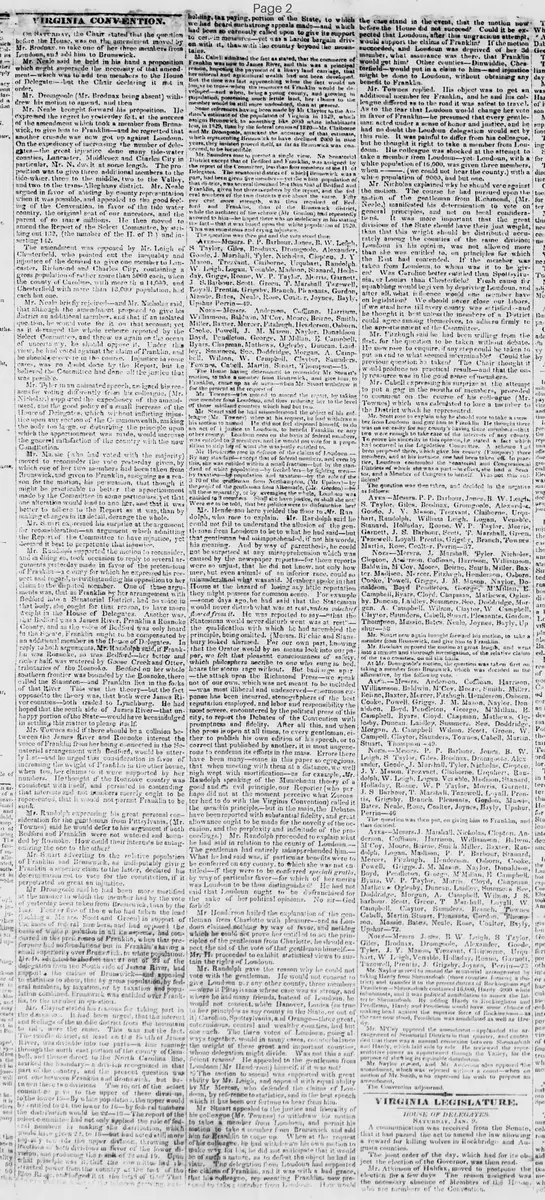
On Saturday, the Chair stated that the question before the House, was on the amendment moved by Mr. Brodnax, to take one of her three members from Loudoun, and add him to Brunswick.
Mr. Neale said he held in his hand a proposition which might supersede the necessity of that amendment—which was to add ten members to the House of Delegates—but the Chair declaring it not in order.
Mr. Dromgoole (Mr. Brodnax being absent) withdrew his motion to amend, and then Mr. Neale brought forward his proposition. He expressed the regret he yesterday felt, at the success of the amendment which took a member from Brunswick, to give him to Franklin—and he regretted that another crusade was now got up against Loudoun.
On the expediency of increasing the number of delegates—the great injustice done many tide-water counties, Lancaster, Middlesex and Charles City in particular, Mr. N. dwelt at some length. The proposition was to give three additional members to the tide-water, three to the middle, two to the Valley, and two to the trans-Alleghany district. Mr. Neale argued in favor of abiding by county representation when it was possible, and appealed to the good feeling of the Convention, in favor of the tide water country, the original seat of our ancestors, and the parent of so many millions. He then moved to amend the Report of the Select Committee, by striking out 102. (the number of the H. of R.) and inserting 112.
The amendment was opposed by Mr. Leigh of Chesterfield, who pointed out the inequality and injustice of the demand to give one member to Lancaster, Richmond and Charles City, containing a gross population of rather more than 5000 each, when the county of Caroline, with more than 14,000, and Chesterfield with more than 18,000 population, had each but one.
Mr. Neale briefly replied—and Mr. Nicholas said, that although the amendment proposed to give his district an additional member, and that if an isolated question, he would vote for it on that account; yet as it deranged the whole scheme reported by the Select Committee, and threw us again on the ocean of uncertainty, he should oppose it. Under this view, he had voted against the claim of Franklin, and he should persevere in that course. Injustice in some cases, was no doubt done by the Report, but he believed the Committee had done all the justice that was possible.
Mr. Tyler in an animated speech, assigned his reasons for voting differently from his colleague, (Mr. Nicholas,) supported the expediency of the amendment, and the good policy of a small increase of the House of Delegates, which without inflicting injustice upon any section of the Commonwealth, making the body too large, or disturbing the principle upon which the apportionment was made, would increase the general satisfaction of the country with the new Constitution.
Mr. Massie (who had voted with the majority) moved to reconsider the vote yesterday given, by which one of her two members had been taken from Brunswick, and given to Franklin, assigning as a reason for the motion, his persuasion, that though it might be practicable to better the apportionment made by the Committee in some particulars, yet that one alteration would lead to another, and that it was better to adhere to the Report as it was, than by making changes in its detail, derange the whole.
Mr. Stuart expressed his surprise at the argument for reconsideration—an argument which admitting the Report of the Committee to have injustice, yet declared it best to perpetuate that injustice.
Mr. Randolph supported the motion to reconsider, and in doing so, took occasion to reply to several arguments yesterday made in favor of the pretensions of Franklin—a county for which he expressed his respect and regard, notwithstanding his opposition to her claim to the disputed member. One of those arguments was, that as Franklin by her arrangement with Bedford into a Senatorial District, had no voice in that body, she ought for that reason, to have more weight in the House of Delegates. Another was, that Bedford was a James River, Franklin a Roanoke County, and as the voice of Bedford was only heard in the Senate, Franklin ought to be compensated by an additional member in the House of Delegates. In reply to both arguments, Mr. Randolph said, if Franklin was Roanoke, so was Bedford—her better and richer half, was watered by Goose Creek and Otter, tributaries of the Roanoke. Bedford on her whole southern frontier was bounded by the Roanoke, there called the Staunton—and Franklin lies in the forks of that River. This was the theory—but the fact opposed to the theory was, that both were James River counties—both traded to Lynchburg. He had hoped that the south side of James River—that unhappy portion of the State—would have been indulged in settling this matter to please itself.
Mr. Townes said if there should be a collision between the James River and Roanoke interest the voice of Franklin from her being connected in the Senatorial arrangement with Bedford, would be utterly lost—and he urged this consideration in favor of increasing the weight of Franklin in the other house, when too, far claims to it were supported by her numbers. He thought if the Roanoke country was consistent with itself, and persisted in contending that interests and not numbers merely ought to be represented, that it would not permit Franklin to be sunk.
Mr. Randolph expressing his great personal consideration for the gentleman from Pittsylvania, (Mr. Townes) said he would defer to his argument if both Bedford and Franklin were not watered and bounded by Roanoke. How could their interests be antagonizing the one to the other?
Mr. Stuart adverting to the relative population of Franklin and Brunswick, as indisputably giving Franklin a superior claim to the latter, declared his determination not to vote for the constitution, if it perpetrated so great an injustice.
Mr. Dromgoole said he had been more mortified at the manner in which the member had by the vote of yesterday been taken from Brunswick, than by the loss. Four or five of those who had taken the lead (naming Messrs. Scott and Green) in support of the basis of federal numbers, and had opposed the basis of white population in all its aspects, had concurred in the preference of Franklin, when that preference had no foundation but in Franklin's having a small superiority over Brunswick, in white population.
Mr. D. added that 21 out of 28 of the delegation from the South side of James River, had supported the claims of Brunswick—and appealed to statistics to show, that by gross population, by federal numbers, by taxation, or by taxation and population combined, Brunswick was entitled over Franklin, to the member in question.
Mr. Claiborne stated his reasons for taking part in the discussion. It had been urged, that the interest and feelings of the whole district from the mountain to tide, were the same. This was not the fact. The people did not think, at least on the South of James River, was divisible into two parts—a line running through the north east portion of the county of Campbell, and thence direct to the North Carolina line, marked the boundary—a division recognized in that part of the country, and the present question was not one between Franklin and Brunswick, but between these two divisions. The report of the select committee gave to the upper of these divisions, to the lower 18—By white population, the upper would be entitled to 21, the lower to 16—by federal numbers the distribution would be 20-18—The report of the select committee had not only applied the rule of federal numbers in making the distribution, which would have given 20 to 18—but had acted still more unjustly to the upper division, throwing the fractions of both divisions in favor of the lower division, and producing the result of 20 and 19. Upon what principle was it that the committee had abstracted power from the county at the foot of the Blue Ridge, and lodged it at the head of five That holding, tax paying, portion of the State, to which we had heard such strong appeals made—and which had been so earnestly called upon to give its support to certain measures—yet was a harder bargain driven with it, than with the country beyond the mountains.
Mr. Cabell admitted the fact as stated, that the commerce of Franklin was now to James River, and this was a principal reason, imposing the payment of a heavy land carriage, that her mineral and agricultural wealth had not been developed. But the time was fast approaching when the fact would no longer be true—when the resources of Franklin would be developed—and when, being a young county, and growing in population, possessing much fertile land, her claims to the member would be still more undoubted, than at present.
Some references having been made by Mr. Claiborne to the Auditor's estimate of the population of Virginia in 1829, which assigns Brunswick to something like 2000 white inhabitants less, in 1829, than by the federal census of 1820—Mr. Claiborne and Mr. Dromgoole, attacked the accuracy of that estimate, which representing Brunswick to have declined 9000 in nine years, they insisted proved itself, as far as Brunswick was concerned, to be incredible.
Mr. Saunders rose to present a single view. No Senatorial District except that of Bedford and Franklin, was assigned by the report of the Committee, less than four members of the House of Delegates. The Senatorial district of which Brunswick was a part, had been given five members—yet the white population of that district, was several thousand less than that of Bedford and Franklin, given but three members by the report, and the federal numbers of the two districts were about the same. Fifty per cent more strength, was thus required of Bedford and Franklin, than of the Brunswick district, while the architect of the scheme (Mr. Gordon) had repeatedly avowed to him—he hoped there was no indelicacy in his stating the fact—that it was based upon the white population of 1820. This was monstrous and crying injustice.
The question was then put and the vote stood thus:
Ayes—Messrs. P. P. Barbour, Jones, B. W. Leigh, S. Taylor, Giles, Brodnax, Dromgoole, Alexander, Goode, J. Marshall, Tyler, Nicholas, Clopton, J. Y. Mason, Trezvant, Claiborne, Urquhart, Randolph, W. Leigh, Logan, Venable, Madison, Stanard, Holladay, Griggs, Roane, W. P. Taylor, Morris, Garnett, J. S. Barbour, Scott, Green, T. Marshall, Tazewell, Royall, Prentiss, Grigsby, Branch, Pleasants, Gordon, Massie, Bates, Neale, Rose, Coalter, Joynes, Bayly, Upshur, Perrin—49.
Nays—Messrs. Anderson, Coffman, Harrison, Williamson, Baldwin, M'Coy, Moore, Beirne, Smith, Miller, Baxter, Mercer, Fitzhugh, Henderson, Osborn, Cooke, Powell, J. M. Mason, Naylor, Donaldson, Boyd, Pendleton, George, M'Millan, E. Campbell, Byars, Chapman, Mathews, Oglesby, Duncan, Laidley, Sommers, See, Doddridge, Morgan, A. Campbell, Wilson, W. Campbell, Claiborne, Saunders, Fownes, Cabell, Martin, Stuart, Thompson—35.
The House having determined to reconsider Mr. Stuart's motion, to take a member from Brunswick, and give him to Franklin, came up as de novo—when Mr. Stuart withdrew it for the present at the request of Mr. Townes—who moved to amend the report, by taking one member from Loudoun, and thus reducing her to the level of those midland counties which had but two.
Mr. Stuart said he had misunderstood the object of his colleague (Mr. Townes) when at his request, he had withdrawn his motion to amend. He did not feel disposed himself, to do an act of injustice to Loudoun, to benefit Franklin or any other county. Loudoun even on the basis of federal numbers, was entitled to 3 members, and he would not vote for a proposition to strip her of what she was justly entitled to.
Mr. Henderson rose in defence of the claims of Loudoun—By any standard—except that of federal numbers, and even by this, she was entitled within a small fraction—but by the standard of white population—by freeholders—by fighting men—by taxation—by population and taxation—by the rule of the gentleman from Northampton, (Mr. Upshur)—by the project of the gentleman from Albemarle, (Mr. Gordon)—by all these separately, or by averaging the rules, Loudoun was entitled to 3 members. Shall she have justice, or shall she not.? Were we to be told, that her politics were to disfranchise her?
Mr. Henderson here yielded the floor to Mr. Randolph, who rose to explain. Mr. Randolph said he could not fail to understand the allusion of the gentleman from Loudoun to be to what he had said but that gentleman had misapprehended, if not his words, his meaning. And by way of parenthesis, he could not be surprised at any misapprehension which was caused by the newspaper reports—for those reports were so unjust, that he did not know, not only how men, but even animals of an inferior race, could so misunderstand what was said. Members spoke in that House at the hazard of losing any little reputation they might possess for common sense. For example—some days ago, he had said that the Statesman would never disturb what was at rest, unless mischief flowed from it. He was reported to say—'that the Statesman would never disturb what was at rest'—the qualification with which he had assembled the principle, being omitted. (Messrs. Ritchie and Stanbury looked alarmed. For our own part, knowing that the Orator would by no means look into our paper, we felt that pleasant consciousness of safety, which philosophers ascribe to one who sung in bed, and hears the storm rage without. But bad one eye apart—the attack upon the Richmond Press—we speak not of our own, which was not meant to be included—was most illiberal and undeserved—enormous expense has been incurred, stenographers of the best reputation employed, and labor and responsibility the most severe, encountered by the political press of this city, to report the Debates of the Convention with promptness and fidelity. After all this, and when the press is open at all times, to every gentleman, either to publish his own edition of his speech, or to correct that published by another, it is most ungracious to condemn its efforts in the mass. Errors there have been many—some in this paper so egregious, that when meeting with them at a distance, we well nigh wept with mortification—as for example, Mr. Randolph speaking of the Manichaean theory of a good and an evil principle, our Reporter (who perhaps did not at the moment perceive what Zoroaster had to do with the Virginia Convention) called it the manikin principle—but in the main, the Debates have been reported with substantial fidelity, and great allowance ought to be made for the novelty of the occasion, and the perplexity and infinitude of the proceedings.) Mr. Randolph proceeded to explain what he had said in relation to the county of Loudoun.—The gentleman had entirely misapprehended him.—What he had said was, if particular benefits were to be conferred on any county, to which she was not entitled—if they were to be conferred special gratia, by way of particular favor—for which of her merits was Loudoun to be thus distinguished? He had not said that Loudoun ought to be disfranchised for the sake of her political opinions. No sir—God forbid!
Mr. Henderson hailed the explanation of the gentleman from Charlotte with pleasure—and as Loudoun claimed nothing by way of favor, and nothing which he could not prove her entitled to on the principles of the gentleman from Charlotte, he should expect the aid of the vote of that gentleman himself.—Mr. H. proceeded to exhibit statistical views to sustain the rights of Loudoun.
Mr. Randolph gave the reason why he could not vote with the gentleman. He would not consent to give Loudoun or any other county, three members—were it Pennsylvania whose case was as strong, and where he had many friends, instead of Loudoun, he would not consent, while Hanover, Louisa (as true to her principles as any county in the State, or out of it) Caroline, Spottsylvania, and Orange—three great, coterminous, central and wealthy counties, had but one each. The three votes of Loudoun, going always together, would in many cases, counterbalance the weight of these great and important counties, whose delegation might divide. Was not this a sufficient reason? He appealed to the gentleman from Loudoun (Mr. Henderson) himself, if it was not?
The motion to amend was supported with great ability by Mr. Leigh, and opposed with equal ability by Mr. Mercer, who defended the claims of Loudoun, by reference to statistics, and in the ablest speech which it has been our fortune to hear from him.
Mr. Stuart appealed to the justice and liberality of his colleague (Mr. Townes) to withdraw his motion to take a member from Loudoun, and permit his motion to take a member from Brunswick and add him to Franklin to come up. When at the request of his colleague, he had withdrawn his own motion to make way for his, he did not anticipate that it would be of such a nature, as to defeat the object he had in view. The delegation from Loudoun had supported the claims of Franklin, and it was with a bad grace, that his colleague, representing Franklin, now proposed to take a member from Loudoun. How would the case stand in the event, that the motion now before the House did not succeed? Could it be expected that Loudoun, after this ungracious attempt, would support the claims of Franklin? If the motion succeeded, and Loudoun was deprived of her 3d member, what assurance was there, that Franklin would get him? Other counties—Dinwiddie, Chesterfield would put in a claim to him—and injustice might be done to Loudoun, without obtaining any benefit to Franklin.
Mr. Townes replied. His object was to get an additional member for Franklin, and he and his colleague differed as to the road it was safest to travel. As to the fear that Loudoun would change her vote in favor of Franklin—he presumed that every gentleman acted under a sense of honor and justice, and he had no doubt the Loudoun delegation would act by this rule. It was painful to differ from his colleague, but he thought it right to take a member from Loudoun. His colleague was shocked at the attempt to take a member from Loudoun—yet—Loudoun, with a white population of 16,000, was given three members, when [we could not hear the county.] with a white population of 9000, had but one.
Mr. Nicholas explained why he should vote against the motion. The course he had pursued upon the motion of the gentleman from Richmond, (Mr. Neale,) manifested his determination to vote on general principles, and not on local considerations. It was more important that the great divisions of the State should have their just weight, than that this weight should be distributed accurately among the counties of the same division; Loudoun in his opinion, was not allowed more than she was entitled to, on principles for which the East had contended. If the member was taken from Loudoun, to whom was it to be given? Was Caroline better entitled than Spottsylvania, or Louisa than Chesterfield? Fresh cause for squabbling would be given by depriving Loudoun, and after all, what influence would one member have on legislation? He should never close our labors, if we stand here till every county was satisfied—and he thought it best unless the members of a District could agree among themselves, to adhere firmly to the apportionment of the Committee.
Mr. Fitzhugh said he had been willing from the first, for the question to be taken without debate. He now rose to enquire, if any step could be taken to put an end to what seemed interminable? Could the previous question be taken? The Chair thought it would produce no practical result—and that the only resource was in the good sense of members.
Mr. Cabell expressing his surprise at the attempt to put a gag in the mouths of members, proceeded to comment on the course of his colleague (Mr. Townes) which was calculated to lose a member to the District which he represented.
Mr. Scott rose to explain why he should vote to take a member from Loudoun and give him to Franklin. He thought there was no necessity for any county's having three members—that two were enough to take care of the interests of any county. To prove his sincerity in this opinion, he stated a fact which had occurred in the Legislative Committee. A scheme had been proposed there, which gave his county (Fauquier) three members, and at his instance, one had been taken off. In practice, Loudoun controlled the Senatorial and Congressional Districts of which she was a part—in effect, she had a Senator, and a Member of Congress to herself. Was not this sufficient?
The question was then taken, and decided in the negative as follows:
Ayes—Messrs. P. P. Barbour, Jones, B. W. Leigh, S. Taylor, Giles, Brodnax, Dromgoole, Alexander, Goode, J. Y. Mason, Trezvant, Claiborne, Urquhart, Randolph, William Leigh, Logan, Venable, Stanard, Holladay, Roane, W. P. Taylor, Morris, Garnett, J. S. Barbour, Scott, T. Marshall, Green, Tazewell, Royall, Prentiss, Grigsby, Branch, Fownes, Martin, Rose, Coalter, Perrin—37.
Nays—Messrs. J. Marshall, Tyler, Nicholas, Clopton, Anderson, Coffman, Harrison, Williamson, Baldwin, M'Coy, Moore, Beirne, Smith, Miller, Baxter, Madison, Mercer, Fitzhugh, Henderson, Osborn, Cooke, Powell, Griggs, J. M. Mason, Naylor, Donaldson, Boyd, Pendleton, George, M'Millan, E. Campbell, Byars, Cloyd, Chapman, Mathews, Oglesby, Duncan, Laidley, Sommers, See, Doddridge, Morgan, A. Campbell, Wilson, Claiborne, W. Campbell, Claytor, Saunders, Cabell, Stuart, Pleasants, Gordon, Thompson, Massie, Bates, Neale, Joynes, Bayly, Upshur—58.
Mr. Stuart now again brought forward his motion, to take a member from Brunswick, and give him to Franklin.
Mr. Brodnax opposed the motion at great length, and went into a minute and thorough investigation, of the relative claims of the two counties, on all the basis.
At Mr. Dromgoole's motion, the question was taken first on taking a member from Brunswick, which was decided in the affirmative, by the following vote.
Ayes.—Messrs. Anderson, Coffman, Harrison, Williamson, Baldwin, M'Coy, Moore, Smith, Miller, Beirne, Baxter, Mercer, Fitzhugh, Henderson, Osborn, Cooke, Powell, Griggs, J. M. Mason, Naylor, Donaldson, Boyd, Pendleton, George, M'Millan, E. Campbell, Byars, Cloyd, Chapman, Mathews, Oglesby, Duncan, Laidley, Sommers, See, Doddridge, Morgan, A. Campbell, Wilson, Scott, Green, W. Campbell, Claiborne, Saunders, Townes, Cabell, Martin, Stuart, Thompson—49.
Nays.—Messrs. P. P. Barbour, Jones, B. W. Leigh, S. Taylor, Giles, Brodnax, Dromgoole, Alexander, Goode, J. Marshall, Tyler, Nicholas, Clopton, J. Y. Mason, Trezvant, Claiborne, Urquhart, Randolph, W. Leigh, Logan, Venable, Madison, Stanard, Holladay, Roane, W. P. Taylor, Morris, Garnett, J. S. Barbour, T. Marshall, Tazewell, Royall, Prentiss, Grigsby, Branch, Pleasants, Gordon, Massie, Bates, Neale, Rose, Coalter, Joynes, Bayly, Upshur, Perrin—46.
The question was then put, on giving him to Franklin, and thus decided.
Ayes—Messrs. J. Marshall, Nicholas, Clopton, Anderson, Coffman, Harrison, Williamson, Baldwin, M'Coy, Moore, Beirne, Smith, Miller, Baxter, Randolph, Logan, Madison, P. P. Barbour, Stanard, Mercer, Fitzhugh, Henderson, Osborn, Cooke, Powell, Griggs, J. M. Mason, Naylor, Donaldson, Boyd, Pendleton, George, M'Millan, E. Campbell, Byars, W. P. Taylor, Morris, Cloyd, Chapman, Mathews, Oglesby, Duncan, Laidley, Sommers, See, Doddridge, Morgan, A. Campbell, Wilson, J. S. Barbour, Scott, Green, T. Marshall, Royall, W. Campbell, Claiborne, Saunders, Branch, Fownes, Cabell, Martin, Stuart, Pleasants, Gordon, Thompson, Massie, Bates, Neale, Rose, Coalter, Bayly, Upshur—72.
Nays—Messrs. James, B. W. Leigh, S. Taylor, Giles, Brodnax, Dromgoole, Alexander, Goode, Tyler, J. Y. Mason, Trezvant, Claiborne, Urquhart, W. Leigh, Venable, Holladay, Roane, Garnett, Tazewell, Prentiss, J. Grigsby, Joynes, Perrin—23.
Mr. Naylor moved to amend the senatorial arrangement by taking Hardy from Shenandoah (those counties forming a district) and transfer it to the present district of Rockingham and Pendleton—Shenandoah contained 16,000, Hardy 4000 white inhabitants, and it was political annihilation to annex the latter to Shenandoah. By adding Hardy to Rockingham and Pendleton, Hardy and Pendleton would have some chance of making head against the superior force of Rockingham—as the case now stood, Pendleton was annihilated as well as Hardy.
Mr. M'Coy opposed the amendment—applauded the arrangement of Senatorial Districts in that quarter, and contended that there was a natural connexion between Shenandoah and Hardy, which lay side by side. He reviewed the representative power as apportioned through the Valley, for the purpose of showing its equitable distribution.
Mr. Naylor replied, and Mr. Anderson also opposed the amendment, which was rejected without a count—when on motion of Mr. Smith, who expressed his wish to propose an amendment,
The Convention adjourned.
What sub-type of article is it?
What keywords are associated?
What entities or persons were involved?
Where did it happen?
Domestic News Details
Primary Location
Virginia
Event Date
On Saturday
Key Persons
Outcome
amendment to increase delegates to 112 rejected (49-35); motion to take member from loudoun rejected (37-58); motion to take member from brunswick and give to franklin passed (49-46 on removal, 72-23 on addition); amendment on senatorial districts for hardy rejected.
Event Details
The Virginia Convention debated amendments to the Select Committee's report on House of Delegates apportionment, including proposals to add ten members total and redistribute among counties based on population, taxation, and regional interests. Speeches addressed injustices to tide-water counties, comparisons between counties like Brunswick, Franklin, and Loudoun, and regional divisions south of James River. Multiple votes occurred on reconsiderations and specific reallocations.