Thank you for visiting SNEWPapers!
Sign up free
Sunbury American
Sunbury, Northumberland County, Pennsylvania
What is this article about?
Thanksgiving sermon delivered by Rev. J. H. Young on November 24, 1864, at the Presbyterian Church in Sunbury, urging trust in God over military might, illustrated by biblical histories and applied to the American Civil War, expressing gratitude for Union progress and calling for national faith.
Clipping
OCR Quality
Full Text
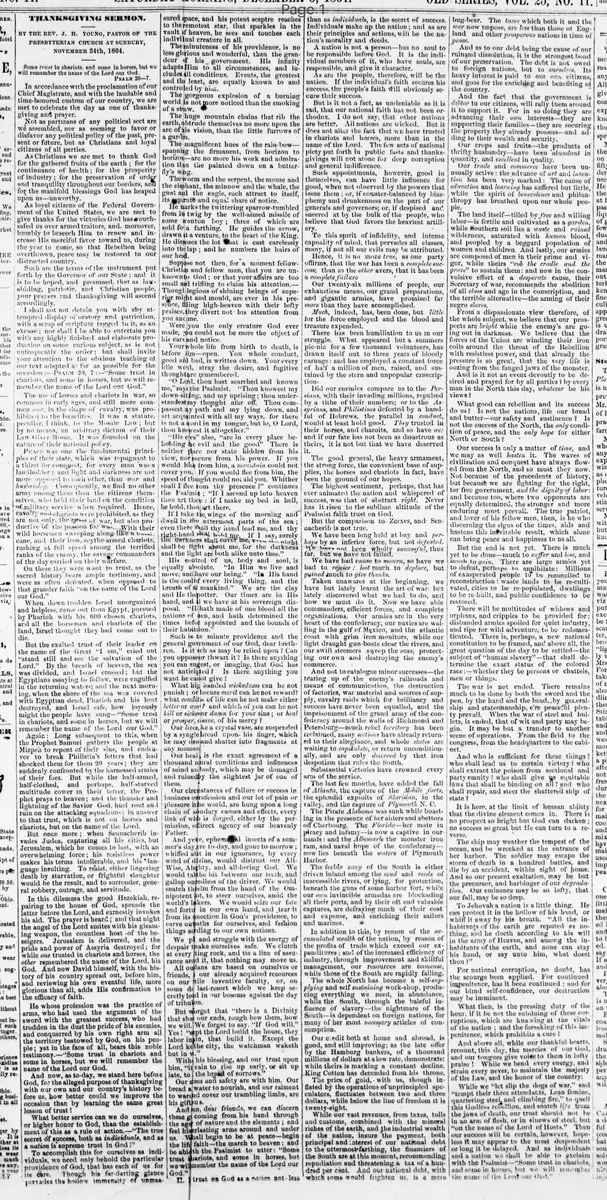
BY THE REV. J. H. YOUNG, PASTOR OF THE PRESBYTERIAN CHURCH AT SUNBURY,
NOVEMBER 24th, 1864.
Some trust in chariots, and some in horses, but we will remember the name of the Lord our God.
PSALM 20:7.
In accordance with the proclamation of our Chief Magistrate, and with the laudable and time-honored custom of our country, we are met to celebrate the day as one of thanksgiving and prayer.
Not as partisans of any political sect are we assembled, nor as seeming to favor or disfavor any political policy of the past, present or future, but as Christians and loyal citizens of all parties.
As Christians we are met to thank God for the gathered fruits of the earth; for the continuance of health; for the prosperity of industry; for the preservation of order and tranquility throughout our borders, and for the manifold blessings God has heaped upon us—unworthy.
As loyal citizens of the Federal Government of the United States, we are met to give thanks for the victories God has vouchsafed us over armed traitors, and, moreover, humbly to beseech Him to renew and increase His merciful favor toward us, during the year to come, so that Rebellion being overthrown, peace may be restored to our distracted country.
Such are the terms of the instrument put forth by the Governor of our State: and it is to be hoped, and presumed, that as law-abiding, patriotic, and Christian people your prayers and thanksgiving will ascend accordingly.
I shall not now detain you with any attempted display of oratory and patriotism, with a scrap of scripture tagged to it, as an excuse: nor shall I be able to entertain you with any highly finished and elaborate production on some curious subject, as is not unfrequently the order; but shall invite your attention to the obvious teaching of our text adapted as far as possible for the occasion:—PSALM 20, 7 :—“Some trust in chariots, and some in horses, but we will remember the name of the Lord our God.”
The use of horses and chariots in war, so common in early ages, and still more common now, in the shape of cavalry, was prohibited to the Israelites. It was a statute, peculiar, I think, to the Mosaie Law; but by no means, an arbitrary dictum of their Lawgiver Moses. It was founded on the nature of their national policy.
Peace was one the fundamental principles of their state, which was repugnant to a thirst for conquest, for every man was a landholder: and light and darkness are not more opposed to each other, than war and husbandry. Consequently, we find no other army among them than the citizens themselves, who held their land on the condition of military service when required. Hence, cavalry and chariots were prohibited, as they are not only, the spirit of war, but also productive of the passion for war. With their wild horsemen sweeping along like a broken cane, and their iron, scythe-armed chariots, rushing at full speed among the terrified ranks of the enemy, the savage commanders of the day carried on their warfare.
On these they were wont to trust, as the sacred history bears ample testimony, and were as often defeated, when opposed to that grander faith "on the name of the Lord our God."
When down-trodden Israel unorganized and helpless, came out from Egypt, pursued by Pharaoh with his God chosen chariots, and all the horsemen and chariots of the land, Israel thought they had come out to die.
But the exalted trust of their leader on the name of the Great "I am," cried out "stand still and see the salvation of the Lord." By the breath of heaven, the sea was divided, and Israel crossed; but the Egyptians essaying to follow, were engulfed in the returning waters; and the next morning, when the shore of the sea was covered with Egyptian dead, Pharaoh and his host destroyed, and Israel safe, how joyously might the people have sung—“Some trust in chariots, and some in horses, but we will remember the name of the Lord our God.”
Again: Long subsequent to this, when the Prophet Samuel gathers the people at Mizpeh to repent of their sins, and endeavor to break Philistia's fetters that had shocked them for them 20 years; they are suddenly confronted by the harnessed armies of their foes. But while the half-armed, half-clothed, and perhaps, half-starved multitude cower in their terror, the Prophet prays to heaven; and the thunder and lightning of the Savior God, hurl rout and ruin on the attacking squadrons; in answer to that trust, which is not on horses and chariots, but on the name of the Lord.
But once more; when Sennacherib invades Judea, capturing all his cities, but Jerusalem, which he comes to last, with an overwhelming force; his resistless power makes his terms intolerable, and his language insulting. To resist, either lingering death by starvation, or frightful slaughter would be the result, and to surrender, general robbery, outrage, and servitude.
In this dilemma the good Hezekiah, repairing to the house of God, spreads the letter before the Lord, and earnestly invokes his aid. The prayer is heard; and that night the angel of the Lord smites with his gleaming weapon, the countless host of the besiegers. Jerusalem is delivered, and the pride and power of Assyria destroyed; for while one trusted in chariots and horses, the other remembered the name of the Lord, his God. And now David himself, with the history of his country spread out, before him, and reviewing his own eventful life, more glorious than all, adds His confirmation to the efficacy of faith.
He whose profession was the practice of arms, who had used the argument of the sword with the greatest success, who had trodden in the dust the pride of his enemies, and conquered by his own right arm all the territory bestowed by God, on his people; yet in the face of all, bears this noble testimony.—Some trust in chariots and some in horses, but we will remember the name of the Lord our God.
And now, as to-day, we stand here before God, for the alleged purpose of thanksgiving with our own and our country's history before us, how better could we improve the occasion than by learning the same great lesson of trust!
What better service can we do ourselves, or higher honor to God, than the establishment of this as a rule of action.—"The true secret of success, both as individuals, and as a nation is supreme trust in God!"
To accomplish this for ourselves as individuals, we need only behold the particular providence of God, that has each of us for its care. Though his far-darting glance pervades the hollow immensity of unmeasured space, and his potent sceptre reaches to the remotest star, that sparkles in the vault of heaven, he sees and touches each individual creature in all.
The minuteness of his providence, is no less glorious and wonderful, than the grandeur of his government. His infinity adapts Him to all circumstances, and includes all conditions. Events, the greatest and the least, are equally known to and controlled by him.
The gorgeous explosion of a burning world is not more noticed than the smoking of a straw.
The huge mountain chains that rib the earth, obtrude themselves no more upon the arc of his vision, than the little furrows of a garden.
The magnificent hues of the rain-bow—spanning the firmament, from horizon to horizon—are no more his work and admiration than the painted down on a butterfly's wing.
The worm and the serpent, the mouse and the elephant, the minnow and the whale, the gnat and the eagle, each attract to itself its separate and equal share of notice.
He marks the twittering sparrow—tumbled from its twig by the well-aimed missile of some wanton boy; three of which are sold for a farthing. He guides the arrow, drawn at a venture, to the heart of the King.
He disposes the lot that is cast carelessly into the lap; and he numbers the hairs of our head.
Suppose not then, for a moment fellow-Christian and fellow man, that you are unknown to God; or that your affairs are too small and trifling to claim his attention.—Though legions of shining beings of superior might and mould, are ever in his presence, filling high-heaven with their lofty praises, they divert not his attention from you and me.
Were you the only creature God ever made, you could not be more the object of his care and notice.
Your whole life from birth to death, is before him—open. Your whole conduct, good and bad, is written down. Your every idle word, stray desire, and fugitive thought are remembered,
"O Lord, thou hast searched and known me," says the Psalmist. "Thou knowest my down-sitting, and my uprising; thou understandest my thought afar off. Thou compassest my path and my lying down, and art acquainted with all my ways. For there is not a word in my tongue, but lo, O Lord, thou knowest it altogether."
"His eyes" also, "are in every place beholding the evil and the good" There is neither place nor state hidden from his view, nor secure from his power. If you would hide from him, a mountain could not cover you. If you would flee from him, the speed of thought could not aid you. Whither shall I flee from thy presence?" continues the Psalmist; "If I ascend up into heaven thou art there: if I make my bed in hell, behold, thou art there.
If I take the wings of the morning and dwell in the uttermost parts of the sea; even there shall thy hand lead me, and thy right-hand shall hold me. If I say, surely the darkness shall cover me, even the night shall be light about me, for the darkness and the light are both alike unto thee."
His control of us, body and soul, is equally absolute. In Him we live and move, and have our being." "In His hand is the soul of every living thing, and the breath of all mankind." We are the clay and He the potter. Our times are in His hand, and all we have at his sovereign disposal. "Hath made of one blood all the nations of men, and hath determined the times before appointed and the bounds of their habitation."
Such is the minute providence and the general government of our God, dear brethren. Is it such as may be relied upon? Can you oppose or thwart it? Is there anything you can suggest, or imagine, that God has not anticipated? Is there anything you want he cannot give?
What high handed wickedness can he not punish; or obscure merit can he not reward? What condition of life can he not make either better or worse? And which of you can he not kill or sicken or damn for your sins; or heal or prosper or save, of his mercy?
Our lives, like a crystal vase, are suspended by a single thread upon his finger, which he may drop and shatter into fragments at any moment
Our health, is the exact agreement of a thousand natural conditions and influences of mind and body, which may be damaged and ruined by the slightest jar of one of them.
Our circumstances of failure or success in business or profession and our lot of pain or pleasure in the world, are hung upon a long chain of secondary causes and effects, every link of which is forged, either by the permission, or direct agency of our heavenly Father.
And yet, ephemeral insects of a summer's day, we to-day, and gone to-morrow; whiffed about in our ignorance, by every wind of doctrine, would distrust our All-Wise, Almighty, and all-loving God. We would take the bit between our teeth, and gallop on heedless of the driver. We would snatch the helm from the hand of the Omnipotent, to steer ourselves, amid the world's breakers. We would seize our fate and fortune in our own hand, and tear it from its connection in God's providence, to carve out paths for ourselves, and fashion things according to our own notions.
We plan and struggle with the energy of despair to make ourselves safe. We clutch at every thing rock, and tie a line of assurance around it, that nothing may move us.
All our plans are based on ourselves or friends, our already acquired resources on our idle inventive faculty, or, on some deus ex machina which we keep secretly locked in our bosoms against the day of tribulation.
But we forget that "there is a Divinity that shapes our ends, rough-hew them, how we will. We forget to say, "If God will."
"Except the Lord build the house, they labor in vain that build it. Except the Lord keep the city, the watchman waketh but in vain."
With his blessing, and our trust upon him, "it vain to rise up early, or sit up late, to eat the bread of sorrows."
Our strength and safety are with him. Our bread and water to nourish, and our raiment to warm and cover our trembling limbs, are his gifts thus.
And then, dear friends, we can discern these gifts coming from his hand through the agency of nature and the elements; and feel his everlasting arms around and under us. We shall begin to be at peace—begin the life of faith—the march to heaven; and be able with the Psalmist to utter: "Some trust in chariots, and some in horses, but we will remember the name of the Lord our God."
I trust on God as a nation not less than as individuals, is the secret of success
Individuals make up the nation; and as are their principles and actions, will be the nation's morality and deeds.
A nation is not a person—has no soul to be responsible before God. It is the individual members of it, who have souls, are responsible, and give it character.
As are the people, therefore, will be the nation. If the individual's faith secures his success, the people's faith will obviously secure their success.
But is it not a fact, as undeniable as it is sad, that our national faith has not been orthodox. I do not say, that other nations are better. All nations are wicked. But it does not alter the fact that we have trusted in chariots and horses, more than in the name of the Lord. The few acts of national piety put forth in public fasts and thanksgivings will not atone for deep corruption and general indifference.
Such appointments, however, good in themselves, can have little influence for good, when not observed by the powers that issue them; or, if counter-balanced by blasphemy and drunkenness on the part of our generals and governors; or, if despised and sneered at by the bulk of the people, who believe that God favors the heaviest artillery.
To this spirit of infidelity, and intense carnality of mind, that pervades all classes, many, if not all our evils may be attributed.
Hence, it is no more true, as one party affirms, that the war has been a complete success; than as the other avers, that it has been a complete failure
Our twenty-six millions of people, our exhaustless means, our grand preparations, and gigantic armies, have promised far more than they have accomplished.
Much, indeed, has been done, but little for the force employed and the blood and treasure expended.
There has been humiliation to us in our struggle. What appeared but a summer's pic-nic for a few thousand volunteers, has drawn itself out to three years of bloody carnage: and has employed a constant force of half a million of men, raised, and sustained by the stern and unpopular conscription—
Did our enemies compare us to the Persians, with their invading millions, repulsed by a tithe of their numbers; or to the Assyrians, and Philistines defeated by a handful of Hebrews, the parallel in conduct, would at least hold good. They trusted in their horses, and chariots, and so have we. and if our fate has not been as disastrous as theirs, it is not but that we have deserved it.
The good general, the heavy armament, the strong force, the convenient base of supplies, the horses and chariots in fact, have been the ground of our hopes.
The highest sentiment, perhaps, that has ever animated the nation and whispered of success, was that of abstract right. Never has it risen to the sublime altitude of the Psalmist faith trust on God.
But the comparison to Xerxes, and Sennacherib is not true.
We have been long held at bay and perhaps by an inferior force, but not defeated. we have not been wholly successful, thus far, but we have not failed.
We have had cause to mourn, so have we had to rejoice: lost much to deplore, but gained much to give thanks.
Taken unawares at the beginning, we have but lately learnt the art of war: but lately discovered what we had to do, and how we must do it. Now we have able commanders, efficient forces, and complete organizations. Our armies are in the very heart of the confederacy, our navies are walling in the gulf of Mexico, and the atlantic coast with grim iron monitors, while our light draught gun-boats clear the rivers, and our swift steamers sweep the seas; protecting our own and destroying the enemy's commerce.
And not to catalogue minor successes—the tearing up of the enemy's railroads and means of communication, the destruction of factories, war material and sources of supply, cavalry raids which for brilliancy and success have never been equalled, and the imprisonment of the grand army of the confederacy around the walls of Richmond and Petersburg—much rebel territory has been reclaimed, many sections have already returned to their allegiance, and whole states are waiting to capitulate, or return unconditionally, and are only deterred by that iron despotism that rules the South,
Substantial victories have crowned every arm of the service.
The last few months, have added the fall of Atlanta, the capture of the Mobile forts the splendid exploits of Sheridan, in the valley, and the capture of Plymouth N. C.
The Pirate Alabama was sunk while boasting in the presence of her aiders and abettors off Cherbourg, "The Florida—her mate in piracy and infamy—is now a captive in our hands: and the Albemarle the monster iron ram, and naval hope of the confederacy— now lies beneath the waters of Plymouth Harbor.
The feeble navy of the South is either driven inland among the mud and reeds of inaccessible rivers, or lying, for protection, beneath the guns of some harbor fort, while our own invincible armadas are blockading all their ports, and by their oft and valuable captures, are defraying much of their cost and expense, and enriching their sailors and marines.
In addition to this, by reason of the accumulated wealth of the nation, by reason of the profits of trade which exceed our expenditures; and of the increased efficiency of industry, through improvement and skillful management, our resources are immense, while those of the South are rapidly failing.
The whole North has become a self-supplying and self sustaining work-shop, producing everything we need, in abundance, while the South, through the baleful influence of slavery—the nightmare of the South—is dependent on foreign nations, for many of her most necessary articles of consumption.
Our credit both at home and abroad, is good, and still improving; as the late offer by the Hamburg bankers, of a thousand millions of dollars at a low rate, demonstrates: while theirs is marking a constant decline.
King Cotton has descended from his throne.
The price of gold, with us, though inflated by the operations of unprincipled speculators, fluctuates between two and three dollars, while below the line of freedom it is twenty-eight.
While our vast revenues, from taxes, tolls and customs, combined with the mineral riches of the earth, and the industrial wealth of the nation, insure the payment, both principal and interest of our national debt to the uttermost farthing, the financiers of the South are at this moment, recommending repudiation and threatening a tax of a hundred per cent. And our national debt, with which some would frighten us, is a mere bug-bear. The tares which both it and the war now impose, are less than those of England and other prosperous nations in time of peace.
And as to our debt being the cause of our ruin and dissolution, it is the strongest bond of our preservation. The debt is not owed to foreign nations, but to ourselves. Its heavy interest is paid to our own citizens, and goes for the enriching and benefiting of the country.
And the fact that the government is debtor to our citizens, will rally them around it to support it. For in so doing they are advancing their own interests—they are supporting their families—they are securing the property they already possess—and adding to their wealth and security.
Our crops and fruits—the products of thrifty husbandry—have been abundant in quantity, and excellent in quality.
Our trade and commerce have been unusually active: the advance of art and invention has been very marked: The cause of education and learning has suffered but little, while the spirit of benevolence and philanthropy has breathed upon our whole people.
The land itself—tilled by free and willing labor—is fertile and cultivated as a garden, while Southern soil lies a waste and ruined wilderness, saturated with human blood and peopled by a beggared population of women and children. And lastly, our armies are composed of men in their prime and vigor, while theirs "rob the cradle and the grave" to sustain them: and now in the convulsive effort of a desperate cause, their Secretary of war, recommends the abolition of all class and age in the conscription, and the terrible alternative—the arming of their negro slaves.
From a dispassionate view therefore, of the whole subject, we believe that our prospects are bright while the enemy's are going out in darkness. We believe that the forces of the Union are winding their iron coils around the throat of the Rebellion with resistless power, and that already the pressure is so great, that the very life is oozing from the fanged jaws of the monster.
And is it not an event devoutly to be desired and prayed for by all parties? by every man in the North this day, whatever be his views?
What good can rebellion and its success do us? Is not the nation's life our bread and butter—our safety and sustenance? Is not the success of the North, the only condition of peace, and the only hope for either North or South?
Our success is only a matter of time, and we may as well hasten it. The waves of civilization and conquest have always flowed from the North, and so must they now Not because of the precedents of history but because we are fighting for the right for free government, and the dignity of labor: and because too, where two opponents are equally determined, the stronger and more enduring must prevail. The true patriot, and lover of his fellow men, then, is he who discerning the signs of the times, aids and hastens this inevitable result, which alone can bring peace and happiness to us all.
But the end is not yet. There is much yet to be done—much to suffer and lose, and much to gain. There are large armies yet to defeat, perhaps to annihilate: Millions of exasperated people to be reconciled, to reconstruction: waste lands to be re-cultivated, cities to be re-populated, dwellings to be re-built, and public confidence to be restored.
There will be multitudes of widows and orphans, and cripples to be provided for: disbanded armies spoiled for quiet industry, and ripe for wild adventure, to be domesticated. There is, perhaps, a new national constitution to be framed, and above all, the great question of the day to be settled—the subject of "human slavery"—that shall determine the exact status of the colored race:—whether they be persons or chattels men or things.
The war is not ended. There remains much to be done by both the sword and the pen, by the arm and the head, by generalship and statesmanship, ere peaceful plenty prevail. When the war of steel and bullets, is ended, that of wit and party may begin. It may be but a transfer to another scene of operations. From the field to the congress, from the headquarters to the cabinet.
And who is sufficient for these things? who shall lead us to certain victory? who shall extract the poison from sectional and party enmity? who shall give us equitable laws that shall be binding on all? and who shall repair, and steer the shattered ship of state?
It is here, at the limit of human ability that the divine element comes in. There is no prospect so bright but God can darken; no success so great but He can turn to a reverse.
The ship may weather the tempest of the ocean, and be wrecked at the entrance of her harbor, The soldier may escape the storm of death in a hundred battles, and die by an accident, within sight of home.
And so our present exaltation, may be but the precursor, and harbinger of our degradation. Our eminence may be so lofty, that our fall, may be so deep.
To Jehovah a nation is a little thing. He can protect it in the hollow of his hand, or whiff it away by his breath. "All the inhabitants of the earth are reputed as nothing, and he doeth according to his will in the army of Heaven, and among the inhabitants of the earth, and none can stay his hand, or say unto him, what doest thou?"
For national corruption, no doubt, has the scourge been applied. For continued impenitence, has it been continued; and for our blind self-confidence, our destruction may be imminent.
What then, is the pressing duty of the hour, if it be not the subduing of these corruptions, which are gnawing at the vitals of the nation: and the forsaking of this impenitence, which prohibits a cure?
And above all, while our thankful hearts, recount, this day, the mercies of our God, and our tongues give voice to them in lofty praise! While we bend every energy, and strain every nerve, to maintain the majesty of the Law, and the honor of the country: While we "let slip the dogs of war," and "tempt their three attendants, Lean famine, quartering steel, and climbing fire," to quell this Godless rebellion, and snatch life from the jaws of death, our trust should not be in an arm of flesh, or in sinews of steel, but "on the name of the Lord of Hosts." Then our success will be certain, however hopeless it may appear to the most despondent or long it be delayed. And as individuals and a nation we shall be able to exclaim with the Psalmist—“Some trust in chariots, and some in horses, but we will remember the name of the Lord our God."
What sub-type of article is it?
What themes does it cover?
What keywords are associated?
What entities or persons were involved?
Where did it happen?
Story Details
Key Persons
Location
Sunbury, Presbyterian Church
Event Date
November 24th, 1864
Story Details
Sermon based on Psalm 20:7, recounting biblical examples of trust in God over military power (Exodus, Samuel vs. Philistines, Hezekiah vs. Assyria, David's life), applying the lesson to individuals and the Union in the Civil War, thanking God for blessings and victories, critiquing national overreliance on arms, and calling for faith to ensure success and peace.