Thank you for visiting SNEWPapers!
Sign up free
Story
October 13, 1849
New England Religious Herald
Hartford, Hartford County, Connecticut
What is this article about?
An essay on the importance of self-knowledge, drawing from ancient philosophers, highlighting its role in avoiding failure in business through over- or underestimation of abilities, and its necessity for recognizing sinfulness, faith in God, and achieving salvation to prevent eternal consequences.
Clipping
OCR Quality
98%
Excellent
Full Text
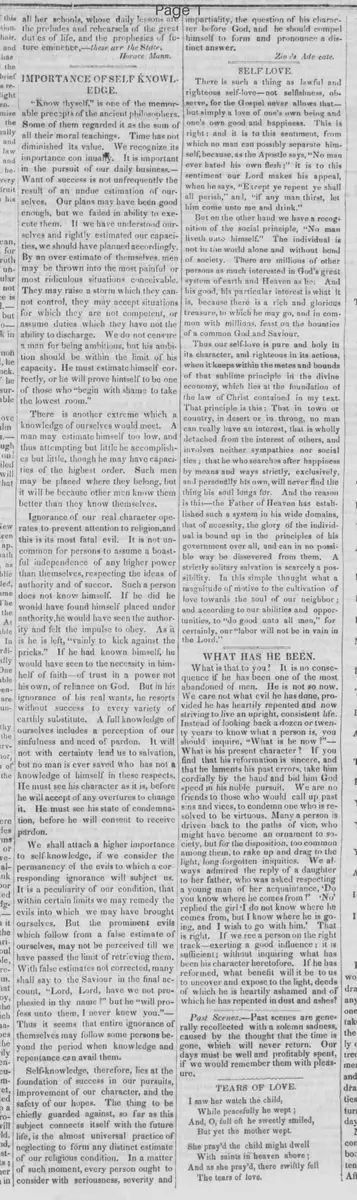
IMPORTANCE OF SELF KNOWLEDGE.
"Know thyself," is one of the memorable precepts of the ancient philosophers. Some of them regarded it as the sum of all their moral teachings. Time has not diminished its value. We recognize its importance continually. It is important in the pursuit of our daily business.— Want of success is not unfrequently the result of an undue estimation of ourselves. Our plans may have been good enough, but we failed in ability to execute them. If we have understood ourselves and rightly estimated our capacities, we should have planned accordingly. By an over estimate of themselves, men may be thrown into the most painful or most ridiculous situations conceivable. They may raise a storm which they cannot control, they may accept situations for which they are not competent, or assume duties which they have not the ability to discharge. We do not censure a man for being ambitious, but his ambition should be within the limit of his capacity. He must estimate himself correctly, or he will prove himself to be one of those who "begin with shame to take the lowest room."
There is another extreme which a knowledge of ourselves would meet. A man may estimate himself too low, and thus attempting but little he accomplishes but little, though he may have capacities of the highest order. Such men may be placed where they belong, but it will be because other men know them better than they know themselves.
Ignorance of our real character operates to prevent attention to religion, and this is its most fatal evil. It is not uncommon for persons to assume a boastful independence of any higher power than themselves, respecting the ideas of authority and of succor. Such a person does not know himself. If he did he would have found himself placed under authority, he would have seen the authority and felt the impulse to obey. As it is he is left, "vainly to kick against the pricks." If he had known himself, he would have seen to the necessity in himself of faith—of trust in a power not his own, of reliance on God. But in his ignorance of his real wants, he resorts without success to every variety of earthly substitute. A full knowledge of ourselves includes a perception of our sinfulness and need of pardon. It will not with certainty lead us to salvation, but no man is ever saved who has not a knowledge of himself in these respects. He must see his character as it is, before he will accept of any overtures to change it. He must see his state of condemnation, before he will consent to receive pardon.
We shall attach a higher importance to self knowledge, if we consider the permanency of the evils to which a corresponding ignorance will subject us. It is a peculiarity of our condition, that within certain limits we may remedy the evils into which we may have brought ourselves. But the prominent evils which follow from a false estimate of ourselves, may not be perceived till we have passed the limit of retrieving them. With false estimates not corrected, many shall say to the Saviour in the final account, "Lord, Lord, have we not prophesied in thy name?" but he "will profess unto them, I never knew you."
Thus it seems that entire ignorance of themselves may follow some persons beyond the period when knowledge and repentance can avail them.
Self-knowledge, therefore, lies at the foundation of success in our pursuits, improvement of our character, and the safety of our hopes. The thing to be chiefly guarded against, so far as this subject connects itself with the future life, is the almost universal practice of neglecting to form any distinct estimate of our religious condition. In a matter of such moment, every person ought to consider with seriousness, severity and impartiality, the question of his character before God, and he should compel himself to form and pronounce a distinct answer.
Zion's Advocate.
"Know thyself," is one of the memorable precepts of the ancient philosophers. Some of them regarded it as the sum of all their moral teachings. Time has not diminished its value. We recognize its importance continually. It is important in the pursuit of our daily business.— Want of success is not unfrequently the result of an undue estimation of ourselves. Our plans may have been good enough, but we failed in ability to execute them. If we have understood ourselves and rightly estimated our capacities, we should have planned accordingly. By an over estimate of themselves, men may be thrown into the most painful or most ridiculous situations conceivable. They may raise a storm which they cannot control, they may accept situations for which they are not competent, or assume duties which they have not the ability to discharge. We do not censure a man for being ambitious, but his ambition should be within the limit of his capacity. He must estimate himself correctly, or he will prove himself to be one of those who "begin with shame to take the lowest room."
There is another extreme which a knowledge of ourselves would meet. A man may estimate himself too low, and thus attempting but little he accomplishes but little, though he may have capacities of the highest order. Such men may be placed where they belong, but it will be because other men know them better than they know themselves.
Ignorance of our real character operates to prevent attention to religion, and this is its most fatal evil. It is not uncommon for persons to assume a boastful independence of any higher power than themselves, respecting the ideas of authority and of succor. Such a person does not know himself. If he did he would have found himself placed under authority, he would have seen the authority and felt the impulse to obey. As it is he is left, "vainly to kick against the pricks." If he had known himself, he would have seen to the necessity in himself of faith—of trust in a power not his own, of reliance on God. But in his ignorance of his real wants, he resorts without success to every variety of earthly substitute. A full knowledge of ourselves includes a perception of our sinfulness and need of pardon. It will not with certainty lead us to salvation, but no man is ever saved who has not a knowledge of himself in these respects. He must see his character as it is, before he will accept of any overtures to change it. He must see his state of condemnation, before he will consent to receive pardon.
We shall attach a higher importance to self knowledge, if we consider the permanency of the evils to which a corresponding ignorance will subject us. It is a peculiarity of our condition, that within certain limits we may remedy the evils into which we may have brought ourselves. But the prominent evils which follow from a false estimate of ourselves, may not be perceived till we have passed the limit of retrieving them. With false estimates not corrected, many shall say to the Saviour in the final account, "Lord, Lord, have we not prophesied in thy name?" but he "will profess unto them, I never knew you."
Thus it seems that entire ignorance of themselves may follow some persons beyond the period when knowledge and repentance can avail them.
Self-knowledge, therefore, lies at the foundation of success in our pursuits, improvement of our character, and the safety of our hopes. The thing to be chiefly guarded against, so far as this subject connects itself with the future life, is the almost universal practice of neglecting to form any distinct estimate of our religious condition. In a matter of such moment, every person ought to consider with seriousness, severity and impartiality, the question of his character before God, and he should compel himself to form and pronounce a distinct answer.
Zion's Advocate.
What sub-type of article is it?
Philosophical Essay
Moral Instruction
What themes does it cover?
Moral Virtue
Providence Divine
Tragedy
What keywords are associated?
Self Knowledge
Ambition
Religion
Salvation
Moral Lesson
Sinfulness
Eternal Consequences
Story Details
Story Details
Essay advocating self-knowledge as essential for success in business by avoiding over- or underestimation of abilities, for recognizing religious needs like faith and pardon from sin, and for preventing eternal damnation through ignorance of one's sinful state.