Thank you for visiting SNEWPapers!
Sign up free
Literary
June 17, 1895
The Herald
Los Angeles, Los Angeles County, California
What is this article about?
An essay reflecting on cyclical changes in fashion and speech, citing a 17th-century New England ordinance against large sleeves, followed by a satirical sketch from Cornhill Magazine depicting 'Novissima,' the assertive New Woman, critiquing her self-satisfaction, independence, and dismissal of traditional roles, concluding that her ideals fail against reality.
Clipping
OCR Quality
98%
Excellent
Full Text
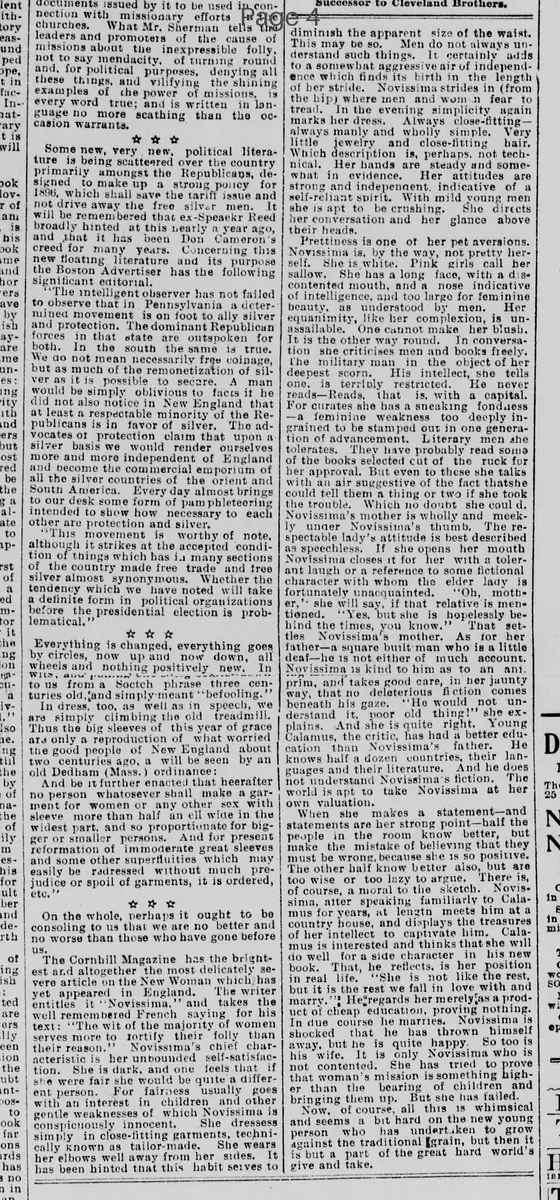
Everything is changed, everything goes by circles, now up and now down, all wheels and nothing positively new. In words, "humbug" comes to us from a Scotch phrase three centuries old, and simply meant "befooling." In dress, too, as well as in speech, we are simply climbing the old treadmill. Thus the big sleeves of this year of grace are only a reproduction of what worried the good people of New England about two centuries ago, as will be seen by an old Dedham (Mass.) ordinance:
"And be it further enacted that hereafter no person whatsoever shall make a garment for women or any other sex with sleeve more than half an ell wide in the widest part, and so proportionate for bigger or smaller persons. And for present reformation of immoderate great sleeves and some other superfluities which may easily be redressed without much prejudice or spoil of garments, it is ordered, etc."
On the whole, perhaps it ought to be consoling to us that we are no better and no worse than those who have gone before us.
The Cornhill Magazine has the brightest and altogether the most delicately severe article on the New Woman which has yet appeared in England. The writer entitles it "Novissima," and takes the well remembered French saying for his text: "The wit of the majority of women serves more to fortify their folly than their reason."
Novissima's chief characteristic is her unbounded self-satisfaction. She is dark, and one feels that if she were fair she would be quite a different person. For fairness usually goes with an interest in children and other gentle weaknesses of which Novissima is conspicuously innocent. She dresses simply in close-fitting garments, technically known as tailor-made. She wears her elbows well away from her sides. It has been hinted that this habit serves to diminish the apparent size of the waist. This may be so. Men do not always understand such things. It certainly adds to a somewhat aggressive air of independence which finds its birth in the length of her stride. Novissima strides in (from the hip) where men and women fear to tread. In the evening simplicity again marks her dress. Always close-fitting-always manly and wholly simple. Very little jewelry and close-fitting hair. Which description is, perhaps, not technical. Her hands are steady and somewhat in evidence. Her attitudes are strong and independent, indicative of a self-reliant spirit. With mild young men she is apt to be crushing. She directs her conversation and her glance above their heads.
Prettiness is one of her pet aversions. Novissima is, by the way, not pretty herself. She is white. Pink girls call her sallow. She has a long face, with a discontented mouth, and a nose indicative of intelligence, and too large for feminine beauty, as understood by men. Her equanimity, like her complexion, is unassailable. One cannot make her blush. It is the other way round. In conversation she criticises men and books freely. The military man is the object of her deepest scorn. His intellect, she tells one, is terribly restricted. He never reads-Reads, that is, with a capital. For curates she has a sneaking fondness-a feminine weakness too deeply ingrained to be stamped out in one generation of advancement. Literary men she tolerates. They have probably read some of the books selected out of the ruck for her approval. But even to these she talks with an air suggestive of the fact that she could tell them a thing or two if she took the trouble. Which no doubt she could.
Novissima's mother is wholly and meekly under Novissima's thumb. The respectable lady's attitude is best described as speechless. If she opens her mouth Novissima closes it for her with a tolerant laugh or a reference to some fictional character with whom the elder lady is fortunately unacquainted. "Oh, mother,'' she will say, if that relative is mentioned. "Yes, but she is hopelessly behind the times, you know." That settles Novissima's mother. As for her father-a square built man who is a little deaf-he is not either of much account. Novissima is kind to him as to an animal, and takes good care, in her jaunty way, that no deleterious fiction comes beneath his gaze. "He would not understand it, poor old thing!" she explains. And she is quite right. Young Calamus, the critic, has had a better education than Novissima's father. He knows half a dozen countries, their languages and their literature. And he does not understand Novissima's fiction. The world is apt to take Novissima at her own valuation.
When she makes a statement-and statements are her strong point-half the people in the room know better, but make the mistake of believing that they must be wrong, because she is so positive. The other half know better also, but are too wise or too lazy to argue. There is, of course, a moral to the sketch. Novissima, after speaking familiarly to Calamus for years, at length meets him at a country house, and displays the treasures of her intellect to captivate him. Calamus is interested and thinks that she will do well for a side character in his new book. That, he reflects, is her position in real life. "She is not like the rest, but it is the rest we fall in love with and marry." He regards her merely as a product of cheap education, proving nothing. In due course he marries. Novissima is shocked that he has thrown himself away, but he is quite happy. So too is his wife. It is only Novissima who is not contented. She has tried to prove that woman's mission is something higher than the bearing of children and bringing them up. But she has failed.
Now, of course, all this is whimsical and seems a bit hard on the new young person who has undertaken to grow against the traditional grain, but then it is but a part of the great hard world's give and take.
"And be it further enacted that hereafter no person whatsoever shall make a garment for women or any other sex with sleeve more than half an ell wide in the widest part, and so proportionate for bigger or smaller persons. And for present reformation of immoderate great sleeves and some other superfluities which may easily be redressed without much prejudice or spoil of garments, it is ordered, etc."
On the whole, perhaps it ought to be consoling to us that we are no better and no worse than those who have gone before us.
The Cornhill Magazine has the brightest and altogether the most delicately severe article on the New Woman which has yet appeared in England. The writer entitles it "Novissima," and takes the well remembered French saying for his text: "The wit of the majority of women serves more to fortify their folly than their reason."
Novissima's chief characteristic is her unbounded self-satisfaction. She is dark, and one feels that if she were fair she would be quite a different person. For fairness usually goes with an interest in children and other gentle weaknesses of which Novissima is conspicuously innocent. She dresses simply in close-fitting garments, technically known as tailor-made. She wears her elbows well away from her sides. It has been hinted that this habit serves to diminish the apparent size of the waist. This may be so. Men do not always understand such things. It certainly adds to a somewhat aggressive air of independence which finds its birth in the length of her stride. Novissima strides in (from the hip) where men and women fear to tread. In the evening simplicity again marks her dress. Always close-fitting-always manly and wholly simple. Very little jewelry and close-fitting hair. Which description is, perhaps, not technical. Her hands are steady and somewhat in evidence. Her attitudes are strong and independent, indicative of a self-reliant spirit. With mild young men she is apt to be crushing. She directs her conversation and her glance above their heads.
Prettiness is one of her pet aversions. Novissima is, by the way, not pretty herself. She is white. Pink girls call her sallow. She has a long face, with a discontented mouth, and a nose indicative of intelligence, and too large for feminine beauty, as understood by men. Her equanimity, like her complexion, is unassailable. One cannot make her blush. It is the other way round. In conversation she criticises men and books freely. The military man is the object of her deepest scorn. His intellect, she tells one, is terribly restricted. He never reads-Reads, that is, with a capital. For curates she has a sneaking fondness-a feminine weakness too deeply ingrained to be stamped out in one generation of advancement. Literary men she tolerates. They have probably read some of the books selected out of the ruck for her approval. But even to these she talks with an air suggestive of the fact that she could tell them a thing or two if she took the trouble. Which no doubt she could.
Novissima's mother is wholly and meekly under Novissima's thumb. The respectable lady's attitude is best described as speechless. If she opens her mouth Novissima closes it for her with a tolerant laugh or a reference to some fictional character with whom the elder lady is fortunately unacquainted. "Oh, mother,'' she will say, if that relative is mentioned. "Yes, but she is hopelessly behind the times, you know." That settles Novissima's mother. As for her father-a square built man who is a little deaf-he is not either of much account. Novissima is kind to him as to an animal, and takes good care, in her jaunty way, that no deleterious fiction comes beneath his gaze. "He would not understand it, poor old thing!" she explains. And she is quite right. Young Calamus, the critic, has had a better education than Novissima's father. He knows half a dozen countries, their languages and their literature. And he does not understand Novissima's fiction. The world is apt to take Novissima at her own valuation.
When she makes a statement-and statements are her strong point-half the people in the room know better, but make the mistake of believing that they must be wrong, because she is so positive. The other half know better also, but are too wise or too lazy to argue. There is, of course, a moral to the sketch. Novissima, after speaking familiarly to Calamus for years, at length meets him at a country house, and displays the treasures of her intellect to captivate him. Calamus is interested and thinks that she will do well for a side character in his new book. That, he reflects, is her position in real life. "She is not like the rest, but it is the rest we fall in love with and marry." He regards her merely as a product of cheap education, proving nothing. In due course he marries. Novissima is shocked that he has thrown himself away, but he is quite happy. So too is his wife. It is only Novissima who is not contented. She has tried to prove that woman's mission is something higher than the bearing of children and bringing them up. But she has failed.
Now, of course, all this is whimsical and seems a bit hard on the new young person who has undertaken to grow against the traditional grain, but then it is but a part of the great hard world's give and take.
What sub-type of article is it?
Essay
Satire
Prose Fiction
What themes does it cover?
Social Manners
Liberty Freedom
What keywords are associated?
New Woman
Fashion Cycles
Satire
Independence
Cornhill Magazine
Social Critique
Literary Details
Form / Style
Satirical Essay With Character Sketch
Key Lines
"And Be It Further Enacted That Hereafter No Person Whatsoever Shall Make A Garment For Women Or Any Other Sex With Sleeve More Than Half An Ell Wide In The Widest Part, And So Proportionate For Bigger Or Smaller Persons."
"The Wit Of The Majority Of Women Serves More To Fortify Their Folly Than Their Reason."
Novissima's Chief Characteristic Is Her Unbounded Self Satisfaction.
She Has Tried To Prove That Woman's Mission Is Something Higher Than The Bearing Of Children And Bringing Them Up. But She Has Failed.
Now, Of Course, All This Is Whimsical And Seems A Bit Hard On The New Young Person Who Has Undertaken To Grow Against The Traditional Grain, But Then It Is But A Part Of The Great Hard World's Give And Take.