Thank you for visiting SNEWPapers!
Sign up free
Daily Kennebec Journal
Augusta, Kennebec County, Maine
What is this article about?
Waterville, Maine, addresses the 'tramp problem' by sentencing vagrants to 90 days in jail, reducing lodgings from 1,302 in 1896 to just 8 recently. This policy cuts costs compared to repeated 30-day sentences, as tramps avoid long solitary confinement. Mayor Redington provides historical figures showing significant savings.
Clipping
OCR Quality
Full Text
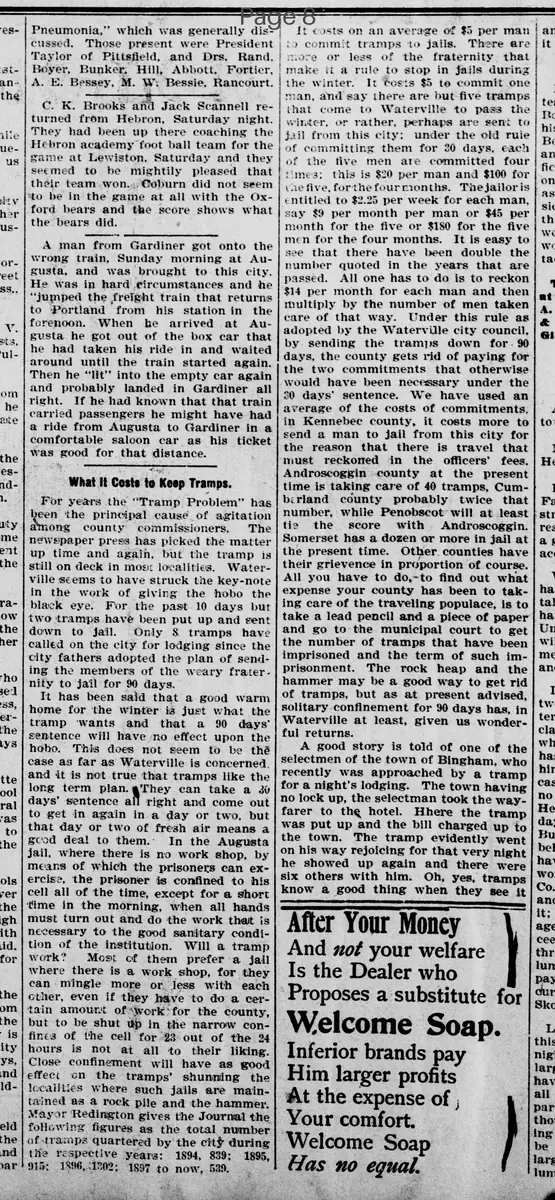
For years the "Tramp Problem" has been the principal cause of agitation among county commissioners.
The newspaper press has picked the matter up time and again, but the tramp is still on deck in most localities. Waterville seems to have struck the key-note in the work of giving the hobo the black eye. For the past 10 days but two tramps have been put up and sent down to jail. Only 8 tramps have called on the city for lodging since the city fathers adopted the plan of sending the members of the weary fraternity to jail for 90 days.
It has been said that a good warm home for the winter is just what the tramp wants and that a 90 days' sentence will have no effect upon the hobo. This does not seem to be the case as far as Waterville is concerned, and it is not true that tramps like the long term plan. They can take a 30 days' sentence all right and come out to get in again in a day or two, but that day or two of fresh air means a good deal to them. In the Augusta jail, where there is no work shop, by means of which the prisoners can exercise, the prisoner is confined to his cell all of the time, except for a short time in the morning, when all hands must turn out and do the work that is necessary to the good sanitary condition of the institution. Will a tramp work? Most of them prefer a jail where there is a work shop, for they can mingle more or less with each other, even if they have to do a certain amount of work for the county, but to be shut up in the narrow confines of the cell for 23 out of the 24 hours is not at all to their liking.
Close confinement will have as good effect on the tramps' shunning the localities where such jails are maintained as a rock pile and the hammer.
Mayor Redington gives the Journal the following figures as the total number of tramps quartered by the city during the respective years: 1894, 839; 1895, 915; 1896, 1302; 1897 to now, 539.
It costs on an average of $5 per man to commit tramps to jails. There are more or less of the fraternity that make it a rule to stop in jails during the winter. It costs $5 to commit one man, and say there are but five tramps that come to Waterville to pass the winter, or rather, perhaps are sent to jail from this city: under the old rule of committing them for 30 days, each of the five men are committed four times: this is $20 per man and $100 for the five, for the four months. The jailor is entitled to $2.25 per week for each man, say $9 per month per man or $45 per month for the five or $180 for the five men for the four months. It is easy to see that there have been double the number quoted in the years that are passed. All one has to do is to reckon $14 per month for each man and then multiply by the number of men taken care of that way. Under this rule as adopted by the Waterville city council, by sending the tramps down for 90 days, the county gets rid of paying for the two commitments that otherwise would have been necessary under the 30 days' sentence. We have used an average of the costs of commitments, in Kennebec county, it costs more to send a man to jail from this city for the reason that there is travel that must reckoned in the officers' fees. Androscoggin county at the present time is taking care of 40 tramps, Cumberland county probably twice that number, while Penobscot will at least tie the score with Androscoggin. Somerset has a dozen or more in jail at the present time. Other counties have their grievance in proportion of course. All you have to do, to find out what expense your county has been to taking care of the traveling populace, is to take a lead pencil and a piece of paper and go to the municipal court to get the number of tramps that have been imprisoned and the term of such imprisonment. The rock heap and the hammer may be a good way to get rid of tramps, but as at present advised, solitary confinement for 90 days has, in Waterville at least, given us wonderful returns.
What sub-type of article is it?
What keywords are associated?
What entities or persons were involved?
Where did it happen?
Domestic News Details
Primary Location
Waterville
Event Date
1897
Key Persons
Outcome
reduced tramps quartered: 1894: 839; 1895: 915; 1896: 1302; 1897 to now: 539. only 8 tramps since policy adoption. cost savings from 90-day sentences vs. repeated 30-day ones, averaging $5 per commitment and $2.25 per week boarding.
Event Details
Waterville city council adopts policy of 90-day jail sentences for tramps, leading to sharp decline in vagrants seeking lodging. Tramps avoid long solitary confinement in Augusta jail, preferring shorter terms or jails with workshops. Policy deters winter stays, reducing county costs compared to multiple short sentences.