Thank you for visiting SNEWPapers!
Sign up free
Domestic News
July 20, 1876
The Elk County Advocate
Ridgway, Elk County, Pennsylvania
What is this article about?
Seasonable farming hints covering cultivation of corn and potatoes, cutting peas, oats, and wheat, proper binding and shocking of grain, and timely thrashing and marketing to minimize losses.
Clipping
OCR Quality
98%
Excellent
Full Text
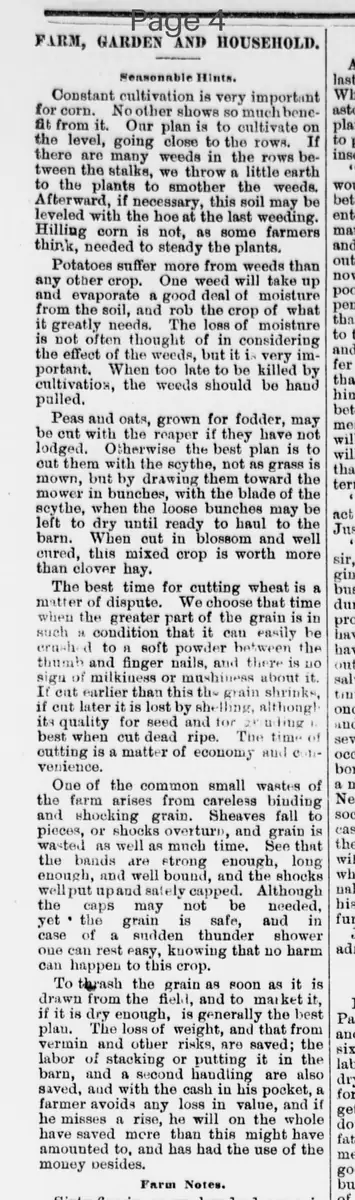
FARM, GARDEN AND HOUSEHOLD.
Seasonable Hints.
Constant cultivation is very important for corn. No other crop shows so much benefit from it. Our plan is to cultivate on the level, going close to the rows. If there are many weeds in the rows between the stalks, we throw a little earth to the plants to smother the weeds. Afterward, if necessary, this soil may be leveled with the hoe at the last weeding. Hilling corn is not, as some farmers think, needed to steady the plants.
Potatoes suffer more from weeds than any other crop. One weed will take up and evaporate a good deal of moisture from the soil, and rob the crop of what it greatly needs. The loss of moisture is not often thought of in considering the effect of the weeds, but it is very important. When too late to be killed by cultivation, the weeds should be hand pulled.
Peas and oats, grown for fodder, may be cut with the reaper if they have not lodged. Otherwise the best plan is to cut them with the scythe, not as grass is mown, but by drawing them toward the mower in bunches, with the blade of the scythe, when the loose bunches may be left to dry until ready to haul to the barn. When cut in blossom and well cured, this mixed crop is worth more than clover hay.
The best time for cutting wheat is a matter of dispute. We choose that time when the greater part of the grain is in such a condition that it can easily be crushed to a soft powder between the thumb and finger nails, and there is no sign of milkiness or mushiness about it. If cut earlier than this the grain shrinks. If cut later it is lost by shelling, although its quality for seed and for using is best when cut dead ripe. The time of cutting is a matter of economy and convenience.
One of the common small wastes of the farm arises from careless binding and shocking grain. Sheaves fall to pieces, or shocks overturn, and grain is wasted as well as much time. See that the bands are strong enough, long enough, and well bound, and the shocks well put up and safely capped. Although the caps may not be needed, yet the grain is safe, and in case of a sudden thunder shower one can rest easy, knowing that no harm can happen to this crop.
To thrash the grain as soon as it is drawn from the field, and to market it, if it is dry enough, is generally the best plan. The loss of weight, and that from vermin and other risks, are saved; the labor of stacking or putting it in the barn, and a second handling are also saved, and with the cash in his pocket, a farmer avoids any loss in value, and if he misses a rise, he will on the whole have saved more than this might have amounted to, and has had the use of the money besides.
Seasonable Hints.
Constant cultivation is very important for corn. No other crop shows so much benefit from it. Our plan is to cultivate on the level, going close to the rows. If there are many weeds in the rows between the stalks, we throw a little earth to the plants to smother the weeds. Afterward, if necessary, this soil may be leveled with the hoe at the last weeding. Hilling corn is not, as some farmers think, needed to steady the plants.
Potatoes suffer more from weeds than any other crop. One weed will take up and evaporate a good deal of moisture from the soil, and rob the crop of what it greatly needs. The loss of moisture is not often thought of in considering the effect of the weeds, but it is very important. When too late to be killed by cultivation, the weeds should be hand pulled.
Peas and oats, grown for fodder, may be cut with the reaper if they have not lodged. Otherwise the best plan is to cut them with the scythe, not as grass is mown, but by drawing them toward the mower in bunches, with the blade of the scythe, when the loose bunches may be left to dry until ready to haul to the barn. When cut in blossom and well cured, this mixed crop is worth more than clover hay.
The best time for cutting wheat is a matter of dispute. We choose that time when the greater part of the grain is in such a condition that it can easily be crushed to a soft powder between the thumb and finger nails, and there is no sign of milkiness or mushiness about it. If cut earlier than this the grain shrinks. If cut later it is lost by shelling, although its quality for seed and for using is best when cut dead ripe. The time of cutting is a matter of economy and convenience.
One of the common small wastes of the farm arises from careless binding and shocking grain. Sheaves fall to pieces, or shocks overturn, and grain is wasted as well as much time. See that the bands are strong enough, long enough, and well bound, and the shocks well put up and safely capped. Although the caps may not be needed, yet the grain is safe, and in case of a sudden thunder shower one can rest easy, knowing that no harm can happen to this crop.
To thrash the grain as soon as it is drawn from the field, and to market it, if it is dry enough, is generally the best plan. The loss of weight, and that from vermin and other risks, are saved; the labor of stacking or putting it in the barn, and a second handling are also saved, and with the cash in his pocket, a farmer avoids any loss in value, and if he misses a rise, he will on the whole have saved more than this might have amounted to, and has had the use of the money besides.
What sub-type of article is it?
Agriculture
What keywords are associated?
Corn Cultivation
Potato Weeding
Fodder Cutting
Wheat Harvest
Grain Shocking
Thrashing Grain
Domestic News Details
Event Details
Provides practical advice on cultivating corn by frequent tilling and weed control without hilling; emphasizes weeding potatoes to preserve soil moisture; suggests cutting peas and oats for fodder with reaper or scythe and curing them; recommends cutting wheat when grain crushes to soft powder without milkiness; advises careful binding and shocking of grain to prevent waste; promotes immediate thrashing and marketing of dry grain to save labor and risks.