Thank you for visiting SNEWPapers!
Sign up free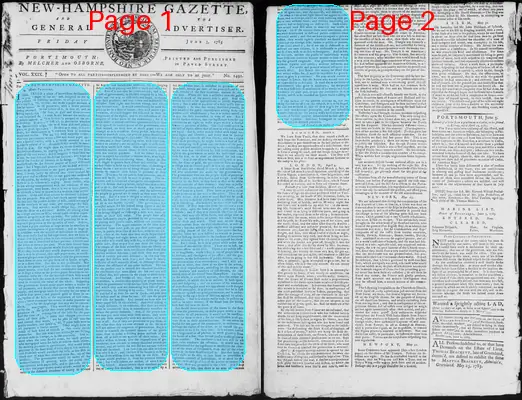
Fowle's New Hampshire Gazette And General Advertiser
Portsmouth, Rockingham County, New Hampshire
What is this article about?
A letter criticizing a prior piece advocating for paper money as legal tender in New Hampshire. The author argues it would cause depreciation, enable fraud, violate constitutional rights, and harm creditors, while defending the existing currency system and government expenditures.
Merged-components note: This is a continuation of the same letter to the editor across pages 1 and 2, as indicated by the sequential reading order and the text flow on paper currency and government policy.
Clippings
1 of 2
OCR Quality
Full Text
Our Printers,
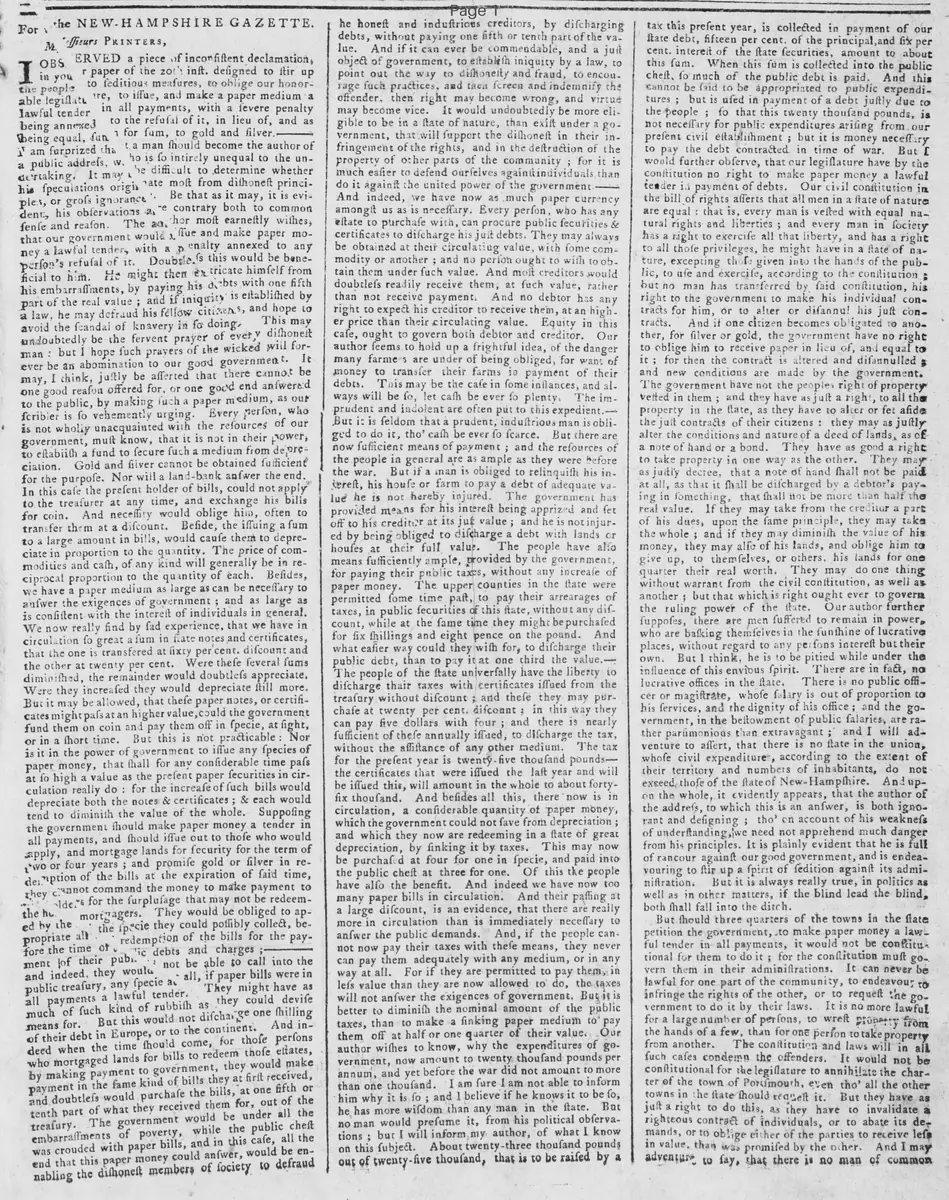
I observed a piece of inconsistent declamation in your paper of the 20th inst. designed to stir up the people to seditious measures, to oblige our honourable legislature, to issue, and make a paper medium a lawful tender in all payments, with a severe penalty being annexed to the refusal of it, in lieu of, and as being equal, sum for sum, to gold and silver.
I am surprised that a man should become the author of a public address, who is so entirely unequal to the undertaking. It may be difficult to determine whether his peculations originate most from dishonest principles, or gross ignorance. Be that as it may, it is evident, his observations are contrary both to common sense and reason. The author most earnestly wishes money a lawful tender, with a penalty annexed to any person's refusal of it. Doubtless this would be beneficial to him. He might then extricate himself from a law, he may defraud his fellow citizens, and hope to part of the real value; and if iniquity is established by his embarrassments, by paying his debts with one fifth undoubtedly be the fervent prayer of every dishonest man: but I hope such prayers of the wicked will forever be an abomination to our good government. It is one good reason offered for, or one good end answered may, I think, justly be asserted that there cannot be to the public, by making such a paper medium, as our scribbler is so vehemently urging. Every person, who is not wholly unacquainted with the resources of our government, must know, that it is not in their power, to establish a fund to secure such a medium from depreciation. Gold and silver cannot be obtained sufficient for the purpose. Nor will a land-bank answer the end.
In this case the present holder of bills, could not apply to the treasurer at any time, and exchange his bills for coin. And necessity would oblige him, often to transfer them at a discount. Beside, the issuing a sum to a large amount in bills, would cause them to depreciate in proportion to the quantity. The price of commodities and cash, of any kind will generally be in reciprocal proportion to the quantity of each. Besides, we have a paper medium as large as can be necessary to answer the exigencies of government; and as large as is consistent with the interest of individuals in general.
We now really find by sad experience, that we have in circulation so great a sum in state notes and certificates, that the one is transferred at sixty per cent. discount and the other at twenty per cent. Were these several sums diminished, the remainder would doubtless appreciate. Were they increased they would depreciate still more. But it may be allowed, that these paper notes, or certificates might pass at an higher value, could the government fund them on coin and pay them off in specie, at sight, or in a short time. But this is not practicable: Nor is it in the power of government to issue any species of paper money, that shall for any considerable time pass at so high a value as the present paper securities in circulation really do: for the increase of such bills would depreciate both the notes & certificates; & each would tend to diminish the value of the whole.
Supposing the government should make paper money a tender in all payments, and should issue out to those who would apply, and mortgage lands for security for the term of two or four years; and promise gold or silver in redemption of the bills at the expiration of said time, they cannot command the money to make payment to description of the bills at the expiration of said time, -lde's for the surplusage that may not be redeem- ed by the mortgagers. They would be obliged to appropriate all the specie they could possibly collect, be- ment lof their pub.ic. fore the time of. redemption of the bills for the pay- debts and charges; and indeed, they would not be able to call into the public treaury, any specie at all, if paper bills were in all payments a lawful tender. They might have as means for. But this would not discharge one shilling much of such kind of rubbish as they could devise of their debt in Europe, or to the continent. And in- deed when the time should come, for those persons who mortgaged lands for bills to redeem those estates, by making payment to government, they would make payment in the same kind of bills they at first received, and doubtless would purchase the bills, at one fifth or tenth part of what they received them for, out of the treaury. The government would be under all the embarrassments of poverty, while the public chest was crowded with paper bills, and in this case, all the end that this paper money could answer, would be enabling the dishonest members of society to defraud the honest and industrious creditors, by discharging debts, without paying one fifth or tenth part of the value.
And if it can ever be commendable, and a just object of government, to establish iniquity by a law, to point out the way to dishonesty and fraud, to encourage such practices, and then screen and indemnify the offender. then right may become wrong, and virtue may become vice. It would undoubtedly be more eligible to be in a state of nature, than exist under a government, that will support the dishonest in their infringement of the rights, and in the destruction of the property of other parts of the community; for it is much easier to defend ourselves against individuals than do it against the united power of the government.
And indeed, we have now as much paper currency amongst us as is necessary. Every person, who has any estate to purchase with, can procure public securities & certificates to discharge his just debts. They may always be obtained at their circulating value, with some commodity or another; and no person ought to wish to obtain them under such value. And most creditors would doubtless readily receive them, at such value, rather than not receive payment. And no debtor has any right to expect his creditor to receive them, at an higher price than their circulating value. Equity in this case, ought to govern both debtor and creditor.
Our author seems to hold up a frightful idea, of the danger many farmers are under of being obliged, for want of money to transfer their farms in payment of their debts. This may be the case in some instances, and always will be so, let cash be ever so plenty. The im- prudent and indolent are often put to this expedient.-- But it is seldom that a prudent, industrious man is obli- ged to do it, tho' cash be ever so scarce. But there are now sufficient means of payment; and the resources of the people in general are as ample as they were before the war. But if a man is obliged to relinquish his in- terest, his house or farm to pay a debt of adequate va- lue he is not hereby injured. The government has provided means for his interest being appraised and set off to his credit.r at its just value; and he is not injured by being obliged to discharge a debt with lands or houses at their full value.
The people have also means sufficiently ample, provided by the government, for paying their public taxes, without any increase of paper money. The upper counties in the state were permitted some time past, to pay their arrearages of taxes, in public securities of this state, without any dis- count, while at the same time they might be purchased for six shillings and eight pence on the pound. And what easier way could they wish for to discharge their public debt, than to pay it at one third the value.-
The people of the state universally have the liberty to discharge their taxes with certificates issued from the treasury without discount; and these they may pur- chase at twenty per cent. discount; in this way they can pay five dollars with four; and there is nearly sufficient of these annually issued, to discharge the tax, without the assistance of any other medium. The tax for the present year is twenty-five thousand pounds-- the certificates that were issued the last year and will be issued this, will amount in the whole to about forty- six thousand. And besides all this. there 'now is in circulation, a considerable quantity of paper money, which the government could not save from depreciation; and which they now are redeeming in a state of great depreciation, by sinking it by taxes. This may now be purchased at four for one in specie, and paid into the public chest at three for one. Of this the people have also the benefit. And indeed we have now too many paper bills in circulation. And their passing at a large discount, is an evidence, that there are really more in circulation than is immediately necessary to answer the public demands.
And, if the people can- not now pay their taxes with these means, they never can pay them adequately with any medium, or in any way at all. For if they are permitted to pay them, in less value than they are now allowed to do, the taxes will not answer the exigencies of government. But it is better to diminish the nominal amount of the public taxes, than to make a sinking paper medium to pay them off at half or one quarter of their value.
Our author wishes to know, why the expenditures of go- vernment, now amount to twenty thousand pounds per annum, and yet before the war did not amount to more than one thousand. I am sure I am not able to inform him why it is so; and I believe if he knows it to be so. he has more wisdom than any man in the state. But no man would presume it, from his political obser- vations: but I will inform my author, of what I know on this subject. About twenty-three thousand pounds out of twenty-five thousand, that is to be raised by a tax this present year, is collected in payment of our state debt, fifteen per cent. of the principal, and six per cent. interest of the state securities, amount to about this sum. When this sum is collected into the public chest. so much of the public debt is paid. And this cannot be said to be appropriated to public expendi- tures; but is used in payment of a debt justly due to the people; so that this twenty thousand pounds, is not necessary for public expenditures arising from.our present civil establishment; but it is money necessary to pay the debt contracted in time of war.
But I would further observe, that our legislature have by the constitution no right to make paper money a lawful tender in payment of debts. Our civil constitution in the bill of rights asserts that all men in a state of nature are equal: that is, every man is vested with equal na- tural rights and liberties; and every man in society has a right to exercise all that liberty, and has a right to all those privileges, he might have in a state of na- ture, excepting those given into the hands of the pub- lic, to use and exercise, according to the constitution - but no man has transferred by said constitution, his right to the government to make his individual con- tracts for him, or to alter or disannul his just con- tracts.
And if one citizen becomes obligated to ano- ther, for silver or gold, the government have no right to oblige him to receive paper in lieu of, and equal to it; for then the contract is altered and disannulled and new conditions are made by the government. The government have not the peoples right of property vested in them; and they have as just a right, to all tha property in the state, as they have to alter or set aside the just contracts of their citizens: they may as justly alter the conditions and nature of a deed of lands, as of a note of hand or a bond. They have as good a right to take property in one way as the other. They may. as justly decree. that a note of hand shall not be paid at all, as that it shall be discharged by a debtor's pay- ing in something. that shall not be more than half the real value. If they may take from the creditor a part of his dues, upon the same principle, they may take the whole; and if they may diminish the value of his money, they may also of his lands, and oblige him ta give up, to themselves, or others, his lands for one quarter their real worth.
They may do one thing without warrant from the civil constitution, as well as another; but that which is right ought ever to govern the ruling power of the state. Our author further supposes, there are men suffered to remain in power, who are basking themselves in the sunshine of lucrative places, without regard to any persons interest but their own. But I think, he is to be pitied while under the influence of this envious spirit. There are in fact, no lucrative offices in the state. There is no public offi- cer or magistrate, whose salary is out of proportion to his services, and the dignity of his office; and the go- vernment, in the bestowment of public salaries, are ra- ther parsimonious than extravagant;' and I will ad- venture to assert, that there is no state in the union, whose civil expenditures, according to the extent of their territory and numbers of inhabitants, do not exceed those of the state of New-Hampshire.
And up- on the whole, it evidently appears, that the author of the address, to which this is an answer, is both igno- rant and designing; tho' on account of his weakness of understanding, we need not apprehend much danger from his principles. It is plainly evident that he is full of rancour against our good government, and is endea- vouring to stir up a spirit of sedition against its admi- nistration. But it is always really true, in politics as well as in other matters, if the blind lead the blind, both shall fall into the ditch.
But should three quarters of the towns in the state petition the government, to make paper money a law- ful tender in all payments, it would not be constitu- tional for them to do it; for the constitution must go- vern them in their administrations. It can never be lawful for one part of the community, to endeavour to infringe the rights of the other, or to request the go- vernment to do it by their laws. It is no more lawful for a large number of persons, to wrest property from the hands of a few, than for one person to take property from another. The constitution and laws will in all such cases condemn the offenders. It would not be constitutional for the legislature to annihilate the char- ter of the town of Portsmouth, even tho' all the other towns in the state should request it. But they have as just a right to do this. as they have to invalidate a righteous contract of individuals. or to abate its de- mands, or to oblige either of the parties to receive le in value, than was promised by the other. And I may adventure to say, that there is no man of common
While tender, that thoroughly counters what must be its operation and ruinous tendency; and no persons but men of ignorance, and the knavish, will desire it. In what a ridiculous light should we appear to other states, and to Europe, whilst we were dabbling with paper money without funds, and thereby increasing our poverty and multiplying our difficulties. Such a measure would tend still more to diminish our credit in Europe: for if the nations there were convinced, that we were determined to defraud public creditors when we could avoid; and that we have no regard to private justice, they would rightly conclude we should never discharge our foreign debt, either in public or private, if we could avoid it; for if we are so dishonest as to defraud our own citizens, it is reasonable to presume we shall not wish to do less to foreigners. And in fact, in this case, neither the public or individuals would have sufficient credit to borrow moneys or loans to supply the greatest exigencies. Our government would be without dignity and credit; without resources and power. For credit and power without resources are merely ideal. But should this money be issued that our writer wishes for, it must be impossible for government to give it a currency. No man would receive it as equal to specie, but the knave who waited only for an opportunity to defraud. It must die in the hands of government who gave it existence; for the people have had sufficient demonstration of its vanity and fatal tendency in time past, to put any confidence in it in future, unless it be founded on specie really existing in bank.
If the author of the address referred to, has anything further to offer on this subject, it is to be hoped, he will not withhold it, that all men might see his errors and mischievous principles, and not insensibly blunder into them: for undoubtedly his sentiments are spawn of British tyranny, designed to convulse and ruin our republic. Seditious harangues or attempts forever deserve severest penalties.
A Friend to the rights of mankind.
What sub-type of article is it?
What themes does it cover?
What keywords are associated?
What entities or persons were involved?
Letter to Editor Details
Author
A Friend To The Rights Of Mankind
Recipient
Our Printers
Main Argument
making paper money a lawful tender would lead to currency depreciation, enable fraud against creditors, and violate constitutional rights to contract freely; the current system of state notes and certificates is sufficient and equitable.
Notable Details