Thank you for visiting SNEWPapers!
Sign up free
Gazette Of The United States
New York, New York County, New York
What is this article about?
Proceedings in the U.S. House of Representatives in New York from April 18-21, 1789, focused on revenue measures including impost duties on goods like anchors, teas, and coal; debates on drawbacks for rum and exports; tonnage rates for vessels; and reports on petitions from John Churchman and Dr. Ramsay regarding inventions and copyrights.
Clipping
OCR Quality
Full Text
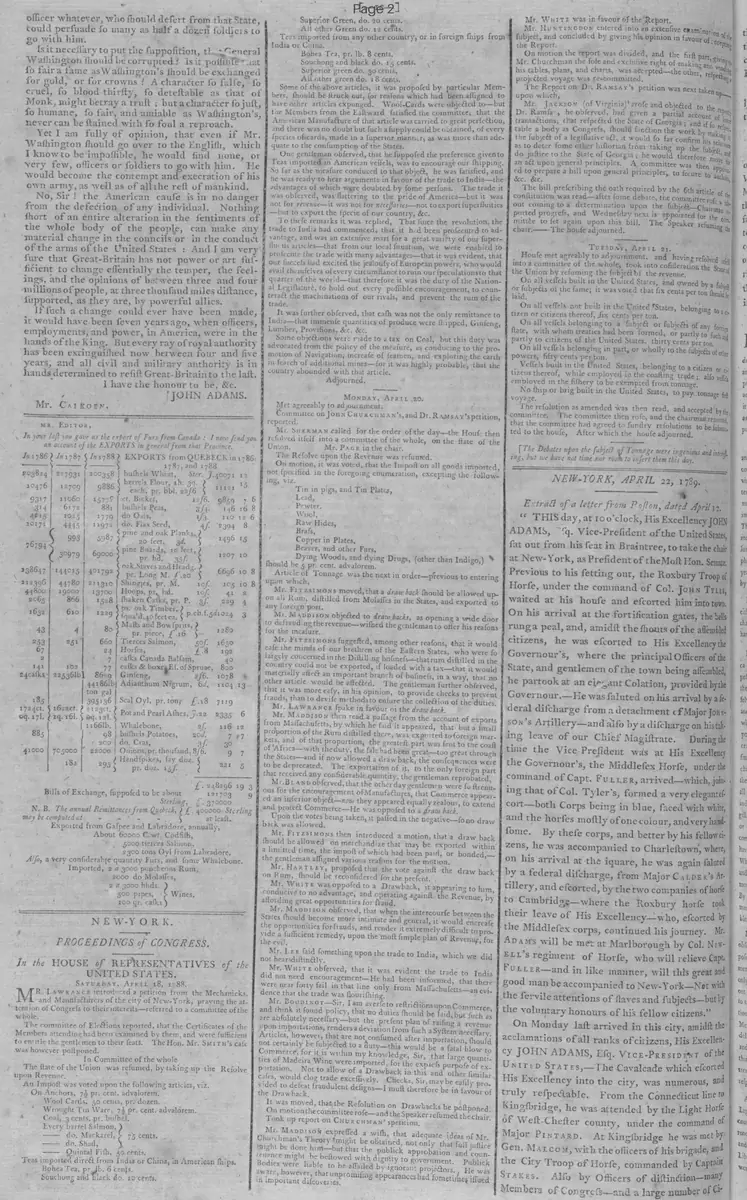
PROCEEDINGS of CONGRESS.
In the
HOUSE of REPRESENTATIVES of the
UNITED STATES.
SATURDAY, APRIL 18, 1789.
Mr. Lawrence introduced a petition from the Mechanicks,
and Manufacturers of the city of New-York, praying the at-
tention of Congress to their interests—referred to a committee of the
whole.
The committee of Elections reported, that the Certificates of the
Members attending had been examined by them, and were sufficient
to entitle the gentlemen to their seats.
The Hon. Mr. SMITH's case
was however postponed.
In Committee of the whole
The state of the Union was resumed, by taking up the Resolve
upon Revenue.
An Impost was voted upon the following articles, viz.
On Anchors, 7 pr. cent. advalorem.
Wool Cards, 50 cents, pr. dozen.
Wrought Tin Ware, 7 pr. cent. advalorem.
Coal, 3 cents, pr. bushel.
Every barrel Salmon, )
do. Mackarel, 75 cents.
do. Shad,
Quintal Fish, 5 cents.
Teas imported direct from India or China, in American ships.
Bohea Tea, pr lb. 6 cents.
Souchong and black do. 10 cents.
Superior Green, do. 20 cents.
All other Green do. 12 cents.
Teas imported from any other country, or in foreign ships from
India or China.
Bohea Tea, pr. lb. 8 cents.
Souchong and black do. 15 cents.
Superior green do. 30 cents,
All other green do. 18 cents.
Some of the above articles, it was proposed by particular Mem-
bers, should be struck out, for reasons which had been assigned to
have other articles expunged. Wool-Cards were objected to—but
the Members from the Eastward satisfied the committee, that the
American Manufacture of that article was carried to great perfection,
and there was no doubt but such a supply could be obtained, of every
species of cards, made in a superior manner, as was more than ade-
quate to the consumption of the States.
One gentleman observed, that he supposed the preference given to
Teas imported in American vessels, was to encourage our shipping.
So far as the measure conduced to that object, he was satisfied, and
he was ready to hear arguments in favour of the trade to India—the
advantages of which were doubted by some persons. The trade it
was observed, was flattering to the pride of America—but it was
not for revenue—it was not for necessaries—not to export superfluities
—but to export the specie of our country, &c.
To these remarks it was replied, That since the revolution, the
trade to India had commenced, that it had been prosecuted to ad-
vantage, and was an extensive mart for a great variety of our super-
fluities articles—that from our local situation, we were enabled to
prosecute the trade with many advantages—that it was evident, that
our success had excited the jealousy of European powers, who would
avail themselves of every circumstance to ruin our speculations to that
quarter of the world that therefore it was the duty of the Nation-
al Legislature, to hold out every possible encouragement, to coun-
teract the machinations of our rivals, and prevent the ruin of the
trade.
It was further observed. that cash was not the only remittance to
India—that immense quantities of produce were shipped, Ginseng,
Lumber, Provisions, &c. &c.
Some objections were raised to a tax on Coal, but this duty was
advocated from the policy of the measure, as conducing to the pro-
motion of Navigation, increase of seamen, and exploring the earth
in search of additional mines—for it was highly probable, that the
country abounded with that article.
Adjourned.
Monday, April 20.
Met agreeably to adjournment.
Committee on John Churchman's, and Dr. Ramsay's petition,
reported.
Mr. Sherman called for the order of the day—the House then
resolved itself into a committee of the whole, on the state of the
Union.
Mr. Page in the chair.
The Resolve upon the Revenue was resumed.
On motion, it was voted, that the Impost on all goods imported,
not specified in the foregoing enumeration, excepting the follow-
ing, viz.
Tin in pigs, and Tin Plates,
Lead,
Pewter.
Wool,
Raw Hides,
Brass,
Copper in Plates,
Beaver, and other Furs,
Dying Woods, and dying Drugs, (other than Indigo,)
should be 5 pr. cent. advalorem.
Article of Tonnage was the next in order—previous to entering
upon which,
Mr. Fitzsimons moved, that a draw back should be allowed up-
on all Rum, distilled from Molasses in the States, and exported to
any foreign port.
Mr. Madison objected to draw backs, as opening a wide door
to defrauding the revenue—wished the gentleman to offer his reasons
for the measure.
Mr. Fitzsimons suggested, among other reasons, that it would
ease the minds of our brethren of the Eastern States, who were so
largely concerned in the Distilling business—that rum distilled in the
country could not be exported, if loaded with a tax—that it would
materially affect an important branch of business, in a way, that no
other article would be affected. The gentleman further observed,
that it was more easy, in his opinion, to provide checks to prevent
frauds, than to devise methods to ensure the collection of the duties.
Mr. Lawrence spoke in favour of the draw back.
Mr. Madison then read a passage from the account of exports
from Massachusetts, by which he said it appeared, that but a small
proportion of the Rum distilled there, was exported to foreign mar-
kets, and of that proportion, the greatest part was sent to the coast
of Africa—with the duty, the sale had been great—too great through
the States—and if now allowed a draw back, the consequences were
to be deprecated. The exportation of it, to the only foreign part
that received any considerable quantity, the gentleman reprobated,
Mr. Bland observed, that the other day gentlemen were so strenu-
ous for the encouragement of Manufactures, that Commerce appear-
ed an inferior object—now they appeared equally zealous, to extend
and protect Commerce—He was opposed to a draw back.
Upon the votes being taken, it passed in the negative—so no draw
back was allowed.
Mr. Fitzsimons then introduced a motion, that a draw back
should be allowed on merchandize that may be exported within
a limited time, the impost of which had been paid, or bonded—
the gentleman assigned various reasons for the motion.
Mr. Hartley, proposed that the vote against the draw back
on Rum, should be reconsidered for the present.
Mr. White was opposed to a Drawback, it appearing to him,
conducive to no advantage, and operating against the Revenue, by
affording great opportunities for fraud.
Mr. Madison observed, that when the intercourse between the
States should become more intimate and general, it would increase
the opportunities for frauds, and render it extremely difficult to pro-
vide a sufficient remedy, upon the most simple plan of Revenue, for
the evil.
Mr. Lee said something upon the trade to India, which we did
not hear distinctly.
Mr. White observed, that it was evident the trade to India
did not need encouragement—He had been informed, that there
were near forty sail in that line only from Massachusetts—an evi-
dence that the trade was flourishing.
Mr. Boudinot—Sir, I am averse to restrictions upon Commerce,
and think it sound policy, that no duties should be laid, but such as
are absolutely necessary—but the present plan of raising a revenue
upon importations, renders a deviation from such a System necessary.
Articles, however, that are not consumed after importation, should
not certainly be subjected to a duty—this would be a fatal blow to
Commerce, for it is within my knowledge, Sir, that large quanti-
ties of Madeira Wine were imported, for the express purpose of ex-
portation. Not to allow of a Drawback in this and other similar
cases, would clog trade excessively. Checks, Sir, may be easily pro-
vided to defeat fraudulent designs—I must therefore be in favour of
the Drawback.
It was moved, that the Resolution on Drawbacks be postponed.
On motion the committee rose—and the Speaker resumed the chair.
Took up report on Churchman's petition.
Mr. Madison expressed a wish, that adequate ideas of Mr.
Churchman's Theory might be obtained, not only that full justice
might be done him—but that the public approbation and coun-
tenance might be bestowed with dignity to government. Public
Bodies were liable to be assailed by ignorant projectors. He was
aware, however, that unpromising appearances had sometimes issued
in important discoveries.
Mr. White was in favour of the Report.
Mr. Huntington entered into an extensive examination of the
subject, and concluded in favour of the Report.
On motion the report was divided, and the part giving
Mr. Churchman the sole and exclusive right of making and vending
projected voyage was re-committed.
The Report on Dr. Ramsay's petition was next taken up—
upon which,
Dr. Ramsay observed that he had given a partial account of some
transactions out of the revolution, and that a respectable body as Congress, should sanction the work by making in if - lonifutive aft. it would so far confirm his rel le- to s todct ome oher han om takin uthe bt do justice to general the State principles of Georgia A committee he would was then appoint- ed to prepare a bill upon general principles, to secure to author &c. &c.
T i rcbin the t eued y e at he as es out constitution coming progress to was a read and determination Wednesday after some upon debate next is the the appointed subject--Chairman for the com ne mittee to set again upon this bill. The Speaker resuming the chair.—The house adjourned.
TUESDAY, APRIL 21.
House met agreeably to adjournment, and having resolved itself
into a committee of the whole, took into consideration the State of
the Union by resuming the subject of the revenue.
On all vessels built in the United States, and owned by a subject
or subjects of the same; it was voted that six cents per ton should be
laid.
On all vessels not built in the United States, belonging to a c-
tizen or citizens thereof, six cents per ton.
On all vessels belonging to a subject or subjects of any foreign
state, with whom treaties had been formed, or partly to such and
partly to citizens of the United States, thirty cents per ton.
On all vessels belonging in part, or wholly to the subjects of other
powers, fifty cents per ton.
Vessels built in the United States, belonging to a citizen or c
tizens thereof, while employed in the coasting trade; also vessels
employed in the fishery to be exempted from tonnage.
No ship or brig built in the United States, to pay tonnage first
voyage.
The resolution as amended was then read, and accepted by the
committee. The committee then rose, and the chairman reported,
that the committee had agreed to sundry resolutions to be submn-
ted to the house, After which the house adjourned.
The Debates upon the subject of Tonnage were ingenious and inter-
esting, but we have not time nor room to insert them this day.
What sub-type of article is it?
What keywords are associated?
What entities or persons were involved?
Where did it happen?
Domestic News Details
Primary Location
New York
Event Date
April 18 21, 1789
Key Persons
Outcome
votes passed on impost duties for various goods including teas, coal, and fish; 5% ad valorem on unspecified imports; drawback on rum rejected; tonnage rates set at 6-50 cents per ton based on vessel origin and ownership; exemptions for coasting trade and fishery; churchman's petition recommitted; committee appointed for ramsay's copyright bill.
Event Details
House proceedings included introduction of petition from New-York mechanics; election certificates approved except Smith's case; debates and votes on revenue resolve with specific imposts on anchors, wool cards, tin ware, coal, fish, and teas (differentiated by origin and ship type); discussions on protecting American manufactures, encouraging shipping and India trade, and coal tax policy; further votes on general 5% impost; debates on drawbacks for rum and exports, ultimately rejected or postponed; tonnage duties established with exemptions; reports on Churchman's invention petition and Ramsay's historical account petition leading to copyright considerations.