Thank you for visiting SNEWPapers!
Sign up free
The Roanoke Times
Roanoke, Virginia
What is this article about?
Interstate Commerce Commission report for year ending June 30, 1895, shows 1,811 railroad employees killed and 25,696 injured, versus 170 passengers killed and 65 injured. One employee killed per 433, injured per 31; one passenger killed per 2,984,832, injured per 213,651. Safety appliances expected to reduce casualties.
Clipping
OCR Quality
Full Text
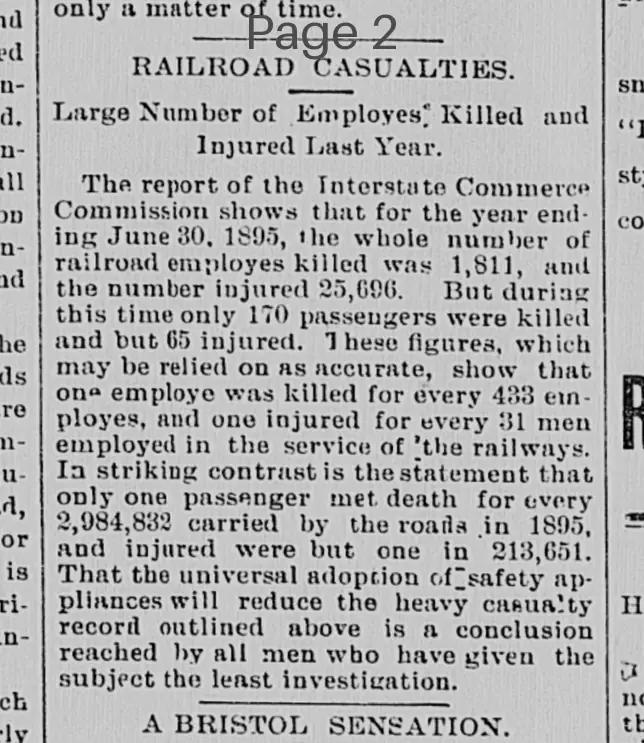
Large Number of Employes Killed and Injured Last Year.
The report of the Interstate Commerce Commission shows that for the year ending June 30, 1895, the whole number of railroad employees killed was 1,811, and the number injured 25,696. But during this time only 170 passengers were killed and but 65 injured. These figures, which may be relied on as accurate, show that one employee was killed for every 433 employees, and one injured for every 31 men employed in the service of the railways. In striking contrast is the statement that only one passenger met death for every 2,984,832 carried by the roads in 1895, and injured were but one in 213,651. That the universal adoption of safety appliances will reduce the heavy casualty record outlined above is a conclusion reached by all men who have given the subject the least investigation.
What sub-type of article is it?
What keywords are associated?
Domestic News Details
Event Date
Year Ending June 30, 1895
Outcome
1,811 employees killed, 25,696 injured; 170 passengers killed, 65 injured; one employee killed per 433, injured per 31; one passenger killed per 2,984,832 carried, injured per 213,651
Event Details
The report of the Interstate Commerce Commission shows that for the year ending June 30, 1895, the whole number of railroad employees killed was 1,811, and the number injured 25,696. But during this time only 170 passengers were killed and but 65 injured. These figures, which may be relied on as accurate, show that one employee was killed for every 433 employees, and one injured for every 31 men employed in the service of the railways. In striking contrast is the statement that only one passenger met death for every 2,984,832 carried by the roads in 1895, and injured were but one in 213,651. That the universal adoption of safety appliances will reduce the heavy casualty record outlined above is a conclusion reached by all men who have given the subject the least investigation.