Thank you for visiting SNEWPapers!
Sign up free
Baxter Springs News
Baxter Springs, Cherokee County, Kansas
What is this article about?
In chapters XIV-XVII, narrator Dorr Jewett confesses love to Coralie Bostock amid family crisis. Her father Pierce reveals Coralie's secret: born to a slave mother, making her legally a slave despite her white appearance. He plans her manumission and inheritance. Backstory includes Bostock's unhappy marriage, affair, son's blackmail, and a fatal duel to protect the secret on a Louisiana plantation.
Merged-components note: Merged serialized literary story components across pages 6 and 7, as they continue the same narrative.
Clippings
1 of 2
OCR Quality
Full Text
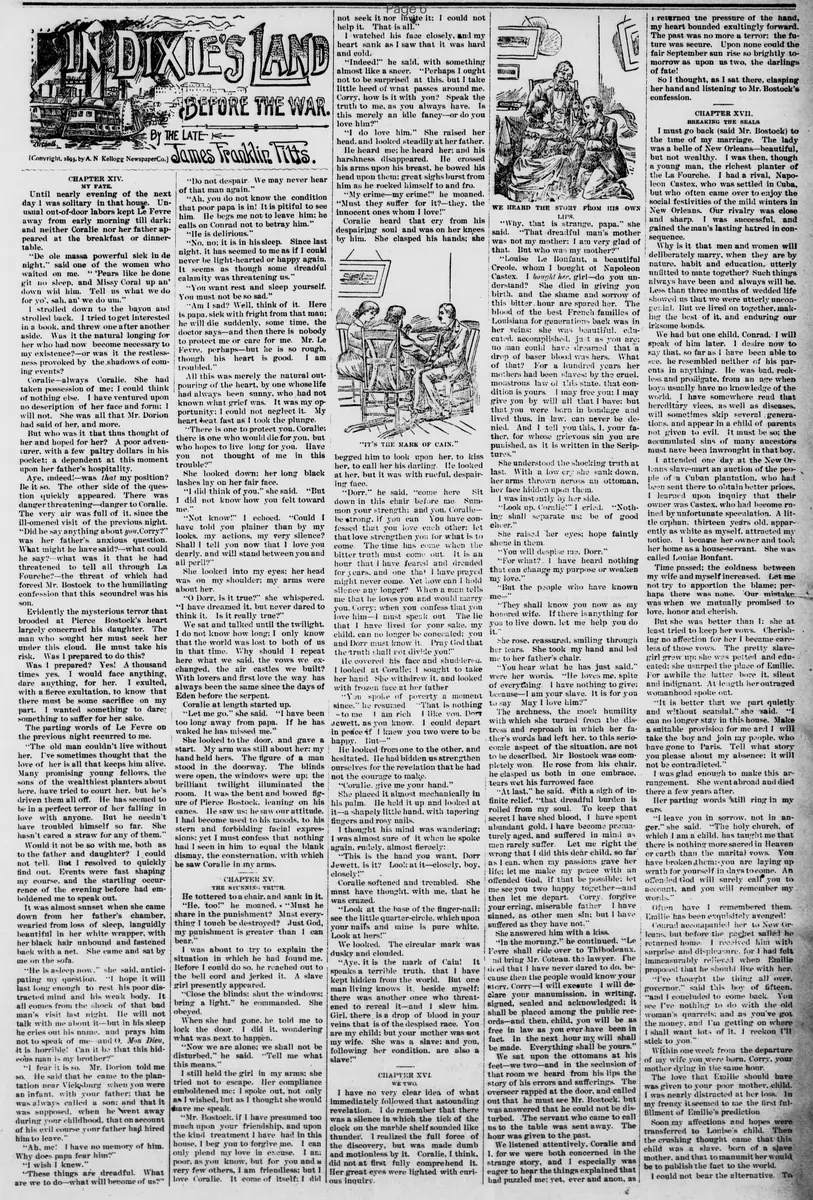
MY FATE
Until nearly evening of the next day I was solitary in that house. Unusual out-of-door labors kept Le Fevre away from early morning till dark: and neither Coralie nor her father appeared at the breakfast or dinner-table.
"De ole massa powerful sick in de night," said one of the women who waited on me. " 'Pears like he done git no sleep, an' Missy Coral up an' down wid him. Tell us what we do for yo', sah, an' we do um."
I strolled down to the bayou and strolled back. I tried to get interested in a book, and threw one after another aside. Was it the natural longing for her who had now become necessary to my existence?—or was it the restlessness provoked by the shadows of coming events?
Coralie—always Coralie. She had taken possession of me: I could think of nothing else. I have ventured upon no description of her face and form: I will not. She was all that Mr. Dorion had said of her, and more.
But who was it that thus thought of her and hoped for her? A poor adventurer, with a few paltry dollars in his pocket; a dependent at this moment upon her father's hospitality.
Aye, indeed!—was that my position?
Be it so. The other side of the question quickly appeared. There was danger threatening—danger to Coralie. The very air was full of it, since the ill-omened visit of the previous night.
"Did he say anything about you, Corry?" was her father's anxious question.
What might he have said?—what could he say?—what was it that he had threatened to tell all through La Fourche?—the threat of which had forced Mr. Bostock to the humiliating confession that this scoundrel was his son.
Evidently the mysterious terror that brooded at Pierce Bostock's heart largely concerned his daughter. The man who sought her must seek her under this cloud. He must take his risk. Was I prepared to do this?
Was I prepared? Yes! A thousand times yes. I would face anything, dare anything, for her. I exulted, with a fierce exultation, to know that there must be some sacrifice on my part. I wanted something to dare: something to suffer for her sake.
The parting words of Le Fevre on the previous night recurred to me. …The old man couldn't live without her. I've sometimes thought that the love of her is all that keeps him alive. Many promising young fellows, the sons of the wealthiest planters about here, have tried to court her, but he's driven them all off. He has seemed to be in a perfect terror of her falling in love with anyone. But he needn't have troubled himself so far. She hasn't cared a straw for any of them."
Would it not be so with me, both as to the father and daughter? I could not tell. But I resolved to quickly find out. Events were fast shaping my course, and the startling occurrence of the evening before had emboldened me to speak out.
It was almost sunset when she came down from her father's chamber, wearied from loss of sleep, languidly beautiful in her white wrapper, with her black hair unbound and fastened back with a net. She came and sat by me on the sofa.
"He is asleep now," she said, anticipating my question. "I hope it will last long enough to rest his poor distracted mind and his weak body. It all comes from the shock of that bad man's visit last night. He will not talk with me about it—but in his sleep he cries out his name, and prays him not to speak of me—and O, Mon Dieu, it is horrible! Can it be that this hideous man is my brother?"
…I fear it is so. Mr. Dorion told me so. He said that he came to the plantation near Vicksburg when you were an infant, with your father: that he was always called a son: and that it was supposed, when he went away during your childhood, that on account of his evil course your father had hired him to leave."
"Ah, me! I have no memory of him. Why does papa fear him?"
"I wish I knew."
"These things are dreadful. What are we to do—what will become of us?"
"Do not despair. We may never hear of that man again."
"Ah, you do not know the condition that poor papa is in! It is pitiful to see him. He begs me not to leave him; he calls on Conrad not to betray him."
"He is delirious."
"No, no: it is in his sleep. Since last night, it has seemed to me as if I could never be light-hearted or happy again. It seems as though some dreadful calamity was threatening us."
"You want rest and sleep yourself. You must not be so sad."
"Am I sad? Well, think of it. Here is papa, sick with fright from that man; he will die suddenly, some time, the doctor says—and then there is nobody to protect me or care for me. Mr. Le Fevre, perhaps—but he is so rough, though his heart is good. I am troubled."
All this was merely the natural outpouring of the heart, by one whose life had always been sunny, who had not known what grief was. It was my opportunity: I could not neglect it.
My heart beat fast as I took the plunge.
"There is one to protect you, Coralie: there is one who would die for you, but who hopes to live long for you. Have you not thought of me in this trouble?"
She looked down: her long black lashes lay on her fair face.
"I did think of you," she said. "But I did not know how you felt toward me."
"Not know!" I echoed. "Could I have told you plainer than by my looks, my actions, my very silence? Shall I tell you now that I love you dearly, and will stand between you and all peril?"
She looked into my eyes: her head was on my shoulder; my arms were about her.
…O Dorr, is it true?" she whispered. "I have dreamed it, but never dared to think it. Is it really true?"
We sat and talked until the twilight. I do not know how long: I only know that the world was lost to both of us in that time. Why should I repeat here what we said, the vows we exchanged, the air castles we built? With lovers and first love the way has always been the same since the days of Eden before the serpent.
Coralie at length started up.
"Let me go," she said. "I have been too long away from papa. If he has waked he has missed me."
She looked to the door, and gave a start. My arm was still about her: my hand held hers. The figure of a man stood in the doorway. The blinds were open, the windows were up; the brilliant twilight illuminated the room. It was the bent and bowed figure of Pierce Bostock, leaning on his canes. He saw us: he saw our attitude.
I had become used to his moods, to his stern and forbidding facial expressions: yet I must confess that nothing had I seen in him to equal the blank dismay, the consternation, with which he saw Coralie in my arms.
CHAPTER XV.
THE STUNNING TRUTH.
He tottered to a chair, and sank in it.
"He, too!" he moaned. "Must he share in the punishment? Must everything I touch be destroyed? Just God, my punishment is greater than I can bear."
I was about to try to explain the situation in which he had found me. Before I could do so, he reached out to the bell cord and jerked it. A slave girl presently appeared.
"Close the blinds: shut the windows: bring a light," he commanded. She obeyed.
When she had gone, he told me to lock the door. I did it, wondering what was next to happen.
"Now we are alone; we shall not be disturbed," he said. "Tell me what this means."
I still held the girl in my arms: she tried not to escape. Her compliance emboldened me: I spoke out, not only as I wished, but as I thought she would have me speak.
"Mr. Bostock, if I have presumed too much upon your friendship, and upon the kind treatment I have had in this house, I beg you to forgive me. I can only plead my love in excuse. I am poor, as you know, but for you and as very few others, I am friendless; but I love Coralie. It come of itself: I did not seek it nor invite it: I could not help it. That is all."
I watched his face closely, and my heart sank as I saw that it was hard and cold.
"Indeed!" he said, with something almost like a sneer. "Perhaps I ought not to be surprised at this, but I take little heed of what passes around me. Corry, how is it with you? Speak the truth to me, as you always have. Is this merely an idle fancy—or do you love him?"
"I do love him."
She raised her head, and looked steadily at her father.
He heard me: he heard her: and his harshness disappeared.
He crossed his arms upon his breast, he bowed his head upon them: great sighs burst from him as he rocked himself to and fro.
"My crime—my crime!" he moaned. "Must they suffer for it?—they, the innocent ones whom I love!"
Coralie heard that cry from his despairing soul and was on her knees by him.
She clasped his hands; she begged him to look upon her, to kiss her, to call her his darling. He looked at her, but it was with rueful, despairing face.
…Dorr," he said. "come here. Sit down in this chair before me. Summon your strength: and you, Coralie—be strong, if you can. You have confessed that you love each other: let that love strengthen you for what is to come.
The time has come when the bitter truth must come out. It is an hour that I have feared and dreaded for years, and one that I have prayed might never come. Yet how can I hold silence any longer? When a man tells me that he loves you and would marry you, Corry: when you confess that you love him—I must speak out. The lie that I have lived for your sake, my child, can no longer be concealed: you and Dorr must know it. Pray God that the truth shall not divide you!"
He covered his face and shuddered.
I looked at Coralie: I sought to take her hand. She withdrew it, and looked with frozen face at her father.
"You spoke of poverty a moment since," he resumed. "That is nothing—to me. I am rich. I like you, Dorr Jewett, as you know. I could depart in peace if I knew you two were to be happy. But—"
He looked from one to the other, and hesitated. He had bidden us strengthen ourselves for the revelation that he had not the courage to make.
"Coralie, give me your hand."
She placed it almost mechanically in his palm. He held it up and looked at it—a shapely little hand, with tapering fingers and rosy nails.
I thought his mind was wandering: I was almost sure of it when he spoke again, rudely, almost fiercely:
"This is the hand you want, Dorr Jewett, is it? Look at it—closely, boy, closely!"
Coralie softened and trembled.
She must have thought, with me, that he was crazed.
"Look at the base of the finger-nail: see the little quarter-circle, which upon your nails and mine is pure white. Look at hers!"
We looked.
The circular mark was dusky and clouded.
"Aye, it is the mark of Cain! It speaks a terrible truth, that I have kept hidden from the world. But one man living knows it, beside myself: there was another once who threatened to reveal it—and I slew him.
Girl, there is a drop of blood in your veins that is of the despised race. You are my child; but your mother was not my wife.
She was a slave; and you, following her condition, are also a slave!"
CHAPTER XVI
WE TWO.
I have no very clear idea of what immediately followed that astounding revelation. I do remember that there was a silence in which the tick of the clock on the marble shelf sounded like thunder. I realized the full force of the discovery, but was made dumb and motionless by it. Coralie, I think, did not at first fully comprehend it. Her great eyes were lighted with curious inquiry.
"Why, that is strange, papa," she said. "That dreadful man's mother was not my mother: I am very glad of that. But who was my mother?"
"Louise Le Bonfant, a beautiful Creole, whom I bought of Napoleon Castex. I bought her, girl—do you understand? She died in giving you birth, and the shame and sorrow of this bitter hour are spared her. The blood of the best French families of Louisiana for generations back was in her veins: she was beautiful, educated, accomplished, just as you are: no man could have dreamed that a drop of baser blood was hers. What of that? For a hundred years her mothers had been slaves: by the cruel, monstrous law of this state, that condition is yours. I may free you: I may give you by will all that I have: but that you were born in bondage and lived thus, in law, can never be denied. And I tell you this, I, your father, for whose grievous sin you are punished, as it is written in the Scriptures."
She understood the shocking truth at last. With a low cry, she sank down, her arms thrown across an ottoman, her face hidden upon them.
I was instantly by her side.
…Look up, Coralie!" I cried. "Nothing shall separate us: be of good cheer."
She raised her eyes: hope faintly shone in them.
"You will despise me, Dorr."
"For what? I have heard nothing that can change my purpose or weaken my love."
"But the people who have known me—they shall know you now as my honored wife. If there is anything for you to live down, let me help you do it."
She rose, reassured, smiling through her tears. She took my hand and led me to her father's chair.
"You hear what he has just said," were her words. "He loves me, spite of everything. I have nothing to give: because—I am your slave. It is for you to say, May I love him?"
The archness, the mock humility with which she turned from the distress and reproach in which her father's words had left her, to this serio-comic aspect of the situation, are not to be described. Mr. Bostock was completely won. He rose from his chair, he clasped us both in one embrace, tears wet his furrowed face.
…At last," he said, with a sigh of infinite relief, "that dreadful burden is rolled from my soul. To keep that secret I have shed blood, I have spent abundant gold, I have become prematurely aged, and suffered in mind as men rarely suffer. Let me right the wrong that I did this dear child, so far as I can, when my passions gave her life: let me make my peace with an offended God, if that be possible: let me see you two happy together—and then let me depart. Corry, forgive your erring, miserable father. I have sinned, as other men sin: but I have suffered as they have not."
She answered him with a kiss.
In the morning," he continued, "Le Fevre shall ride over to Thibodeaux, and bring Mr. Coteau, the lawyer. The deed that I have never dared to do, because then the people would know your story, Corry—I will execute. I will declare your manumission, in writing, signed, sealed and acknowledged; it shall be placed among the public records—and then, child, you will be as free in law as you ever have been in fact. In the next hour my will shall be made. Everything shall be yours."
We sat upon the ottomans at his feet—we two—and in the seclusion of that room we heard from his lips the story of his errors and sufferings. The overseer rapped at the door, and called out that he must see Mr. Bostock, but was answered that he could not be disturbed. The servant who came to call us to the table was sent away. The hour was given to the past.
We listened attentively, Coralie and I, for we were both concerned in the strange story, and I especially was eager to hear the things explained that had puzzled me; yet, ever and anon, as he returned the pressure of the hand, my heart bounded exultingly forward.
The past was no more a terror: the future was secure. Upon none could the fair September sun rise so brightly tomorrow as upon us two, the darlings of fate!
So I thought, as I sat there, clasping her hand and listening to Mr. Bostock's confession.
CHAPTER XVII.
BREAKING THE SEALS
I must go back (said Mr. Bostock) to the time of my marriage. The lady was a belle of New Orleans—beautiful, but not wealthy. I was then, though a young man, the richest planter of the La Fourche. I had a rival, Napoleon Castex, who was settled in Cuba, but who often came over to enjoy the social festivities of the mild winters in New Orleans. Our rivalry was close and sharp. I was successful, and gained the man's lasting hatred in consequence.
Why is it that men and women will deliberately marry, when they are by nature, habit and education, utterly unfitted to mate together? Such things always have been and always will be. Less than three months of wedded life showed us that we were utterly uncongenial. But we lived on together, making the best of it, and enduring our irksome bonds.
We had but one child, Conrad. I will speak of him later. I desire now to say that, so far as I have been able to see, he resembled neither of his parents in anything. He was bad, reckless and profligate, from an age when boys usually have no knowledge of the world. I have somewhere read that hereditary vices, as well as diseases, will sometimes skip several generations, and appear in a child of parents not given to evil. It must be so; the accumulated sins of many ancestors must have been inwrought in that boy.
I attended one day at the New Orleans slave-mart an auction of the people of a Cuban plantation, who had been sent there to obtain better prices. I learned upon inquiry that their owner was Castex, who had become ruined by unfortunate speculation. A little orphan, thirteen years old, apparently as white as myself, attracted my notice. I became her owner and took her home as a house-servant. She was called Louise Bonfant.
Time passed: the coldness between my wife and myself increased. Let me not try to apportion the blame; perhaps there was none. Our mistake was when we mutually promised to love, honor and cherish.
But she was better than I: she at least tried to keep her vows. Cherishing no affection for her I became careless of those vows. The pretty slave-girl grew up: she was petted and educated: she usurped the place of Emilie. For awhile the latter bore it, silent and indignant. At length her outraged womanhood spoke out.
…It is better that we part quietly and without scandal," she said. "I can no longer stay in this house. Make a suitable provision for me and I will take the boy and join my people, who have gone to Paris. Tell what story you please about my absence: it will not be contradicted."
I was glad enough to make this arrangement. She went abroad and died there a few years after.
Her parting words still ring in my ears.
"I leave you in sorrow, not in anger," she said. "The holy church, of which I am a child, has taught me that there is nothing more sacred in Heaven or earth than the marital vows. You have broken them: you are laying up wrath for yourself in days to come. An offended God will surely call you to account, and you will remember my words."
Often have I remembered them. Emilie has been exquisitely avenged: Conrad accompanied her to New Orleans, but before the packet sailed he returned home. I received him with surprise and displeasure, for I had felt immeasurably relieved when Emilie proposed that he should live with her.
"I've thought the thing all over, governor," said this boy of fifteen, "and I concluded to come back. You see I've nothing to do with the old woman's quarrels: and as you've got the money, and I'm getting on where I shall want lots of it, I reckon I'll stick to you."
Within one week from the departure of my wife you were born, Corry, your mother dying in the same hour.
The love that Emilie should have was given to your poor mother, child. I was nearly distracted at her loss. In my frenzy it seemed to me the first fulfillment of Emilie's prediction.
Soon my affections and hopes were transferred to Louise's child. Then the crushing thought came that this child was a slave, born of a slave mother, and that to manumit her would be to publish the fact to the world.
I could not bear the alternative. To
save it. I resolved on a course which good judgment should have warned me against. I would break up my home here, lease the plantation, go four hundred miles up the river, and, in a locality where no stories would be likely to come from La Fourche, I would bring up this child of my affection. No one there should know of the taint in her origin: no one should ever guess that she was born in bondage.
This plan I put in execution immediately. It promised to succeed. Unfortunately, I had not taken into account the precocity and wickedness of that boy. He instantly divined the truth, and began to hold the knowledge of it over me like a rod. For five years he kept me in constant terror, not so much by his evil courses as by the constant threat of betraying my secret. The amount of money that I have paid him for his silence would represent a fortune. At last, in his twenty-first year, he agreed to leave home and never return, and to keep his knowledge to himself. I was to pay him a large quarterly allowance, which has, in fact, been almost doubled. I have relied on his love of money to keep him from betraying me: and my purse alone has closed his mouth. Where the great sums that I have given him have gone, the gamblers of the river can tell.
I look back to the time between 1846, when I got rid of this unnatural son, and 1855, when the tragedy occurred which will be briefly noticed, as the happiest of my life. The disagreeable part was all behind me: conscience, as well as the fear of exposure, so torturing in these later years, did not trouble me: you were growing up, Corry, to be just what I wished you: charming acquaintances, valued friends were all about me: my success in growing cotton was adding enormously to my wealth. All this was rudely troubled by the appearance of Napoleon Castex.
I had heard little of this man since my successful rivalry for the hand of Emilie made him my enemy. After my purchase of Louise I learned incidentally that he had once visited New Orleans, and it was told me that he made particular inquiries about me. There were none but unpleasant recollections connected with him, and I hoped that I should never meet him again.
Suddenly, twelve years after my removal from La Fourche, he presented himself to me. I had no previous knowledge that he was in the neighborhood, and the sight of him disconcerted me. It was at a gentleman's dinner party at my own house, and he came with one of the guests, whom he was visiting. I knew that the man was revengeful and a good hater, and I began to tremble for the consequences of such a visit. I conjectured that if he had not learned the true cause of Emilie's alienation from me, he would be likely to guess it if he happened to see you, Corry: for you were then about the age of your mother when he last saw her, and very closely resembled her. And what he should discover I knew that his hatred of me would prompt him to spread broadcast in the neighborhood.
Before I could form any plan to check such a catastrophe, dinner was announced. We were just seated, when you, Corry, came to the door and looked in, prompted, I suppose, by childish curiosity. Castex saw you, recognized your face, and asked me in French if that was my daughter. I replied that she was: and then—
The man is dead: I must soon follow him. I would like to speak to him now without bitterness or passion: yet I should not speak the whole truth if I did not say that his face was shining with savage joy as he gave me the brutal rejoinder in French that assured me that his discovery would be published far and near. He said: "Ah, monsieur! Five or six years hence, when the charming daughter of Louise Bonfant shall come to the same auction block in New Orleans where you purchased the mother, then I think the spirit of your wronged wife will feel avenged."
I saw that he had deliberately planned to force a quarrel on me. I knew that there could be no safety for my secret while he lived. A duel followed, and I killed him. The wound that I received at the same time from his hand laid me up for weeks, and nearly brought me to the grave.
My misery dates from that hour. It is not a comfortable reflection to carry around with you night and day that you have slain a fellow creature, though a bad one, and the thought has troubled me: but much more tormenting than this was the fear that Castex had in some way left his discovery to be revealed after his death. I grew suspicious of everybody: I abandoned old friends: while they never suspected the reason, I was continually fearful that the truth would be known and made public. Then the thought occurred to me that all this torment might be ended by returning to La Fourche. I came back to this place as suddenly as I had left it. We had been absent fifteen years, and there had been many changes: Coralie was everywhere presented as my daughter, and I gave out that Emilie, her mother, had died at my plantation far up the river. Thus, in fear and falsehood, have I preserved your good name, my child, and concealed the story of your birth. That concealment has always been at the mercy of accidents, and I have lived in the same state of torment since the duel. Perhaps it is all part of my punishment: Emilie's words were prophetic. You saw the agitation and the excitement into which the visit of that reprobate son threw me. For the sake of both of you, this falsehood can be told no longer. The truth is painful, it is humiliating: but that way lies safety for you. Thank God, the burden is gone, at last! In the morning Mr. Coteau shall come and make the writings.
[To be continued.]
What sub-type of article is it?
What themes does it cover?
What keywords are associated?
Literary Details
Form / Style
Narrative Chapters Revealing Family Secrets And Romance
Key Lines