Thank you for visiting SNEWPapers!
Sign up free
Literary
July 4, 1792
National Gazette
Philadelphia, Philadelphia County, Pennsylvania
What is this article about?
Voltaire's essay explores the roots of human inequality, arguing it stems from scarcity and dependence rather than natural superiority, contrasting humans with independent animals, and critiquing social hierarchies, slavery, and tyranny.
Clipping
OCR Quality
85%
Good
Full Text
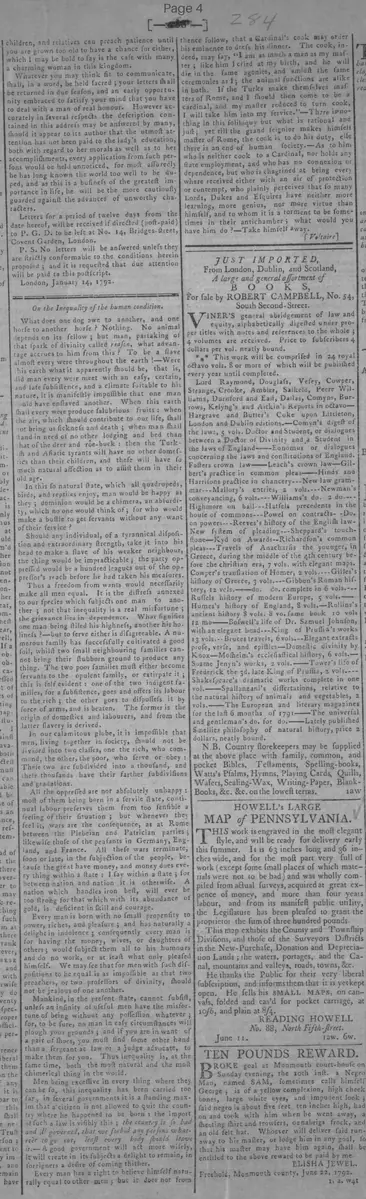
On the Inequality of the human condition.
What does one dog owe to another, and one
horse to another horse? Nothing.
No animal
depends on its fellow; but man, partaking of
that spark of divinity called reason, what advan-
tage accrues to him from this? To be a slave
almost every where throughout the earth!—Were
his earth what it apparently should be, that is,
did man every where meet with an easy, certain,
and safe subsistence, and a climate suitable to his
nature, it is manifestly impossible that one man
would have enslaved another. When this earth
shall every where produce salubrious fruits: when
the air, which should contribute to our life, shall
not bring us sickness and death; when man shall
stand in need of no other lodging and bed than
that of the deer and roe-buck: then the Turk-
ish and Asiatic tyrants will have no other domes-
tics than their children, and these will have so
much natural affection as to assist them in their
old age.
In this so natural state, which all quadrupeds,
birds, and reptiles enjoy, man would be happy as
they; dominion would be a chimera, an absurdi-
ty, which no one would think of; for who would
make a bustle to get servants without any want
of their service?
Should any individual, of a tyrannical disposi-
tion and extraordinary strength, take it into his
head to make a slave of his weaker neighbour,
the thing would be impracticable; the party op-
pressed would be a hundred leagues out of the op-
pressor's reach before he had taken his measures.
Thus a freedom from wants would necessarily
make all men equal. It is the distress annexed
to our species which subjects one man to
another; not that inequality is a real misfortune;
the grievance lies in dependence. What signifies
one man being styled his highness, another his ho-
ness?—but to serve either is disagreeable. A nu-
merous family has successfully cultivated a good
soil, whilst two small neighbouring families can-
not bring their stubborn ground to produce any
thing. The two poor families must either become
servants to the opulent family, or extirpate it;
this is self-evident: one of the two indigent fa-
milies, for a subsistence, goes and offers its labour
to the rich; the other goes to dispossess it by
force of arms, and is beaten. The former is the
origin of domestics and labourers, and from the
latter slavery is derived.
In our calamitous globe, it is impossible that
men, living together in society, should not be
divided into two classes, one the rich, who com-
mand, the other, the poor, who serve or obey:
These two are subdivided into a thousand, and
these thousands have their farther subdivisions
and gradations.
All the oppressed are not absolutely unhappy:
most of them being born in a servile state, conti-
ual labour preserves them from too sensible a
feeling of their situation; but whenever they
feel it, wars are the consequence, as at Rome
between the Plebeian and Patrician parties;
likewise those of the peasants in Germany, Eng-
land, and France. All these wars terminate,
soon or late, in the subjection of the people, be-
cause the great have money, and money does eve-
ry thing within a state: I say within a state; for
between nation and nation it is otherwise. A
nation which handles iron best, will ever be
too strong for that which with its abundance of
gold, is deficient in skill and courage.
Every man is born with no small propensity to
power, riches, and pleasure; and has naturally a
delight in indolence; consequently every man is
for having the money, wives, or daughters of
others; would subject them all to his humours
and do no work, or at least what only pleased
himself. We may see that for men with such dis-
positions to be equal is as impossible as that two
preachers, or two professors of divinity, should
not be jealous of one another.
Mankind, in the present state, cannot subsist,
unless an infinity of useful men have the misfor-
tune of being without any possession whatever;
for, to be sure, no man in easy circumstances will
plough your grounds; and if you are in want of
a pair of shoes, you must find some other hand
than a sergeant at law or a judge advocate, to
make them for you. Thus inequality is, at the
same time, both the most natural and the most
chimerical thing in the world.
Men being excessive in every thing where they
can be so, this inequality has been carried too
far, in several governments it is a standing max-
im that a citizen is not allowed to quit the coun-
try where he happened to be born: the import
of such a law is visibly this; the country is so bad
and ill governed, that we forbid any persons what-
ever to go out, lest every body should leave
it.—A good government will act more wisely,
it will create in its subjects a delight to remain, in
foreigners a desire of coming thither.
Every man has a right to believe himself natu-
rally equal to other men; but it does not from
thence follow, that a Cardinal's cook may order
his eminence to dress his dinner. The cook, in-
ter ; like him I cried at my birth, and he will
deed, may say, "I am as much a man as my mas-
ter;"
die in the same agonies, and amidst the same
ceremonies as I; the animal functions are alike
in both. If the Turks make themselves mas-
ters of Rome, and I should then come to be a
cardinal, and my master reduced to turn cook,
I will take him into my service."—There is no-
thing in this soliloquy but what is rational and
just; yet till the grand signior makes himself
master of Rome, the cook is to do his duty, else
there is an end of human society.—As to him
who is neither cook to a Cardinal, nor holds any
state employment, and who has no connexion or
dependence, but who is chagrined at being every
where received either with an air of protection
or contempt, who plainly perceives that so many
Lords, Dukes and Esquires have neither more
learning, more genius, nor more virtue than
himself, and to whom it is a torment to be some-
times in their antichamber; what would you
have him do?—Take himself away.
[Voltaire]
What does one dog owe to another, and one
horse to another horse? Nothing.
No animal
depends on its fellow; but man, partaking of
that spark of divinity called reason, what advan-
tage accrues to him from this? To be a slave
almost every where throughout the earth!—Were
his earth what it apparently should be, that is,
did man every where meet with an easy, certain,
and safe subsistence, and a climate suitable to his
nature, it is manifestly impossible that one man
would have enslaved another. When this earth
shall every where produce salubrious fruits: when
the air, which should contribute to our life, shall
not bring us sickness and death; when man shall
stand in need of no other lodging and bed than
that of the deer and roe-buck: then the Turk-
ish and Asiatic tyrants will have no other domes-
tics than their children, and these will have so
much natural affection as to assist them in their
old age.
In this so natural state, which all quadrupeds,
birds, and reptiles enjoy, man would be happy as
they; dominion would be a chimera, an absurdi-
ty, which no one would think of; for who would
make a bustle to get servants without any want
of their service?
Should any individual, of a tyrannical disposi-
tion and extraordinary strength, take it into his
head to make a slave of his weaker neighbour,
the thing would be impracticable; the party op-
pressed would be a hundred leagues out of the op-
pressor's reach before he had taken his measures.
Thus a freedom from wants would necessarily
make all men equal. It is the distress annexed
to our species which subjects one man to
another; not that inequality is a real misfortune;
the grievance lies in dependence. What signifies
one man being styled his highness, another his ho-
ness?—but to serve either is disagreeable. A nu-
merous family has successfully cultivated a good
soil, whilst two small neighbouring families can-
not bring their stubborn ground to produce any
thing. The two poor families must either become
servants to the opulent family, or extirpate it;
this is self-evident: one of the two indigent fa-
milies, for a subsistence, goes and offers its labour
to the rich; the other goes to dispossess it by
force of arms, and is beaten. The former is the
origin of domestics and labourers, and from the
latter slavery is derived.
In our calamitous globe, it is impossible that
men, living together in society, should not be
divided into two classes, one the rich, who com-
mand, the other, the poor, who serve or obey:
These two are subdivided into a thousand, and
these thousands have their farther subdivisions
and gradations.
All the oppressed are not absolutely unhappy:
most of them being born in a servile state, conti-
ual labour preserves them from too sensible a
feeling of their situation; but whenever they
feel it, wars are the consequence, as at Rome
between the Plebeian and Patrician parties;
likewise those of the peasants in Germany, Eng-
land, and France. All these wars terminate,
soon or late, in the subjection of the people, be-
cause the great have money, and money does eve-
ry thing within a state: I say within a state; for
between nation and nation it is otherwise. A
nation which handles iron best, will ever be
too strong for that which with its abundance of
gold, is deficient in skill and courage.
Every man is born with no small propensity to
power, riches, and pleasure; and has naturally a
delight in indolence; consequently every man is
for having the money, wives, or daughters of
others; would subject them all to his humours
and do no work, or at least what only pleased
himself. We may see that for men with such dis-
positions to be equal is as impossible as that two
preachers, or two professors of divinity, should
not be jealous of one another.
Mankind, in the present state, cannot subsist,
unless an infinity of useful men have the misfor-
tune of being without any possession whatever;
for, to be sure, no man in easy circumstances will
plough your grounds; and if you are in want of
a pair of shoes, you must find some other hand
than a sergeant at law or a judge advocate, to
make them for you. Thus inequality is, at the
same time, both the most natural and the most
chimerical thing in the world.
Men being excessive in every thing where they
can be so, this inequality has been carried too
far, in several governments it is a standing max-
im that a citizen is not allowed to quit the coun-
try where he happened to be born: the import
of such a law is visibly this; the country is so bad
and ill governed, that we forbid any persons what-
ever to go out, lest every body should leave
it.—A good government will act more wisely,
it will create in its subjects a delight to remain, in
foreigners a desire of coming thither.
Every man has a right to believe himself natu-
rally equal to other men; but it does not from
thence follow, that a Cardinal's cook may order
his eminence to dress his dinner. The cook, in-
ter ; like him I cried at my birth, and he will
deed, may say, "I am as much a man as my mas-
ter;"
die in the same agonies, and amidst the same
ceremonies as I; the animal functions are alike
in both. If the Turks make themselves mas-
ters of Rome, and I should then come to be a
cardinal, and my master reduced to turn cook,
I will take him into my service."—There is no-
thing in this soliloquy but what is rational and
just; yet till the grand signior makes himself
master of Rome, the cook is to do his duty, else
there is an end of human society.—As to him
who is neither cook to a Cardinal, nor holds any
state employment, and who has no connexion or
dependence, but who is chagrined at being every
where received either with an air of protection
or contempt, who plainly perceives that so many
Lords, Dukes and Esquires have neither more
learning, more genius, nor more virtue than
himself, and to whom it is a torment to be some-
times in their antichamber; what would you
have him do?—Take himself away.
[Voltaire]
What sub-type of article is it?
Essay
What themes does it cover?
Political
Liberty Freedom
Social Manners
What keywords are associated?
Inequality
Slavery
Human Condition
Social Classes
Tyranny
Dependence
Scarcity
Equality
What entities or persons were involved?
Voltaire
Literary Details
Title
On The Inequality Of The Human Condition.
Author
Voltaire
Subject
On The Inequality Of The Human Condition
Key Lines
What Does One Dog Owe To Another, And One Horse To Another Horse? Nothing.
To Be A Slave Almost Every Where Throughout The Earth!
Thus A Freedom From Wants Would Necessarily Make All Men Equal.
In Our Calamitous Globe, It Is Impossible That Men, Living Together In Society, Should Not Be Divided Into Two Classes, One The Rich, Who Command, The Other, The Poor, Who Serve Or Obey.
Thus Inequality Is, At The Same Time, Both The Most Natural And The Most Chimerical Thing In The World.