Thank you for visiting SNEWPapers!
Sign up free
Editorial
September 14, 1818
Alexandria Gazette & Daily Advertiser
Alexandria, Virginia
What is this article about?
Editorial critiques Kentucky voters' forgiveness of Henry Clay and Richard Johnson's involvement in the Compensation bill, seen as a venial sin, while others face harsher judgment. It quotes Patrick Henry's constitutional objection to self-set pay, arguing it enables self-interest over honor, and calls for impartial justice.
Clipping
OCR Quality
95%
Excellent
Full Text
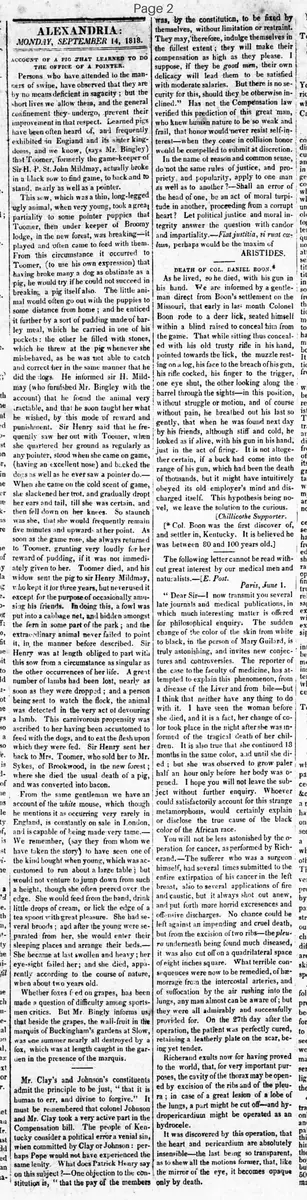
Mr. Clay's and Johnson's constituents
admit the principle to be just, "that it is
human to err, and divine to forgive." It
must be remembered that colonel Johnson
and Mr. Clay took a very active part in the
Compensation bill. The people of Ken-
tucky consider a political error a venial sin.
when committed by Clay or Johnson: per-
haps Pope would not have experienced the
same lenity. What does Patrick Henry say
on this subject?---One objection to the con-
stitution is, "that the pay of the members
was, by the constitution, to be fixed by
themselves, without limitation or restraint.
They may, therefore, indulge themselves in
the fullest extent; they will make their
compensation as high as they please. I
suppose, if they be good men, their own
delicacy will lead them to be satisfied
with moderate salaries. But there is no se-
curity for this, should they be otherwise in-
clined." Has not the Compensation law
verified this prediction of this great man,
who knew human nature to be so weak and
frail, that honor would never resist self-in-
terest—when they come in collision honor
would be compelled to submit at discretion.
In the name of reason and common sense,
do not the same rules of justice, and pro-
priety, and popularity, apply to one man
as well as to another?--Shall an error of
the head of one, be an act of moral turpi-
tude in another, proceeding from a corrupt
heart? Let political justice and moral in-
tegrity answer the question with candor
and impartiality.--Fiat justitia, si ruat cæ-
lum, perhaps would be the maxim of
ARISTIDES.
admit the principle to be just, "that it is
human to err, and divine to forgive." It
must be remembered that colonel Johnson
and Mr. Clay took a very active part in the
Compensation bill. The people of Ken-
tucky consider a political error a venial sin.
when committed by Clay or Johnson: per-
haps Pope would not have experienced the
same lenity. What does Patrick Henry say
on this subject?---One objection to the con-
stitution is, "that the pay of the members
was, by the constitution, to be fixed by
themselves, without limitation or restraint.
They may, therefore, indulge themselves in
the fullest extent; they will make their
compensation as high as they please. I
suppose, if they be good men, their own
delicacy will lead them to be satisfied
with moderate salaries. But there is no se-
curity for this, should they be otherwise in-
clined." Has not the Compensation law
verified this prediction of this great man,
who knew human nature to be so weak and
frail, that honor would never resist self-in-
terest—when they come in collision honor
would be compelled to submit at discretion.
In the name of reason and common sense,
do not the same rules of justice, and pro-
priety, and popularity, apply to one man
as well as to another?--Shall an error of
the head of one, be an act of moral turpi-
tude in another, proceeding from a corrupt
heart? Let political justice and moral in-
tegrity answer the question with candor
and impartiality.--Fiat justitia, si ruat cæ-
lum, perhaps would be the maxim of
ARISTIDES.
What sub-type of article is it?
Partisan Politics
Economic Policy
Moral Or Religious
What keywords are associated?
Compensation Bill
Henry Clay
Richard Johnson
Patrick Henry
Congressional Pay
Political Error
Moral Integrity
What entities or persons were involved?
Mr. Clay
Johnson
Colonel Johnson
Patrick Henry
Pope
Aristides
Editorial Details
Primary Topic
Criticism Of Leniency Toward Clay And Johnson On Compensation Bill
Stance / Tone
Critical Of Political Favoritism And Self Interested Congressional Pay
Key Figures
Mr. Clay
Johnson
Colonel Johnson
Patrick Henry
Pope
Aristides
Key Arguments
Constituents Admit 'Human To Err, Divine To Forgive' But Apply It Leniently To Clay And Johnson
Clay And Johnson Actively Supported Compensation Bill
Kentucky Views Their Political Error As Venial Sin, Unlike Pope's Treatment
Patrick Henry Warned Constitution Allows Unchecked Self Set Pay
Compensation Law Verifies Henry's Prediction Of Human Frailty And Self Interest Over Honor
Same Rules Of Justice Should Apply To All, Not Just Favorites
Error Of Head Vs. Moral Turpitude From Corrupt Heart Must Be Judged Impartially