Thank you for visiting SNEWPapers!
Sign up free
The Union Times
Union, Union County, South Carolina
What is this article about?
A Lockhart Junction correspondent reports on dry weather aiding crop harvesting, limited grain sowing, local editor's Salvation Army preaching, a Revolutionary War anecdote of slave Essox escaping Tories via boat trick on a large river, family Revolutionary fighters, upcoming county fair, and various social visits and trips. Dated Sept. 27.
Clipping
OCR Quality
Full Text
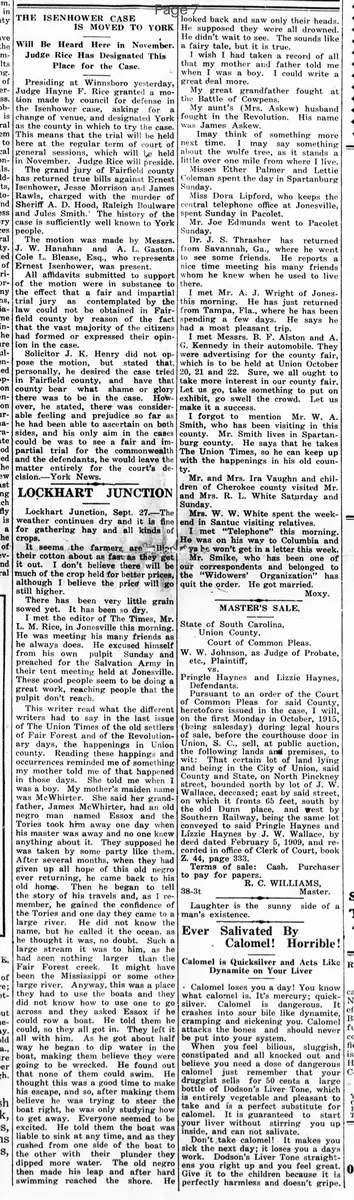
Lockhart Junction, Sept. 27. The weather continues dry and it is fine for gathering hay and all kinds of crops.
It seems the farmers are all hauling their cotton about as fast as they get it out. I don't believe there will be much of the crop held for better prices, although I believe the price will go still higher.
There has been very little grain sowed yet. It has been so dry.
I met the editor of The Times, Mr. L. M. Rice, in Jonesville this morning. He was meeting his many friends as he always does. He excused himself from his own pulpit Sunday and preached for the Salvation Army in their tent meeting held at Jonesville.
These good people seem to be doing a great work, reaching people that the pulpit don't reach.
This writer read what the different writers had to say in the last issue of The Union Times of the old settlers of Fair Forest and of the Revolutionary days, the happenings in Union county. Reading these happenings and occurrences reminded me of something my mother told me of that happened in those days. She told me when I was a boy. My mother's maiden name was McWhirter. She said her grandfather, James McWhirter, had an old negro man named Essox and the Tories took him away one day when his master was away and no one knew anything about it. They supposed he was taken by some party like them.
After several months, when they had given up all hope of this old negro ever returning, he came back to his old home. Then he began to tell the story of his travels and, as I remember, he gained the confidence of the Tories and one day they came to a large river. He did not know the name, but he called it the ocean, as he thought it was, no doubt. Such a large stream it was to him, as he had seen nothing larger than the Fair Forest creek. It might have been the Mississippi or some other large river. Anyway, this was a place they had to use the boats and they did not know how to use one to go across and they asked Essox if he could row a boat. He told them he could, so they all got in. They left it all with him. As he got about half way he began to dip water in the boat, making them believe they were going to be wrecked. He found out that none of them could swim. He thought this was a good time to make his escape, and so, after making them believe he was trying to steer the boat right, he was only studying how to get away. Everyone seemed to be excited. He told them the boat was liable to sink at any time, and as they rushed from one side of the boat to the other with their plunder they dipped more water. The old negro then made his leap and after hard swimming reached the shore. He looked back and saw only their heads. He supposed they were all drowned. He didn't wait to see. The sounds like a fairy tale, but it is true.
I wish I had taken a record of all that my mother and father told me when I was a boy. I could write a great deal more.
My great grandfather fought at the Battle of Cowpens.
My aunt's (Mrs. Askew) husband fought in the Revolution. His name was James Askew.
I may think of something more next time. I may say something about the wolfe tree, as it stands a little over one mile from where I live.
Misses Ether Palmer and Lettie Coleman spent the day in Spartanburg Sunday.
Miss Dora Lipford, who keeps the central telephone office at Jonesville, spent Sunday in Pacolet.
Mr. Joe Edmunds went to Pacolet Sunday.
Dr. J. S. Thrasher has returned from Savannah, Ga., where he went to see some friends. He reports a nice time meeting his many friends whom he knew when he used to live there.
I met Mr. A. J. Wright of Jonesville this morning. He has just returned from Tampa, Fla., where he has been spending a few days. He says he had a most pleasant trip.
I met Messrs. B. F. Alston and A. G. Kennedy in their automobile. They were advertising for the county fair, which is to be held at Union October 20, 21 and 22. Sure, we all ought to take more interest in our county fair.
Let us go, take something to put on exhibit, go swell the crowd. Let us make it a success.
I forgot to mention Mr. W. A. Smith, who has been visiting in this county. Mr. Smith lives in Spartanburg county. He says that he takes The Union Times, so he can keep up with the happenings in his old county.
Mr. and Mrs. Ira Vaughn and children of Cherokee county visited Mr. and Mrs. R. L. White Saturday and Sunday.
Mrs. W. W. White spent the week-end in Santuc visiting relatives.
I met "Telephone" this morning. He was on his way to Columbia and p ys bs won't get in a letter this week,
Mr. Smike, who has been one of our correspondents and belonged to the "Widowers' Organization" has quit the order. He got married.
Moxy.
What sub-type of article is it?
What themes does it cover?
What keywords are associated?
What entities or persons were involved?
Where did it happen?
Story Details
Key Persons
Location
Union County, Fair Forest Creek, Large River
Event Date
Revolutionary Days
Story Details
The writer's mother recounted how her grandfather James McWhirter's slave Essox was abducted by Tories. After months, Essox escaped by gaining their trust, rowing a boat across a large river he mistook for the ocean, pretending the boat was sinking to panic the non-swimmers, then leaping overboard and swimming to shore. The writer also notes his great grandfather fought at the Battle of Cowpens and his uncle James Askew fought in the Revolution.