Thank you for visiting SNEWPapers!
Sign up free
Story
October 6, 1857
Oroville Daily Butte Record
Oroville, Butte County, California
What is this article about?
President Buchanan responds to a memorial from Professor Silliman and 42 Connecticut clergymen criticizing his enforcement of Kansas laws, defending the territorial government's legitimacy and urging clergy to avoid politics.
Clipping
OCR Quality
98%
Excellent
Full Text
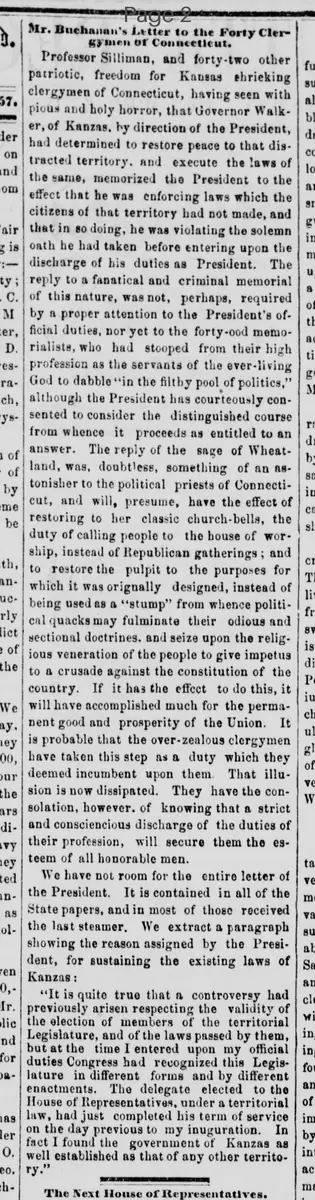
Mr. Buchanan's Letter to the Forty Clergymen of Connecticut.
Professor Silliman, and forty-two other patriotic, freedom for Kansas shrieking clergymen of Connecticut, having seen with pious and holy horror, that Governor Walker, of Kansas, by direction of the President, had determined to restore peace to that distracted territory, and execute the laws of the same, memorialized the President to the effect that he was enforcing laws which the citizens of that territory had not made, and that in so doing, he was violating the solemn oath he had taken before entering upon the discharge of his duties as President. The reply to a fanatical and criminal memorial of this nature, was not, perhaps, required by a proper attention to the President's official duties, nor yet to the forty-odd memorialists, who had stooped from their high profession as the servants of the ever-living God to dabble "in the filthy pool of politics," although the President has courteously consented to consider the distinguished course from whence it proceeds as entitled to an answer. The reply of the sage of Wheatland, was, doubtless, something of an astonisher to the political priests of Connecticut, and will, we presume, have the effect of restoring to her classic church-bells, the duty of calling people to the house of worship, instead of Republican gatherings; and to restore the pulpit to the purposes for which it was originally designed, instead of being used as a "stump" from whence political quacks may fulminate their odious and sectional doctrines, and seize upon the religious veneration of the people to give impetus to a crusade against the constitution of the country. If it has the effect to do this, it will have accomplished much for the permanent good and prosperity of the Union. It is probable that the over-zealous clergymen have taken this step as a duty which they deemed incumbent upon them. That illusion is now dissipated. They have the consolation, however, of knowing that a strict and conscientious discharge of the duties of their profession, will secure them the esteem of all honorable men.
We have not room for the entire letter of the President. It is contained in all of the State papers, and in most of those received the last steamer. We extract a paragraph showing the reason assigned by the President, for sustaining the existing laws of Kansas:
"It is quite true that a controversy had previously arisen respecting the validity of the election of members of the territorial Legislature, and of the laws passed by them, but at the time I entered upon my official duties Congress had recognized this Legislature in different forms and by different enactments. The delegate elected to the House of Representatives, under a territorial law, had just completed his term of service on the day previous to my inauguration. In fact I found the government of Kansas as well established as that of any other territory."
Professor Silliman, and forty-two other patriotic, freedom for Kansas shrieking clergymen of Connecticut, having seen with pious and holy horror, that Governor Walker, of Kansas, by direction of the President, had determined to restore peace to that distracted territory, and execute the laws of the same, memorialized the President to the effect that he was enforcing laws which the citizens of that territory had not made, and that in so doing, he was violating the solemn oath he had taken before entering upon the discharge of his duties as President. The reply to a fanatical and criminal memorial of this nature, was not, perhaps, required by a proper attention to the President's official duties, nor yet to the forty-odd memorialists, who had stooped from their high profession as the servants of the ever-living God to dabble "in the filthy pool of politics," although the President has courteously consented to consider the distinguished course from whence it proceeds as entitled to an answer. The reply of the sage of Wheatland, was, doubtless, something of an astonisher to the political priests of Connecticut, and will, we presume, have the effect of restoring to her classic church-bells, the duty of calling people to the house of worship, instead of Republican gatherings; and to restore the pulpit to the purposes for which it was originally designed, instead of being used as a "stump" from whence political quacks may fulminate their odious and sectional doctrines, and seize upon the religious veneration of the people to give impetus to a crusade against the constitution of the country. If it has the effect to do this, it will have accomplished much for the permanent good and prosperity of the Union. It is probable that the over-zealous clergymen have taken this step as a duty which they deemed incumbent upon them. That illusion is now dissipated. They have the consolation, however, of knowing that a strict and conscientious discharge of the duties of their profession, will secure them the esteem of all honorable men.
We have not room for the entire letter of the President. It is contained in all of the State papers, and in most of those received the last steamer. We extract a paragraph showing the reason assigned by the President, for sustaining the existing laws of Kansas:
"It is quite true that a controversy had previously arisen respecting the validity of the election of members of the territorial Legislature, and of the laws passed by them, but at the time I entered upon my official duties Congress had recognized this Legislature in different forms and by different enactments. The delegate elected to the House of Representatives, under a territorial law, had just completed his term of service on the day previous to my inauguration. In fact I found the government of Kansas as well established as that of any other territory."
What sub-type of article is it?
Historical Event
What themes does it cover?
Moral Virtue
Justice
What keywords are associated?
Buchanan Letter
Kansas Laws
Clergymen Memorial
Territorial Government
Political Interference
What entities or persons were involved?
Mr. Buchanan
Professor Silliman
Governor Walker
Where did it happen?
Connecticut, Kansas
Story Details
Key Persons
Mr. Buchanan
Professor Silliman
Governor Walker
Location
Connecticut, Kansas
Story Details
Connecticut clergymen memorialize President Buchanan against enforcing Kansas laws; he replies defending the territorial government's validity established by Congress.