Thank you for visiting SNEWPapers!
Sign up free
Story
November 20, 1899
Freeland Tribune
Freeland, Luzerne County, Pennsylvania
What is this article about?
The U.S. Naval Hydrographic Office studies ocean currents using bottles thrown from ships and recovered by others, tracking drifts of thousands of miles in the North Atlantic, aided by Russian cooperation.
Clipping
OCR Quality
98%
Excellent
Full Text
DRIFTING BOTTLES.
Give Valuable Information as to the Ocean Currents.
Washington Special to Baltimore Sun:
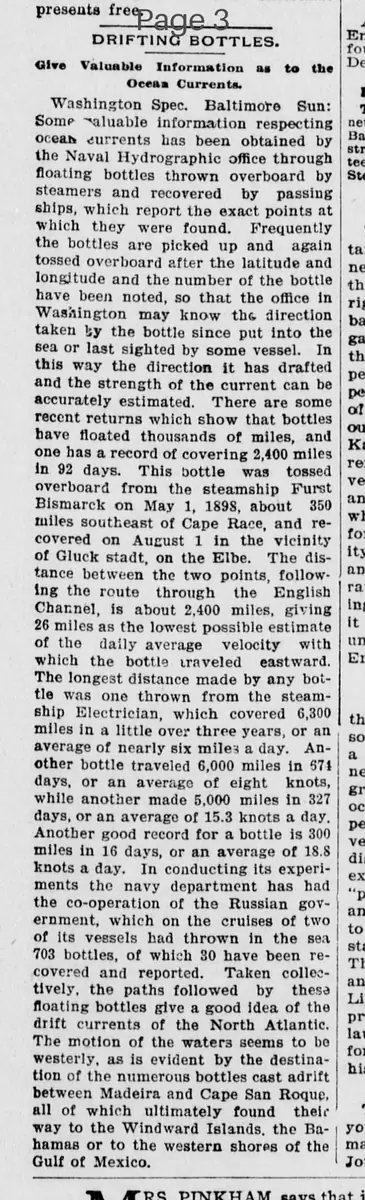
Some valuable information respecting ocean currents has been obtained by the Naval Hydrographic office through floating bottles thrown overboard by steamers and recovered by passing ships, which report the exact points at which they were found. Frequently the bottles are picked up and again tossed overboard after the latitude and longitude and the number of the bottle have been noted, so that the office in Washington may know the direction taken by the bottle since put into the sea or last sighted by some vessel. In this way the direction it has drifted and the strength of the current can be accurately estimated. There are some recent returns which show that bottles have floated thousands of miles, and one has a record of covering 2,400 miles in 92 days. This bottle was tossed overboard from the steamship Furst Bismarck on May 1, 1898, about 350 miles southeast of Cape Race, and recovered on August 1 in the vicinity of Gluckstadt on the Elbe. The distance between the two points, following the route through the English Channel, is about 2,400 miles, giving 26 miles as the lowest possible estimate of the daily average velocity with which the bottle traveled eastward. The longest distance made by any bottle was one thrown from the steamship Electrician, which covered 6,300 miles in a little over three years, or an average of nearly six miles a day. Another bottle traveled 6,000 miles in 574 days, or an average of eight knots, while another made 5,000 miles in 327 days, or an average of 15.3 knots a day. Another good record for a bottle is 300 miles in 16 days, or an average of 18.8 knots a day. In conducting its experiments the navy department has had the co-operation of the Russian government, which on the cruises of two of its vessels had thrown in the sea 703 bottles, of which 30 have been recovered and reported. Taken collectively, the paths followed by these floating bottles give a good idea of the drift currents of the North Atlantic. The motion of the waters seems to be westerly, as is evident by the destination of the numerous bottles cast adrift between Madeira and Cape San Roque, all of which ultimately found their way to the Windward Islands, the Bahamas or to the western shores of the Gulf of Mexico.
Give Valuable Information as to the Ocean Currents.
Washington Special to Baltimore Sun:
Some valuable information respecting ocean currents has been obtained by the Naval Hydrographic office through floating bottles thrown overboard by steamers and recovered by passing ships, which report the exact points at which they were found. Frequently the bottles are picked up and again tossed overboard after the latitude and longitude and the number of the bottle have been noted, so that the office in Washington may know the direction taken by the bottle since put into the sea or last sighted by some vessel. In this way the direction it has drifted and the strength of the current can be accurately estimated. There are some recent returns which show that bottles have floated thousands of miles, and one has a record of covering 2,400 miles in 92 days. This bottle was tossed overboard from the steamship Furst Bismarck on May 1, 1898, about 350 miles southeast of Cape Race, and recovered on August 1 in the vicinity of Gluckstadt on the Elbe. The distance between the two points, following the route through the English Channel, is about 2,400 miles, giving 26 miles as the lowest possible estimate of the daily average velocity with which the bottle traveled eastward. The longest distance made by any bottle was one thrown from the steamship Electrician, which covered 6,300 miles in a little over three years, or an average of nearly six miles a day. Another bottle traveled 6,000 miles in 574 days, or an average of eight knots, while another made 5,000 miles in 327 days, or an average of 15.3 knots a day. Another good record for a bottle is 300 miles in 16 days, or an average of 18.8 knots a day. In conducting its experiments the navy department has had the co-operation of the Russian government, which on the cruises of two of its vessels had thrown in the sea 703 bottles, of which 30 have been recovered and reported. Taken collectively, the paths followed by these floating bottles give a good idea of the drift currents of the North Atlantic. The motion of the waters seems to be westerly, as is evident by the destination of the numerous bottles cast adrift between Madeira and Cape San Roque, all of which ultimately found their way to the Windward Islands, the Bahamas or to the western shores of the Gulf of Mexico.
What sub-type of article is it?
Curiosity
Historical Event
Journey
What themes does it cover?
Exploration
Nature
Triumph
What keywords are associated?
Drifting Bottles
Ocean Currents
Naval Hydrographic Office
North Atlantic Drift
Scientific Tracking
Where did it happen?
North Atlantic
Story Details
Location
North Atlantic
Event Date
1898
Story Details
Naval Hydrographic Office tracks ocean currents via drifting bottles thrown from ships like Furst Bismarck and Electrician, recovering them to map paths and speeds, with Russian aid; bottles drift thousands of miles westward.