Thank you for visiting SNEWPapers!
Sign up free
Phenix Gazette
Alexandria, Virginia
What is this article about?
In Paris, pork butcher Bellan was tried for attempting to murder his wife by throwing her into the Canal St. Martin on June 28 and later murdering her at a Belleville quarry on August 9. Evidence included forged suicide letters, a bloody shirt with human blood, and witness testimonies. The jury found him guilty, sentencing him to death.
Clipping
OCR Quality
Full Text
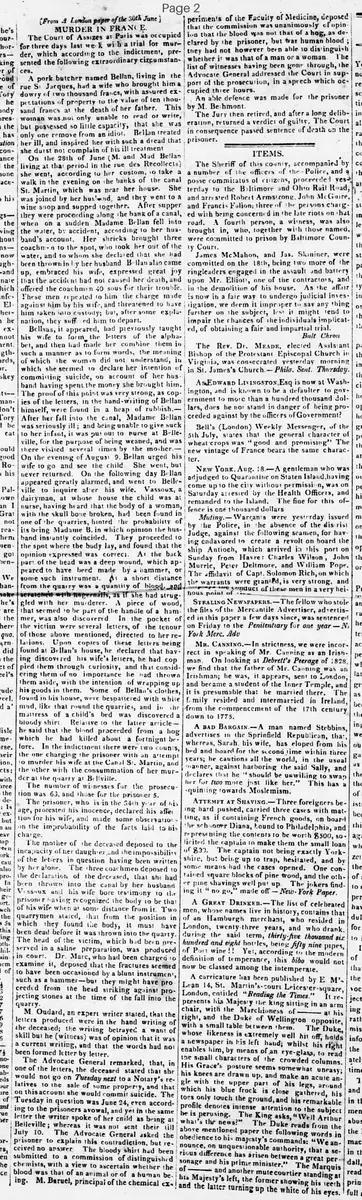
A pork butcher named Bellan, living in the rue St Jacques, had a wife who brought him a dowry of two thousand francs, with assured expectations of property to the value of ten thousand francs at the death of her father. This woman was not only unable to read or write, but possessed so little capacity, that she was only one remove from an idiot. Bellan treated her ill, and inspired her with such a dread that she durst not complain of his ill treatment On the 28th of June (M. and Mad. Bellan living at that period in the rue des Recollects) she went, according to her custom, to take a walk in the evening on the banks of the canal St. Martin, which was near her house. She was joined by her husband, and they went to a wine shop and supped together. After supper they were proceeding along the bank of a canal. when on a sudden Madame Bellan fell into the water, by accident, according to her husband's account. Her shrieks brought three coachmen to the spot, who took her out of the water, and to whom she declared that she had been thrown in by her husband Bellan also came up, embraced his wife, expressed great joy that the accident had not caused her death, and offered the coachmen 40 sous for their trouble. These men repeated to him the charge made against him by his wife, and threatened to have him taken into custody; but, after some explanation, they suffered him to depart. Bellan, it appeared, had previously taught his wife to form the letters of the alphabet, and then had made her combine them in such a manner as to form words, the meaning of which the woman did not understand, in which she seemed to declare her intention of committing suicide, on account of her husband having spent the money she brought him. The proof of this point was very strong, as copies of the letters, in the hand-writing of Bellan himself, were found in a heap of rubbish.--After her fall into the canal, Madame Bellan was seriously ill; and being unable to give suck to her infant, it was put out to nurse at Belleville, for the purpose of being weaned, and was there visited several times by the mother.--On the evening of August 9. Bellan urged his wife to go and see the child She went, but never returned. On the following day Bellan appeared greatly alarmed, and went to Belleville to inquire after his wife. Vassoux, a dairyman, at whose house the child was at nurse, having heard that the body of a woman, with the skull bone broken, had been found in one of the quarries, hinted the probability of its being Madame B. in which opinion the husband instantly coincided. They proceeded to the spot where the body lay, and found that the opinion expressed was correct. At the back part of the head was a deep wound, which appeared to have been made by a hammer, or some such instrument. At a short distance from the quarry was a quantity of blood... scratched with fingernails, as if she had struggled with her murderer. A piece of wood, that seemed to be part of the handle of a hammer, was also discovered In the pocket of the victim were several letters, of the tenor of those above mentioned, directed to her relations. Upon copies of these letters being found at Bellan's house, he declared that having discovered his wife's letters, he had copied them through curiosity, and that considering them of no importance he had thrown them aside, with the intention of wrapping up his goods in them. Some of Bellan's clothes, found in his house, were bespattered with white mud, like that round the quarries, and in the mattress of a child's bed was discovered a bloody shirt Relative to the latter article--he said that the blood proceeded from a hog which he had killed about a fortnight before. In the indictment there were two counts, the one charging the prisoner with an attempt to murder his wife at the Canal St. Martin, and the other with the consummation of her murder at the quarry at Belleville. The number of witnesses for the prosecution was 63, and those for the prisoner 5. The prisoner, who is in the 54th year of his age, protested his innocence, declared his affection for his wife, and made some observations on the improbability of the facts laid to his charge. The mother of the deceased deposed to the incapacity of her daughter, and the impossibility of the letters in question having been written by her alone. The three coachmen deposed to the declaration of the deceased, that she had been thrown into the canal by her husband Vassoux and his wife bore testimony to the prisoner having recognized the body to be that of his wife when at some distance from it. Two quarrymen stated, that from the position in which they found the body, it must have been dead before it was thrown into the quarry. The head of the victim, which had been preserved in a saline preparation, was produced in court. Dr. Marc, who had been charged to examine it, deposed that the fractures seemed to have been occasioned by a blunt instrument, such as a hammer--but they might have proceeded from the head striking against projecting stones at the time of the fall into the quarry. M. Oudard, an expert writer stated, that the letters produced were in the hand writing of the deceased; the writing betrayed a want of skill but he (witness) was of opinion that it was a current writing, and that the words had not been formed letter by letter. The Advocate General remarked, that, in one of the letters, the deceased stated that she would not go on Tuesday next to a Notary's relatives to the sale of some property, and that on this account she would commit suicide. The Tuesday in question was June 24, even according to the prisoner's avowal, and yet in the same letter the writer spoke of her child as being at Belleville; whereas it was not sent there till July 10. The Advocate General asked the prisoner to explain this contradiction, but received no answer The bloody shirt had been submitted to a commission of distinguished chemists, with a view to ascertain whether the blood was that of an animal or of a human being.
M. Baruel, principal of the chemical experiments of the Faculty of Medicine, deposed that the commission was unanimously of opinion that the blood was not that of a hog, as declared by the prisoner, but was human blood ; they had not however been able to distinguish whether it was that of a man or a woman The list of witnesses having been gone through, the Advocate General addressed the Court in support of the prosecution, in a speech which occupied three hours. . An able defence was made for the prisoner by M. Belmont. The Jury then retired, and after a long deliberation, returned a verdict of guilty. The Court in consequence passed sentence of death on the prisoner.
What sub-type of article is it?
What keywords are associated?
What entities or persons were involved?
Where did it happen?
Foreign News Details
Primary Location
Paris
Event Date
Trial Last Week; Prior Events June 28 And August 9
Key Persons
Outcome
madame bellan murdered; bellan found guilty and sentenced to death
Event Details
The Court of Assizes at Paris tried pork butcher Bellan for murdering his illiterate wife. On June 28, she accused him of throwing her into the Canal St. Martin. On August 9, she visited their child in Belleville and was found dead in a quarry with a head wound from a hammer-like instrument. Evidence included forged suicide letters in her handwriting copied by Bellan, a bloody shirt with human blood, clothes with quarry mud, and witness accounts. 63 prosecution witnesses vs. 5 for defense. Jury returned guilty verdict after deliberation.