Thank you for visiting SNEWPapers!
Sign up free
The Virginia Gazette
Richmond, Williamsburg, Richmond County, Virginia
What is this article about?
An officer's letter from camp dated Dec. 10 describes British army movements from Dec. 5-8, 1777, advancing through Germantown, skirmishing with American forces near Chestnut Hill, and retreating after minor engagements, with Morgan's riflemen inflicting losses.
Clipping
OCR Quality
Full Text
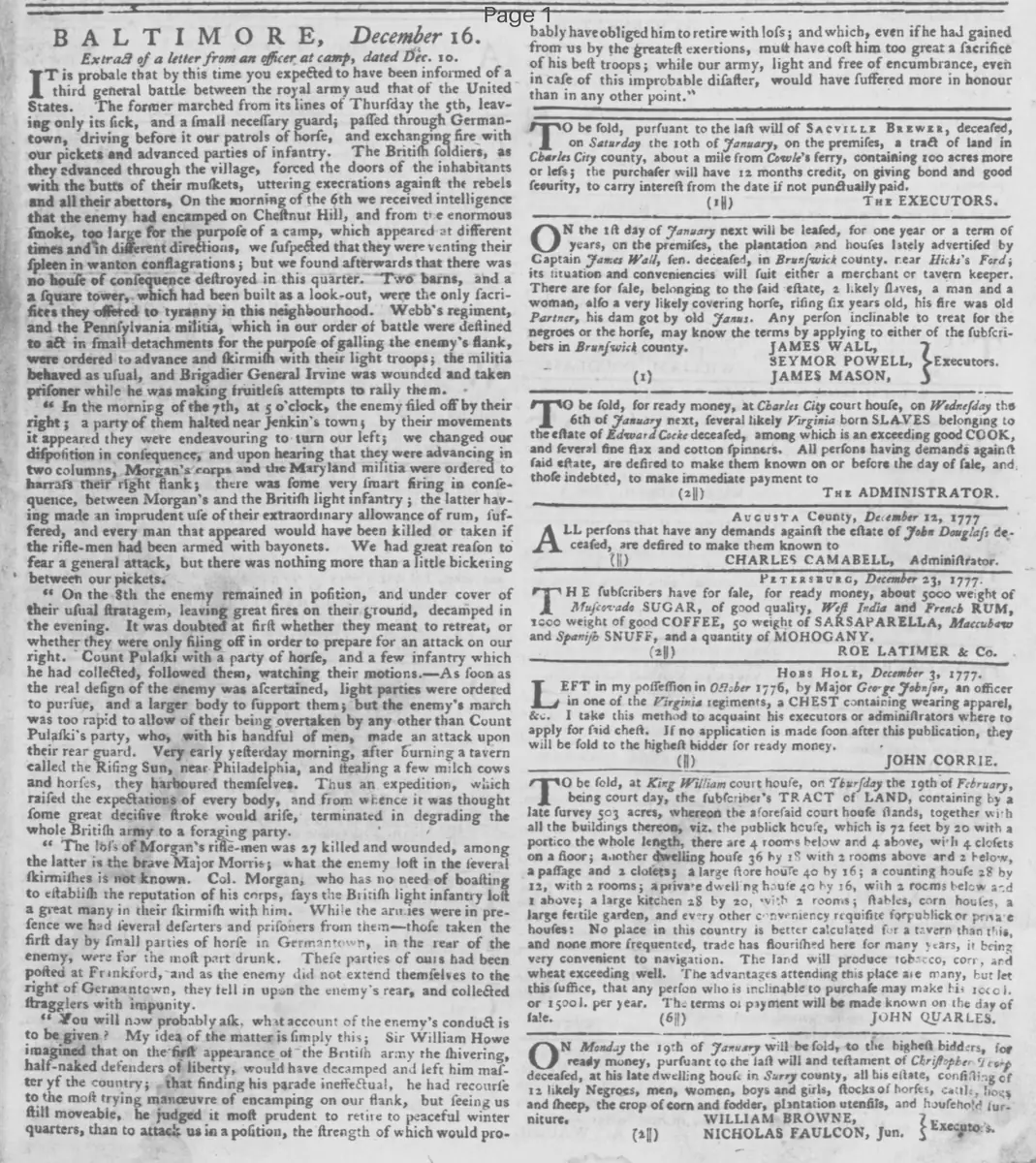
Extract of a letter from an officer at camp, dated Dec. 10.
It is probable that by this time you expected to have been informed of a third general battle between the royal army and that of the United States. The former marched from its lines on Thursday the 5th, leaving only its sick, and a small necessary guard; passed through Germantown, driving before it our patrols of horse, and exchanging fire with our pickets and advanced parties of infantry. The British soldiers, as they advanced through the village, forced the doors of the inhabitants with the butts of their muskets, uttering execrations against the rebels and all their abettors. On the morning of the 6th we received intelligence that the enemy had encamped on Chestnut Hill, and from the enormous smoke, too large for the purpose of a camp, which appeared at different times and in different directions, we suspected that they were venting their spleen in wanton conflagrations; but we found afterwards that there was no house of consequence destroyed in this quarter. Two barns, and a square tower, which had been built as a look-out, were the only sacrifices they offered to tyranny in this neighbourhood. Webb's regiment, and the Pennsylvania militia, which in our order of battle were destined to act in small detachments for the purpose of galling the enemy's flank, were ordered to advance and skirmish with their light troops; the militia behaved as usual, and Brigadier General Irvine was wounded and taken prisoner while he was making fruitless attempts to rally them.
In the morning of the 7th, at 5 o'clock, the enemy filed off by their right; a party of them halted near Jenkin's town; by their movements it appeared they were endeavouring to turn our left; we changed our disposition in consequence, and upon hearing that they were advancing in two columns, Morgan's corps and the Maryland militia were ordered to harass their right flank; there was some very smart firing in consequence, between Morgan's and the British light infantry; the latter having made an imprudent use of their extraordinary allowance of rum, suffered, and every man that appeared would have been killed or taken if the rifle-men had been armed with bayonets. We had great reason to fear a general attack, but there was nothing more than a little bickering between our pickets.
On the 8th the enemy remained in position, and under cover of their usual stratagem, leaving great fires on their ground, decamped in the evening. It was doubted at first whether they meant to retreat, or whether they were only filing off in order to prepare for an attack on our right. Count Pulaski with a party of horse, and a few infantry which he had collected, followed them, watching their motions. As soon as the real design of the enemy was ascertained, light parties were ordered to pursue, and a larger body to support them; but the enemy's march was too rapid to allow of their being overtaken by any other than Count Pulaski's party, who, with his handful of men, made an attack upon their rear guard. Very early yesterday morning, after burning a tavern called the Rising Sun, near Philadelphia, and stealing a few milch cows and horses, they harboured themselves. Thus an expedition, which raised the expectations of every body, and from whence it was thought some great decisive stroke would arise, terminated in degrading the whole British army to a foraging party.
The loss of Morgan's rifle-men was 27 killed and wounded, among the latter is the brave Major Morris; what the enemy lost in the several skirmishes is not known. Col. Morgan, who has no need of boasting to establish the reputation of his corps, says the British light infantry lost a great many in their skirmish with him. While the armies were in presence we had several deserters and prisoners from them—those taken the first day by small parties of horse in Germantown, in the rear of the enemy, were for the most part drunk. These parties of ours had been posted at Frankford, and as the enemy did not extend themselves to the right of Germantown, they fell in upon the enemy's rear, and collected stragglers with impunity.
You will now probably ask, what account of the enemy's conduct is to be given? My idea of the matter is simply this; Sir William Howe imagined that on the first appearance of the British army the shivering, half-naked defenders of liberty, would have decamped and left him master of the country; that finding his parade ineffectual, he had recourse to the most trying manoeuvre of encamping on our flank, but seeing us still movable, he judged it most prudent to retire to peaceful winter quarters, than to attack us in a position, the strength of which would probably have obliged him to retire with loss; and which, even if he had gained from us by the greatest exertions, must have cost him too great a sacrifice of his best troops; while our army, light and free of encumbrance, even in case of this improbable disaster, would have suffered more in honour than in any other point.
What sub-type of article is it?
What keywords are associated?
What entities or persons were involved?
Where did it happen?
Domestic News Details
Primary Location
Germantown And Chestnut Hill, Near Philadelphia
Event Date
December 5 8, 1777
Key Persons
Outcome
morgan's rifle-men lost 27 killed and wounded, including major morris wounded; brigadier general irvine wounded and taken prisoner; british light infantry suffered significant losses in skirmishes; enemy burned two barns, a lookout tower, and the rising sun tavern; expedition ended as a foraging party with no decisive battle.
Event Details
British army under Sir William Howe marched from lines on Dec. 5 through Germantown, skirmishing with American patrols; encamped on Chestnut Hill on Dec. 6 with minor destruction; on Dec. 7, advanced and skirmished with Morgan's corps and Maryland militia; decamped on Dec. 8, pursued by Count Pulaski's party who attacked rear guard; retreated after burning tavern and stealing livestock near Philadelphia.