Thank you for visiting SNEWPapers!
Sign up free
Gazette Of The United States & Evening Advertiser
Philadelphia, Philadelphia County, Pennsylvania
What is this article about?
On February 25, 1794, the U.S. House of Representatives passed a bill for government appropriations in 1794 and corrected a reference in the President's message. In committee, Mr. Dayton proposed amendments to a resolution funding a naval armament against Algerine corsairs by reducing duties on necessaries and increasing them on luxuries and domestic-producible goods, which were adopted after discussion.
Clipping
OCR Quality
Full Text
House of Representatives.
Tuesday February 25.
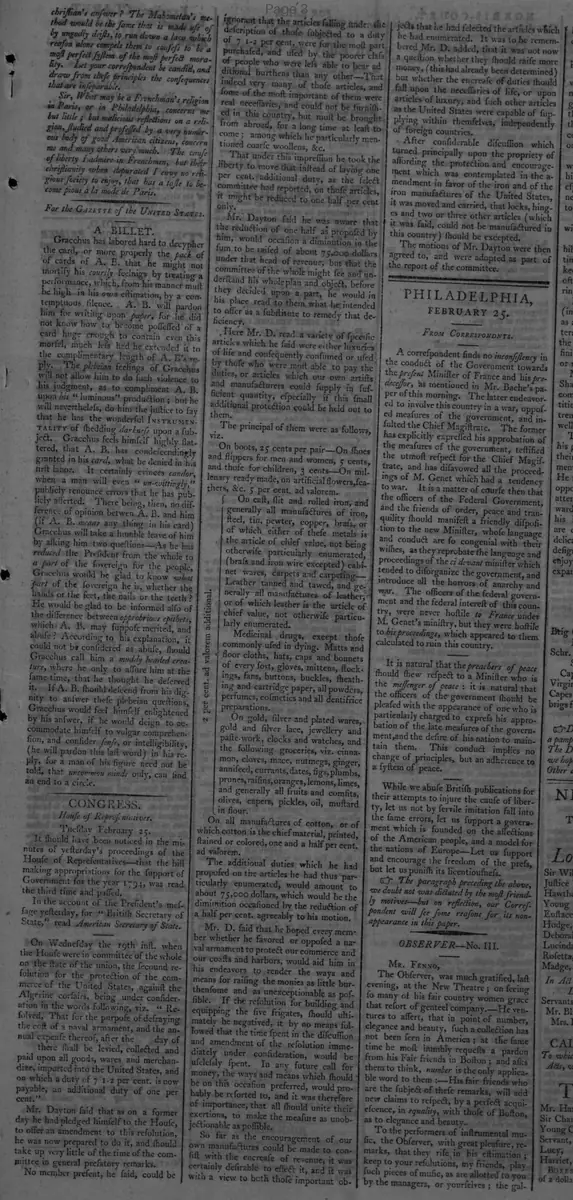
It should have been noticed in the minutes of yesterday's proceedings of the House of Representatives—that the bill making appropriations for the support of Government for the year 1794, was read the third time and passed.
In the account of the President's message yesterday, for "British Secretary of State," read American Secretary of State.
On Wednesday the 19th inst. when the House were in committee of the whole on the state of the union, the second resolution for the protection of the commerce of the United States, against the Algerine corsairs, being under consideration in the words following, viz. "Resolved, That for the purpose of defraying the cost of a naval armament, and the annual expense thereof, after the day of there shall be levied, collected and paid upon all goods, wares and merchandise, imported into the United States, and on which a duty of 7 1-2 per cent. is now payable, an additional duty of one per cent. 2 per cent. ad valorem additional.
Mr. Dayton said that as on a former day he had pledged himself to the House, to offer an amendment to this resolution, he was now prepared to do it, and should take up very little of the time of the committee in general prefatory remarks. No member present, he said, could be ignorant that the articles falling under the description of those subjected to a duty of 7 1-2 per cent. were for the most part purchased, and used by the poorer class of people who were less able to bear additional burdens than any other—That indeed very many of those articles, and some of the most important of them were real necessaries, and could not be furnished in this country, but must be brought from abroad, for a long time at least to come; among which he particularly mentioned coarse woollens, &c.
That under this impression he took the liberty to move that instead of laying one per cent. additional duty, as the select committee had reported, on those articles, it might be reduced to one half per cent. only.
Mr. Dayton said he was aware that the reduction of one half as proposed by him, would occasion a diminution in the sum to be raised of about 75,000 dollars under that head of revenue. but that the committee of the whole might see and understand his whole plan and object, before they decided upon a part, he would in his place read to them what he intended to offer as a substitute to remedy that deficiency.
Here Mr. D. read a variety of specific articles which he said were either luxuries of life and consequently consumed or used by those who were most able to pay the duties, or articles which our own artists and manufacturers could supply in sufficient quantity, especially if this small additional protection could be held out to them.
The principal of them were as follows, viz.
On boots, 25 cents per pair—On shoes and slippers for men and women, 5 cents, and those for children, 3 cents—On millenary ready made, on artificial flowers, feathers, &c. 5 per cent. ad valorem.
On cast, slit and rolled iron, and generally all manufactures of iron, steel, tin, pewter, copper, brass, or of which either of these metals is the article of chief value, not being otherwise particularly enumerated, (brass and iron wire excepted) cabinet wares, carpets and carpeting— Leather tanned and tawed, and generally all manufactures of leather, or of which leather is the article of chief value, not otherwise particularly enumerated.
Medicinal drugs, except those commonly used in dying. Mats and floor cloths, hats, caps and bonnets of every sort, gloves, mittens, stockings, fans, buttons, buckles, sheathing and cartridge paper, all powders, perfumes, cosmetics and all dentifrice preparations.
On gold, silver and plated wares, gold and silver lace, jewellery and paste-work, clocks and watches, and the following groceries, viz. cinnamon, cloves, mace, nutmegs, ginger, aniseed, currants, dates, figs, plumbs, prunes, raisins, oranges, lemons, limes, and generally all fruits and comfits, olives, capers, pickles, oil, mustard in flour.
On all manufactures of cotton, or of which cotton is the chief material, printed, stained or colored, one and a half per cent. ad valorem.
The additional duties which he had proposed on the articles he had thus particularly enumerated, would amount to about 75,000 dollars, which would be the diminution occasioned by the reduction of a half per cent. agreeably to his motion.
Mr. D. said that he hoped every member whether he favored or opposed a naval armament to protect our commerce and our coasts and harbors, would aid him in his endeavors to render the ways and means for raising the monies as little burdensome and as unexceptionable as possible. If the resolution for building and equipping the five frigates, should ultimately be negatived, it by no means followed that the time spent in the discussion and amendment of the resolution immediately under consideration, would be uselessly spent. In any future call for money, the ways and means which should be on this occasion preferred, would probably be resorted to, and it was therefore of importance, that all should unite their exertions, to make the measure as unobjectionable as possible.
So far as the encouragement of our own manufactures could be made to consist with the increase of revenue, it was certainly desirable to effect it, and it was with a view to both those important objects that he had selected the articles which he had enumerated. It was to be remembered Mr. D. added, that it was not now a question whether they should raise more money, (this had already been determined) but whether the increase of duties should fall upon the necessaries of life, or upon articles of luxury, and such other articles as the United States were capable of supplying, within themselves, independently of foreign countries.
After considerable discussion which turned principally upon the propriety of affording the protection and encouragement which was contemplated in the amendment in favor of the iron and of the iron manufactures of the United States, it was moved and carried, that locks, hinges and two or three other articles (which it was said, could not be manufactured in this country) should be excepted.
The motions of Mr. Dayton were then agreed to, and were adopted as part of the report of the committee. 4, 1.
What sub-type of article is it?
What keywords are associated?
What entities or persons were involved?
Domestic News Details
Event Date
Tuesday February 25, 1794
Key Persons
Outcome
motions of mr. dayton agreed to and adopted as part of the committee report; bill for 1794 appropriations passed; correction to president's message.
Event Details
House proceedings included passing the 1794 government appropriations bill and correcting 'British Secretary of State' to 'American Secretary of State' in the President's message. Debate on resolution for naval armament against Algerine corsairs: Mr. Dayton proposed reducing additional duty on 7.5% items to 0.5% (affecting poorer classes' necessaries like coarse woollens) and adding duties on luxuries and domestic-producible items (e.g., boots 25 cents/pair, iron manufactures, gold/silver wares, spices, cotton goods) to offset ~75,000 dollar loss. Discussion focused on protecting U.S. iron manufactures; exceptions made for locks, hinges, etc. not producible domestically.