Thank you for visiting SNEWPapers!
Sign up free
Story
June 21, 1881
National Republican (Washington City
Washington, District Of Columbia
What is this article about?
New York Tribune editorials from October 1877 denounce State Senator William D. Woodin for alleged corruption with Boss Tweed, highlighting his tainted reputation and eventual withdrawal from the 25th district race, saving the Republican seat.
Clipping
OCR Quality
95%
Excellent
Full Text
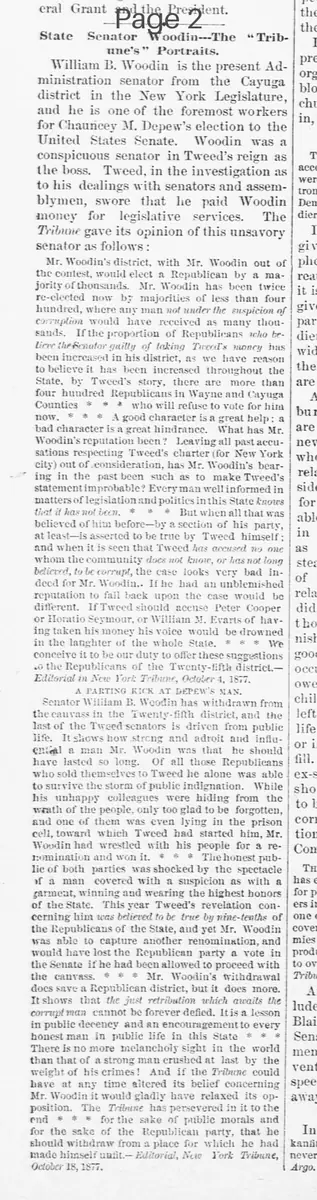
State Senator Woodin - The "Tribune's" Portraits.
William D. Woodin is the present Administration senator from the Cayuga district in the New York Legislature, and he is one of the foremost workers for Chauncey M. Depew's election to the United States Senate.
Woodin was a conspicuous senator in Tweed's reign as the boss. Tweed, in the investigation as to his dealings with senators and assemblymen, swore that he paid Woodin money for legislative services.
The Tribune gave its opinion of this unsavory senator as follows:
Mr. Woodin's district, with Mr. Woodin out of the contest, would elect a Republican by a majority of thousands. Mr. Woodin has been twice re-elected now by majorities of less than four hundred, where any man not under the suspicion of corruption would have received as many thousands. If the proportion of Republicans who believe the Senator guilty of taking Tweed's money has been increased in his district, as we have reason to believe it has been increased throughout the State, by Tweed's story, there are more than four hundred Republicans in Wayne and Cayuga Counties who will refuse to vote for him now.
A good character is a great help: a bad character is a great hindrance. What has Mr. Woodin's reputation been? Leaving all past accusations respecting Tweed's charter (for New York city) out of consideration, has Mr. Woodin's bearing in the past been such as to make Tweed's statement improbable? Every man well informed in matters of legislation and politics in this State knows that it has not been.
But when all that was believed of him before - by a section of his party, at least - is asserted to be true by Tweed himself; and when it is seen that Tweed has accused no one whom the community does not know, or has not long believed, to be corrupt, the case looks very bad indeed for Mr. Woodin. If he had an unblemished reputation to fall back upon the case would be different. If Tweed should accuse Peter Cooper or Horatio Seymour, or William M. Evarts of having taken his money his voice would be drowned in the laughter of the whole State.
We conceive it to be our duty to offer these suggestions to the Republicans of the Twenty-fifth district. - Editorial in New York Tribune, October 4, 1877.
A PARTING KICK AT DEPEW'S MAN.
Senator William B. Woodin has withdrawn from the canvass in the Twenty-fifth district, and the last of the Tweed senators is driven from public life. It shows how strong and adroit and influential a man Mr. Woodin was that he should have lasted so long. Of all those Republicans who sold themselves to Tweed he alone was able to survive the storm of public indignation. While his unhappy colleagues were hiding from the wrath of the people, only too glad to be forgotten, and one of them was even lying in the prison cell, toward which Tweed had started him, Mr. Woodin had wrestled with his people for a renomination and won it.
The honest public of both parties was shocked by the spectacle of a man covered with a suspicion as with a garment, winning and wearing the highest honors of the State. This year Tweed's revelation concerning him was believed to be true by nine-tenths of the Republicans of the State, and yet Mr. Woodin was able to capture another renomination, and would have cost the Republican party a vote in the Senate if he had been allowed to proceed with the canvass.
Mr. Woodin's withdrawal does save a Republican district, but it does more. It shows that the just retribution which awaits the corrupt man cannot be forever defied. It is a lesson in public decency and an encouragement to every honest man in public life in this State.
There is no more melancholy sight in the world than that of a strong man crushed at last by the weight of his crimes! And if the Tribune could have at any time altered its belief concerning Mr. Woodin it would gladly have relaxed its opposition. The Tribune has persevered in it to the end and for the sake of public morals and for the sake of the Republican party, that he should withdraw from a place for which he had made himself unfit. - Editorial, New York Tribune, October 18, 1877.
William D. Woodin is the present Administration senator from the Cayuga district in the New York Legislature, and he is one of the foremost workers for Chauncey M. Depew's election to the United States Senate.
Woodin was a conspicuous senator in Tweed's reign as the boss. Tweed, in the investigation as to his dealings with senators and assemblymen, swore that he paid Woodin money for legislative services.
The Tribune gave its opinion of this unsavory senator as follows:
Mr. Woodin's district, with Mr. Woodin out of the contest, would elect a Republican by a majority of thousands. Mr. Woodin has been twice re-elected now by majorities of less than four hundred, where any man not under the suspicion of corruption would have received as many thousands. If the proportion of Republicans who believe the Senator guilty of taking Tweed's money has been increased in his district, as we have reason to believe it has been increased throughout the State, by Tweed's story, there are more than four hundred Republicans in Wayne and Cayuga Counties who will refuse to vote for him now.
A good character is a great help: a bad character is a great hindrance. What has Mr. Woodin's reputation been? Leaving all past accusations respecting Tweed's charter (for New York city) out of consideration, has Mr. Woodin's bearing in the past been such as to make Tweed's statement improbable? Every man well informed in matters of legislation and politics in this State knows that it has not been.
But when all that was believed of him before - by a section of his party, at least - is asserted to be true by Tweed himself; and when it is seen that Tweed has accused no one whom the community does not know, or has not long believed, to be corrupt, the case looks very bad indeed for Mr. Woodin. If he had an unblemished reputation to fall back upon the case would be different. If Tweed should accuse Peter Cooper or Horatio Seymour, or William M. Evarts of having taken his money his voice would be drowned in the laughter of the whole State.
We conceive it to be our duty to offer these suggestions to the Republicans of the Twenty-fifth district. - Editorial in New York Tribune, October 4, 1877.
A PARTING KICK AT DEPEW'S MAN.
Senator William B. Woodin has withdrawn from the canvass in the Twenty-fifth district, and the last of the Tweed senators is driven from public life. It shows how strong and adroit and influential a man Mr. Woodin was that he should have lasted so long. Of all those Republicans who sold themselves to Tweed he alone was able to survive the storm of public indignation. While his unhappy colleagues were hiding from the wrath of the people, only too glad to be forgotten, and one of them was even lying in the prison cell, toward which Tweed had started him, Mr. Woodin had wrestled with his people for a renomination and won it.
The honest public of both parties was shocked by the spectacle of a man covered with a suspicion as with a garment, winning and wearing the highest honors of the State. This year Tweed's revelation concerning him was believed to be true by nine-tenths of the Republicans of the State, and yet Mr. Woodin was able to capture another renomination, and would have cost the Republican party a vote in the Senate if he had been allowed to proceed with the canvass.
Mr. Woodin's withdrawal does save a Republican district, but it does more. It shows that the just retribution which awaits the corrupt man cannot be forever defied. It is a lesson in public decency and an encouragement to every honest man in public life in this State.
There is no more melancholy sight in the world than that of a strong man crushed at last by the weight of his crimes! And if the Tribune could have at any time altered its belief concerning Mr. Woodin it would gladly have relaxed its opposition. The Tribune has persevered in it to the end and for the sake of public morals and for the sake of the Republican party, that he should withdraw from a place for which he had made himself unfit. - Editorial, New York Tribune, October 18, 1877.
What sub-type of article is it?
Biography
Crime Story
Historical Event
What themes does it cover?
Crime Punishment
Justice
Moral Virtue
What keywords are associated?
Senator Woodin
Tweed Corruption
New York Politics
Republican Party
Legislative Bribery
Election Withdrawal
What entities or persons were involved?
William D. Woodin
Chauncey M. Depew
Tweed
Peter Cooper
Horatio Seymour
William M. Evarts
Where did it happen?
New York State, Cayuga District, Wayne And Cayuga Counties
Story Details
Key Persons
William D. Woodin
Chauncey M. Depew
Tweed
Peter Cooper
Horatio Seymour
William M. Evarts
Location
New York State, Cayuga District, Wayne And Cayuga Counties
Event Date
October 4, 1877 And October 18, 1877
Story Details
State Senator William D. Woodin, accused by Boss Tweed of receiving bribes for legislative services, faces criticism in New York Tribune editorials for his corruption suspicions, leading to his withdrawal from the 25th district race despite prior reelections.