Thank you for visiting SNEWPapers!
Sign up free
New Hampshire Statesman And State Journal
Concord, Merrimack County, New Hampshire
What is this article about?
Whig criticizes Loco-foco orator Mr. Norris's July 4 speech in Portsmouth for falsely portraying Whigs as opponents of liberty, schools, and equality, exposing contradictions on banks and railroads amid Van Buren-Harrison election rivalry.
Clipping
OCR Quality
Full Text
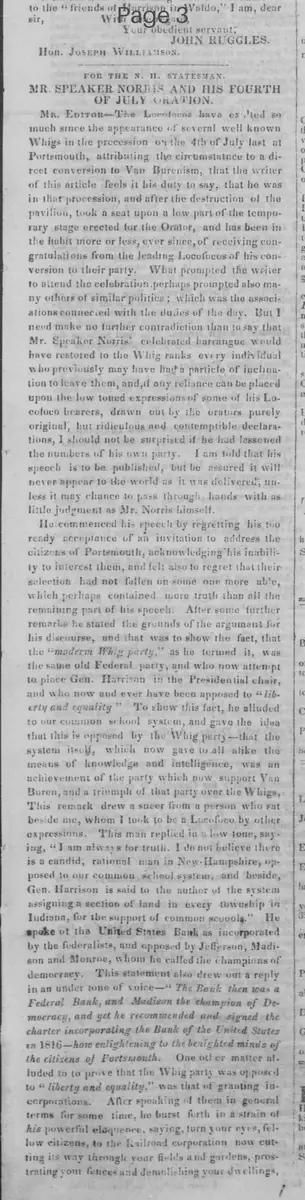
MR. SPEAKER NORRIS AND HIS FOURTH OF JULY ORATION.
Mr. Editor—The Loco-focos have exulted so much since the appearance of several well known Whigs in the procession on the 4th of July last at Portsmouth, attributing the circumstance to a direct conversion to Van Burenism, that the writer of this article feels it his duty to say, that he was in that procession, and after the destruction of the pavilion, took a seat upon a low part of the temporary stage erected for the Orator, and has been in the habit more or less, ever since, of receiving congratulations from the leading Locofocos of his conversion to their party. What prompted the writer to attend the celebration, perhaps prompted also many others of similar politics; which was the associations connected with the duties of the day. But I need make no further contradiction than to say that Mr. Speaker Norris' celebrated harangue would have restored to the Whig ranks every individual who previously may have had a particle of inclination to leave them, and, if any reliance can be placed upon the low toned expressions of some of his Loco-foco hearers, drawn out by the orator's purely original, but ridiculous and contemptible declarations, I should not be surprised if he had lessened the numbers of his own party. I am told that his speech is to be published, but be assured it will never appear to the world as it was delivered, unless it may chance to pass through hands with as little judgment as Mr. Norris himself.
He commenced his speech by regretting his too ready acceptance of an invitation to address the citizens of Portsmouth, acknowledging his inability to interest them, and felt also to regret that their selection had not fallen on some one more able, which perhaps contained more truth than all the remaining part of his speech. After some further remarks he stated the grounds of the argument for his discourse, and that was to show the fact, that the "modern Whig party," as he termed it, was the same old Federal party, and who now attempt to place Gen. Harrison in the Presidential chair, and who now and ever have been opposed to "liberty and equality." To show this fact, he alluded to our common school system, and gave the idea that this is opposed by the Whig party—that the system itself, which now gave to all alike the means of knowledge and intelligence, was an achievement of the party which now support Van Buren, and a triumph of that party over the Whigs. This remark drew a sneer from a person who sat beside me, whom I took to be a Loco-foco by other expressions. This man replied in a low tone, saying, "I am always for truth. I do not believe there is a candid, rational man in New-Hampshire, opposed to our common school system, and beside, Gen. Harrison is said to be the author of the system assigning a section of land in every township in Indiana, for the support of common schools." He spoke of the United States Bank as incorporated by the federalists, and opposed by Jefferson, Madison and Monroe, whom he called the champions of democracy. This statement also drew out a reply in an under tone of voice—“The Bank then was a Federal Bank, and Madison the champion of Democracy, and yet he recommended and signed the charter incorporating the Bank of the United States in 1816—how enlightening to the benighted minds of the citizens of Portsmouth. One other matter alluded to to prove that the Whig party was opposed to "liberty and equality," was that of granting incorporations. After speaking of them in general terms for some time, he burst forth in a strain of his powerful eloquence, saying, turn your eyes, fellow citizens, to the Railroad corporation now cutting its way through your fields and gardens, prostrating your fences and demolishing your dwellings, leasing your fields open to the beasts, and your wives and children without a covering but the canopy of heaven, and when you call on them for remuneration, they tell you that Government has left them without the currency that they have none to pay; but the day is arising and soon the enemies of "liberty and equality" would be put down. A conversation with one of the marshals of the day, a short time afterward, explained the many smiles and sneers this declaration drew from many of the audience, who knew that the act incorporating this very Railroad, took place when the Legislature stood nearly two Loco-focos to one Whig, and when Mr. Norris was a member; and not only this, but that the Loco-focos have had a large majority for the last ten years, and yet the Whigs are responsible for all that is done. The cheering of Mr. Norris, was, I believe, principally confined to two individuals, a bookseller Loco-foco, and the noisy and blustering demagogue who now holds a seat in the Legislature, and who has been promoted from a visionary seat in the Halls of Congress, to a clerk in a post office of third rate order. It is no less interesting than it is amusing to witness the effect of the ridiculous schemes of electioneering resorted to by the leaders and office-holders of the Loco-foco party at the present day.
A Republican.
What sub-type of article is it?
What themes does it cover?
What keywords are associated?
What entities or persons were involved?
Where did it happen?
Story Details
Key Persons
Location
Portsmouth, New Hampshire
Event Date
4th Of July Last
Story Details
A Whig attendee critiques Mr. Speaker Norris's Fourth of July oration in Portsmouth, which accused the modern Whig party of being the old Federal party opposed to liberty and equality, citing opposition to common schools, the U.S. Bank, and railroad incorporations. The writer highlights factual inaccuracies and hypocrisies in Norris's claims, noting audience skepticism and suggesting the speech may have alienated some Loco-focos.