Thank you for visiting SNEWPapers!
Sign up free
Story
September 14, 1911
Canton Weekly Register
Canton, Fulton County, Illinois
What is this article about?
Article discusses significant improvements in Fulton County roads over recent years, crediting rural free delivery mail service for prompting better maintenance through ditching, dragging, and drainage, benefiting farmers, merchants, and consumers despite funding challenges.
Clipping
OCR Quality
98%
Excellent
Full Text
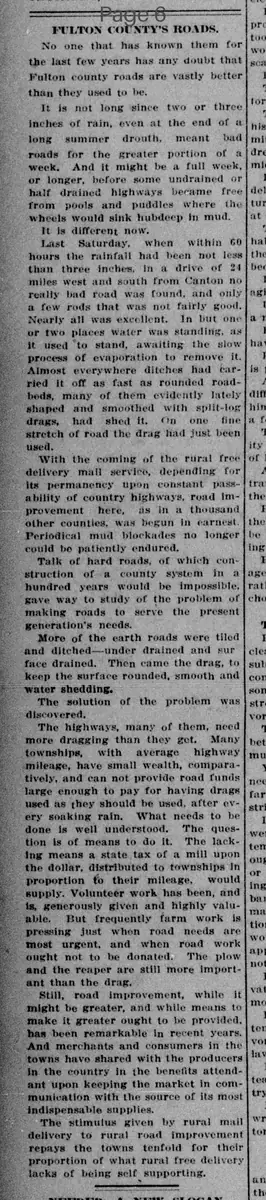
FULTON COUNTY'S ROADS.
No one that has known them for the last few years has any doubt that Fulton county roads are vastly better than they used to be.
It is not long since two or three inches of rain, even at the end of a long summer drouth, meant bad roads for the greater portion of a week. And it might be a full week, or longer, before some undrained or half drained highways became free from pools and puddles where the wheels would sink hubdeep in mud.
It is different now.
Last Saturday, when within 60 hours the rainfall had been not less than three inches. In a drive of 24 miles west and south from Canton no really bad road was found, and only a few rods that was not fairly good.
Nearly all was excellent. In but one or two places water was standing, as it used to stand, awaiting the slow process of evaporation to remove it.
Almost everywhere ditches had carried it off as fast as rounded roadbeds, many of them evidently lately shaped and smoothed with split-log drags, had shed it. On one fine stretch of road the drag had just been used.
With the coming of the rural free delivery mail service, depending for its permanency upon constant passability of country highways, road improvement here, as in a thousand other counties, was begun in earnest.
Periodical mud blockades no longer could be patiently endured.
Talk of hard roads, of which construction of a county system in a hundred years would be impossible, gave way to study of the problem of making roads to serve the present generation's needs.
More of the earth roads were tiled and ditched--under drained and surface drained. Then came the drag, to keep the surface rounded, smooth and water shedding.
The solution of the problem was discovered.
The highways, many of them, need more dragging than they get. Many townships, with average highway mileage, have small wealth, comparatively, and can not provide road funds large enough to pay for having drags used as they should be used, after every soaking rain. What needs to be done is well understood. The question is of means to do it. The lacking means a state tax of a mill upon the dollar, distributed to townships in proportion to their mileage, would supply. Volunteer work has been, and is, generously given and highly valuable. But frequently farm work is pressing just when road needs are most urgent, and when road work ought not to be donated. The plow and the reaper are still more important than the drag.
Still, road improvement, while it might be greater, and while means to make it greater ought to be provided, has been remarkable in recent years.
And merchants and consumers in the towns have shared with the producers in the country in the benefits attendant upon keeping the market in communication with the source of its most indispensable supplies.
The stimulus given by rural mail delivery to rural road improvement repays the towns tenfold for their proportion of what rural free delivery lacks of being self supporting.
No one that has known them for the last few years has any doubt that Fulton county roads are vastly better than they used to be.
It is not long since two or three inches of rain, even at the end of a long summer drouth, meant bad roads for the greater portion of a week. And it might be a full week, or longer, before some undrained or half drained highways became free from pools and puddles where the wheels would sink hubdeep in mud.
It is different now.
Last Saturday, when within 60 hours the rainfall had been not less than three inches. In a drive of 24 miles west and south from Canton no really bad road was found, and only a few rods that was not fairly good.
Nearly all was excellent. In but one or two places water was standing, as it used to stand, awaiting the slow process of evaporation to remove it.
Almost everywhere ditches had carried it off as fast as rounded roadbeds, many of them evidently lately shaped and smoothed with split-log drags, had shed it. On one fine stretch of road the drag had just been used.
With the coming of the rural free delivery mail service, depending for its permanency upon constant passability of country highways, road improvement here, as in a thousand other counties, was begun in earnest.
Periodical mud blockades no longer could be patiently endured.
Talk of hard roads, of which construction of a county system in a hundred years would be impossible, gave way to study of the problem of making roads to serve the present generation's needs.
More of the earth roads were tiled and ditched--under drained and surface drained. Then came the drag, to keep the surface rounded, smooth and water shedding.
The solution of the problem was discovered.
The highways, many of them, need more dragging than they get. Many townships, with average highway mileage, have small wealth, comparatively, and can not provide road funds large enough to pay for having drags used as they should be used, after every soaking rain. What needs to be done is well understood. The question is of means to do it. The lacking means a state tax of a mill upon the dollar, distributed to townships in proportion to their mileage, would supply. Volunteer work has been, and is, generously given and highly valuable. But frequently farm work is pressing just when road needs are most urgent, and when road work ought not to be donated. The plow and the reaper are still more important than the drag.
Still, road improvement, while it might be greater, and while means to make it greater ought to be provided, has been remarkable in recent years.
And merchants and consumers in the towns have shared with the producers in the country in the benefits attendant upon keeping the market in communication with the source of its most indispensable supplies.
The stimulus given by rural mail delivery to rural road improvement repays the towns tenfold for their proportion of what rural free delivery lacks of being self supporting.
What sub-type of article is it?
Historical Event
What themes does it cover?
Triumph
What keywords are associated?
Road Improvement
Fulton County
Rural Free Delivery
Rainfall Effects
Drag Maintenance
State Tax Proposal
Where did it happen?
Fulton County, Canton
Story Details
Location
Fulton County, Canton
Event Date
Last Saturday
Story Details
Fulton County roads have improved dramatically in recent years due to rural free delivery mail service, which necessitated better maintenance through ditching, tiling, and using split-log drags to handle heavy rains, reducing mud blockades and benefiting rural and urban communities, though funding remains a challenge.