Thank you for visiting SNEWPapers!
Sign up free
Editorial
January 3, 1795
The Kentucky Gazette
Lexington, Fayette County, Kentucky
What is this article about?
An anonymous editorial accuses the state legislature of violating the constitution by passing a resolution censuring Court of Appeals judges for a land claims decision, arguing it breaches separation of powers and judicial independence. It quotes the constitution on press freedom to justify the critique and calls for public judgment.
Clipping
OCR Quality
95%
Excellent
Full Text
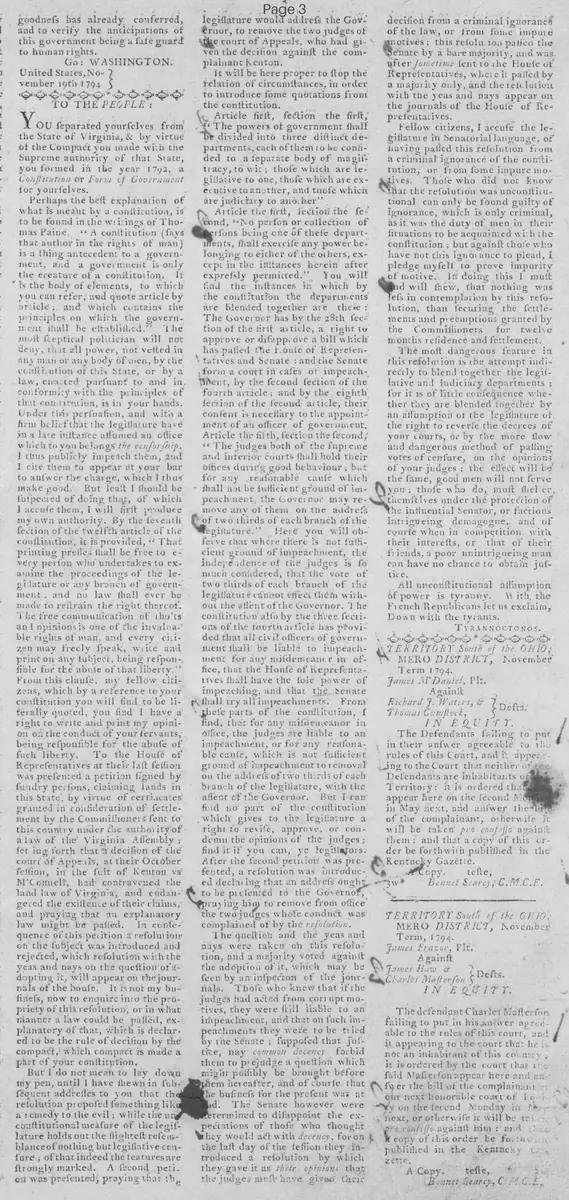
TO THE PEOPLE:
You separated yourselves from the State of Virginia, & by virtue of the Compact you made with the Supreme authority of that State, you formed in the year 1772, a Constitution or Form of Government for yourselves.
Perhaps the best explanation of what is meant by a constitution, is to be found in the writings of Thomas Paine. "A constitution (says that author in the rights of man) is a thing antecedent to a government, and a government is only the creature of a constitution. It is the body of elements, to which you can refer, and quote article by article; and which contains the principles on which the government shall be established." The most sceptical politician will not deny, that all power, not vested in any man or any body of men, by the constitution of this State, or by a law, enacted pursuant to and in conformity with the principles of that constitution, is in your hands.
Under this persuasion, and with a firm belief that the legislature have in a late instance assumed an office which to you belongs the censorship. I thus publicly impeach them, and I cite them to appear at your bar to answer the charge, which I thus make good, But lest I should be suspected of doing that, of which I accuse them, I will first produce my own authority. By the seventh section of the twelfth article of the constitution, it is provided, "That printing presses shall be free to every person who undertakes to examine the proceedings of the legislature or any branch of government, and no law shall ever be made to restrain the right thereof. The free communication of thoughts and opinions is one of the invaluable rights of man, and every citizen may freely speak, write and print on any subject, being responsible for the abuse of that liberty."
From this clause, my fellow citizens, which by a reference to your constitution you will find to be literally quoted, you find I have a right to write and print my opinion on the conduct of your servants, being responsible for the abuse of such liberty. To the House of Representatives at their last session was presented a petition signed by sundry persons, claiming lands in this State, by virtue of certificates granted in consideration of settlement by the Commissioners sent to this country under the authority of a law of the Virginia Assembly; setting forth that a decision of the court of Appeals, at their October session, in the suit of Kenton vs M'Connel, had contravened the land law of Virginia, and endangered the existence of their claims, and praying that an explanatory law might be passed. In consequence of this petition a resolution of the subject was introduced and rejected, which resolution with the yeas and nays on the question of adopting it, will appear on the journals of the house. It is not my business, now to enquire into the propriety of this resolution, or in what manner a law could be passed, explanatory of that, which is declared to be the rule of decision by the compact, which compact is made a part of your constitution.
But I do not mean to lay down my pen, until I have shewn in subsequent addresses to you that the resolution proposed something like a remedy to the evil; while the unconstitutional measure of the legislature holds out the slightest resemblance of nothing but legislative censure; of that indeed the features are strongly marked. A second petition was presented, praying that the legislature would address the Governor, to remove the two judges of the court of Appeals, who had given the decision against the complainant Kenton.
It will be here proper to stop the relation of circumstances, in order to introduce some quotations from the constitution. Article first, section the first, The powers of government shall be divided into three distinct departments, each of them to be confided to a separate body of magistracy, to wit; those which are legislative to one, those which are executive to another, and those which are judiciary to another.
Article the first, section the second, "No person or collection of persons being one of these departments, shall exercise any power belonging to either of the others, except in the instances hereinafter expressly permitted." You will find the instances in which by the constitution the departments are blended together are these: The Governor has by the 28th section of the first article, a right to approve or disapprove a bill which has passed the House of Representatives and Senate: and the Senate, form a court in cases of impeachment, by the second section of the fourth article; and by the eighth section of the second article, their consent is necessary to the appointment of an officer of government.
Article the fifth, section the second, "The judges both of the supreme and inferior courts shall hold their offices during good behaviour; but for any reasonable cause which shall not be sufficient ground of impeachment, the Governor may remove any of them on the address of two thirds of each branch of the legislature." Here you will observe that where there is not sufficient ground of impeachment, the independence of the judges is so much considered, that the vote of two thirds of each branch of the legislature cannot effect them without the assent of the Governor. The constitution also by the three sections of the fourth article has provided that all civil officers of government shall be liable to impeachment for any misdemeanor in office, that the House of Representatives shall have the sole power of impeaching, and that the Senate shall try all impeachments. From these parts of the constitution, I find, that for any misdemeanor in office, the judges are liable to an impeachment, or for any reasonable cause, which is not sufficient ground of impeachment to removal on the address of two thirds of each branch of the legislature, with the assent of the Governor. But I can find no part of the constitution, which gives to the legislature a right to revise, approve, or condemn the opinions of the judges; find it if you can, ye legislators.
After the second petition was presented, a resolution was introduced declaring that an address ought to be presented to the Governor, praying him to remove from office the two judges whose conduct was complained of by the resolution. The question and the yeas and nays were taken on this resolution, and a majority voted against the adoption of it, which may be seen by an inspection of the journals. Those who knew that if the judges had acted from corrupt motives, they were still liable to an impeachment, and that on such impeachments they were to be tried by the Senate; supposed that justice, nay common decency forbid them to prejudge a question which might possibly be brought before them hereafter, and of course that the business for the present was at an end. The Senate however were determined to disappoint the expectations of those who thought they would act with decency, for on the last day of the session they introduced a resolution by which they gave it as their opinions that the judges must have given their decision from a criminal ignorance of the law, or from some impure motives; this resolution passed the Senate by a bare majority, and was after some time sent to the House of Representatives, where it passed by a majority only, and the resolution with the yeas and nays appear on the journals of the House of Representatives.
Fellow citizens, I accuse the legislature in Senatorial language, of having passed this resolution from a criminal ignorance of the constitution, or from some impure motives. Those who did not know that the resolution was unconstitutional can only be found guilty of ignorance, which is only criminal, as it was the duty of men in their situations to be acquainted with the constitution; but against those who have not this ignorance to plead, I pledge myself to prove impurity of motive. In doing this I must and will shew, that nothing was less in contemplation by this resolution, than securing the settlements and preemptions granted by the Commissioners for twelve months residence and settlement.
The most dangerous feature in this resolution is the attempt indirectly to blend together the legislative and judiciary departments; for it is of little consequence whether they are blended together by an assumption of the legislature of the right to reverse the decrees of your courts, or by the more slow and dangerous method of passing votes of censure, on the opinions of your judges; the effect will be the same, good men will not serve you; those who do, must shelter themselves under the protection of the influential Senator, or factious intriguing demagogue, and of course when in competition with their interests, or that of their friends, a poor unintriguing man can have no chance to obtain justice.
All unconstitutional assumption of power is tyranny. With the French Republicans let us exclaim, Down with the tyrants.
TYRANNOCIDOS.
You separated yourselves from the State of Virginia, & by virtue of the Compact you made with the Supreme authority of that State, you formed in the year 1772, a Constitution or Form of Government for yourselves.
Perhaps the best explanation of what is meant by a constitution, is to be found in the writings of Thomas Paine. "A constitution (says that author in the rights of man) is a thing antecedent to a government, and a government is only the creature of a constitution. It is the body of elements, to which you can refer, and quote article by article; and which contains the principles on which the government shall be established." The most sceptical politician will not deny, that all power, not vested in any man or any body of men, by the constitution of this State, or by a law, enacted pursuant to and in conformity with the principles of that constitution, is in your hands.
Under this persuasion, and with a firm belief that the legislature have in a late instance assumed an office which to you belongs the censorship. I thus publicly impeach them, and I cite them to appear at your bar to answer the charge, which I thus make good, But lest I should be suspected of doing that, of which I accuse them, I will first produce my own authority. By the seventh section of the twelfth article of the constitution, it is provided, "That printing presses shall be free to every person who undertakes to examine the proceedings of the legislature or any branch of government, and no law shall ever be made to restrain the right thereof. The free communication of thoughts and opinions is one of the invaluable rights of man, and every citizen may freely speak, write and print on any subject, being responsible for the abuse of that liberty."
From this clause, my fellow citizens, which by a reference to your constitution you will find to be literally quoted, you find I have a right to write and print my opinion on the conduct of your servants, being responsible for the abuse of such liberty. To the House of Representatives at their last session was presented a petition signed by sundry persons, claiming lands in this State, by virtue of certificates granted in consideration of settlement by the Commissioners sent to this country under the authority of a law of the Virginia Assembly; setting forth that a decision of the court of Appeals, at their October session, in the suit of Kenton vs M'Connel, had contravened the land law of Virginia, and endangered the existence of their claims, and praying that an explanatory law might be passed. In consequence of this petition a resolution of the subject was introduced and rejected, which resolution with the yeas and nays on the question of adopting it, will appear on the journals of the house. It is not my business, now to enquire into the propriety of this resolution, or in what manner a law could be passed, explanatory of that, which is declared to be the rule of decision by the compact, which compact is made a part of your constitution.
But I do not mean to lay down my pen, until I have shewn in subsequent addresses to you that the resolution proposed something like a remedy to the evil; while the unconstitutional measure of the legislature holds out the slightest resemblance of nothing but legislative censure; of that indeed the features are strongly marked. A second petition was presented, praying that the legislature would address the Governor, to remove the two judges of the court of Appeals, who had given the decision against the complainant Kenton.
It will be here proper to stop the relation of circumstances, in order to introduce some quotations from the constitution. Article first, section the first, The powers of government shall be divided into three distinct departments, each of them to be confided to a separate body of magistracy, to wit; those which are legislative to one, those which are executive to another, and those which are judiciary to another.
Article the first, section the second, "No person or collection of persons being one of these departments, shall exercise any power belonging to either of the others, except in the instances hereinafter expressly permitted." You will find the instances in which by the constitution the departments are blended together are these: The Governor has by the 28th section of the first article, a right to approve or disapprove a bill which has passed the House of Representatives and Senate: and the Senate, form a court in cases of impeachment, by the second section of the fourth article; and by the eighth section of the second article, their consent is necessary to the appointment of an officer of government.
Article the fifth, section the second, "The judges both of the supreme and inferior courts shall hold their offices during good behaviour; but for any reasonable cause which shall not be sufficient ground of impeachment, the Governor may remove any of them on the address of two thirds of each branch of the legislature." Here you will observe that where there is not sufficient ground of impeachment, the independence of the judges is so much considered, that the vote of two thirds of each branch of the legislature cannot effect them without the assent of the Governor. The constitution also by the three sections of the fourth article has provided that all civil officers of government shall be liable to impeachment for any misdemeanor in office, that the House of Representatives shall have the sole power of impeaching, and that the Senate shall try all impeachments. From these parts of the constitution, I find, that for any misdemeanor in office, the judges are liable to an impeachment, or for any reasonable cause, which is not sufficient ground of impeachment to removal on the address of two thirds of each branch of the legislature, with the assent of the Governor. But I can find no part of the constitution, which gives to the legislature a right to revise, approve, or condemn the opinions of the judges; find it if you can, ye legislators.
After the second petition was presented, a resolution was introduced declaring that an address ought to be presented to the Governor, praying him to remove from office the two judges whose conduct was complained of by the resolution. The question and the yeas and nays were taken on this resolution, and a majority voted against the adoption of it, which may be seen by an inspection of the journals. Those who knew that if the judges had acted from corrupt motives, they were still liable to an impeachment, and that on such impeachments they were to be tried by the Senate; supposed that justice, nay common decency forbid them to prejudge a question which might possibly be brought before them hereafter, and of course that the business for the present was at an end. The Senate however were determined to disappoint the expectations of those who thought they would act with decency, for on the last day of the session they introduced a resolution by which they gave it as their opinions that the judges must have given their decision from a criminal ignorance of the law, or from some impure motives; this resolution passed the Senate by a bare majority, and was after some time sent to the House of Representatives, where it passed by a majority only, and the resolution with the yeas and nays appear on the journals of the House of Representatives.
Fellow citizens, I accuse the legislature in Senatorial language, of having passed this resolution from a criminal ignorance of the constitution, or from some impure motives. Those who did not know that the resolution was unconstitutional can only be found guilty of ignorance, which is only criminal, as it was the duty of men in their situations to be acquainted with the constitution; but against those who have not this ignorance to plead, I pledge myself to prove impurity of motive. In doing this I must and will shew, that nothing was less in contemplation by this resolution, than securing the settlements and preemptions granted by the Commissioners for twelve months residence and settlement.
The most dangerous feature in this resolution is the attempt indirectly to blend together the legislative and judiciary departments; for it is of little consequence whether they are blended together by an assumption of the legislature of the right to reverse the decrees of your courts, or by the more slow and dangerous method of passing votes of censure, on the opinions of your judges; the effect will be the same, good men will not serve you; those who do, must shelter themselves under the protection of the influential Senator, or factious intriguing demagogue, and of course when in competition with their interests, or that of their friends, a poor unintriguing man can have no chance to obtain justice.
All unconstitutional assumption of power is tyranny. With the French Republicans let us exclaim, Down with the tyrants.
TYRANNOCIDOS.
What sub-type of article is it?
Constitutional
Legal Reform
Press Freedom
What keywords are associated?
Constitution
Separation Of Powers
Judicial Independence
Legislative Censure
Press Freedom
Land Claims
Court Of Appeals
What entities or persons were involved?
Legislature
House Of Representatives
Senate
Judges Of The Court Of Appeals
Governor
Thomas Paine
Kenton
M'connel
Editorial Details
Primary Topic
Legislative Censure Of Judicial Decisions
Stance / Tone
Accusatory Of Legislature, Defensive Of Constitutional Separation Of Powers
Key Figures
Legislature
House Of Representatives
Senate
Judges Of The Court Of Appeals
Governor
Thomas Paine
Kenton
M'connel
Key Arguments
All Power Not Vested By Constitution Is With The People
Constitution Guarantees Free Press To Examine Government Proceedings
Legislature Assumed Censorship Role Belonging To The People
Separation Of Powers Divides Legislative, Executive, And Judicial Departments
No Constitutional Provision Allows Legislature To Censure Judicial Opinions
Judges Removable Only By Impeachment Or Address With Governor's Assent
Resolution Passed From Criminal Ignorance Or Impure Motives
Censuring Judges Blends Legislative And Judicial Powers, Deterring Good Men From Service
Unconstitutional Assumption Of Power Is Tyranny