Thank you for visiting SNEWPapers!
Sign up free
Editorial
May 6, 1881
Springfield Weekly Republican
Springfield, Hampden County, Massachusetts
What is this article about?
Editorial critiques Western Massachusetts residents for blaming neighboring towns for rising crime, citing cases in Pelham, Shutesbury, and court scandals in Wilbraham and Springfield. Urges communal confession and Christian action over deflection. (214 characters)
Clipping
OCR Quality
95%
Excellent
Full Text
"WE AND OUR NEIGHBORS."
Who are the Greatest Criminals?
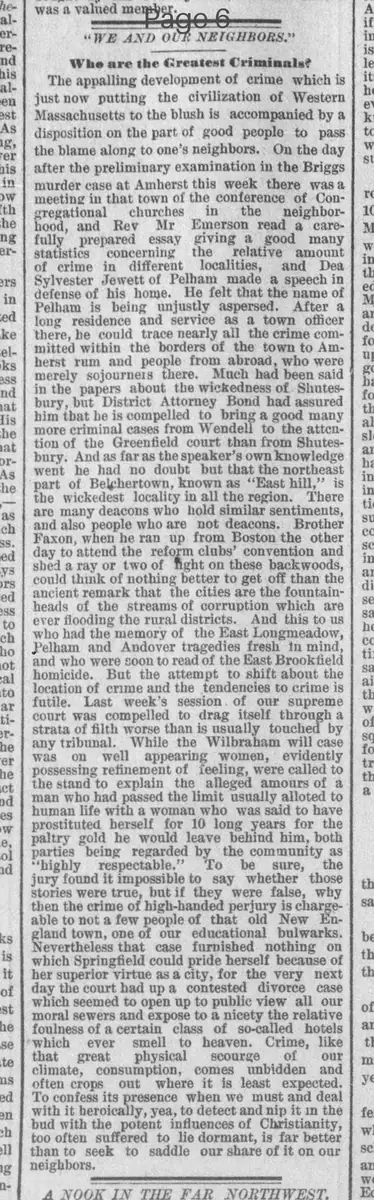
The appalling development of crime which is just now putting the civilization of Western Massachusetts to the blush is accompanied by a disposition on the part of good people to pass the blame along to one's neighbors. On the day after the preliminary examination in the Briggs murder case at Amherst this week there was a meeting in that town of the conference of Congregational churches in the neighborhood, and Rev Mr Emerson read a carefully prepared essay giving a good many statistics concerning the relative amount of crime in different localities, and Deacon Sylvester Jewett of Pelham made a speech in defense of his home. He felt that the name of Pelham is being unjustly aspersed. After a long residence and service as a town officer there, he could trace nearly all the crime committed within the borders of the town to Amherst rum and people from abroad, who were merely sojourners there. Much had been said in the papers about the wickedness of Shutesbury, but District Attorney Bond had assured him that he is compelled to bring a good many more criminal cases from Wendell to the attention of the Greenfield court than from Shutesbury. And as far as the speaker's own knowledge went he had no doubt but that the northeast part of Belchertown, known as "East hill," is the wickedest locality in all the region. There are many deacons who hold similar sentiments, and also people who are not deacons. Brother Faxon, when he ran up from Boston the other day to attend the reform clubs' convention and shed a ray or two of light on these backwoods, could think of nothing better to get off than the ancient remark that the cities are the fountainheads of the streams of corruption which are ever flooding the rural districts. And this to us who had the memory of the East Longmeadow, Pelham and Andover tragedies fresh in mind, and who were soon to read of the East Brookfield homicide. But the attempt to shift about the location of crime and the tendencies to crime is futile. Last week's session of our supreme court was compelled to drag itself through a strata of filth worse than is usually touched by any tribunal. While the Wilbraham will case was on well-appearing women, evidently possessing refinement of feeling, were called to the stand to explain the alleged amours of a man who had passed the limit usually allotted to human life with a woman who was said to have prostituted herself for 10 long years for the paltry gold he would leave behind him, both parties being regarded by the community as highly respectable. "To be sure, the jury found it impossible to say whether those stories were true, but if they were false, why then the crime of high-handed perjury is chargeable to not a few people of that old New England town, one of our educational bulwarks. Nevertheless that case furnished nothing on which Springfield could pride herself because of her superior virtue as a city, for the very next day the court had up a contested divorce case which seemed to open up to public view all our moral sewers and expose to a nicety the relative foulness of a certain class of so-called hotels which ever smell to heaven. Crime, like that great physical scourge of our climate, consumption, comes unbidden and often crops out where it is least expected. To confess its presence when we must and deal with it heroically, yea, to detect and nip it in the bud with the potent influences of Christianity, too often suffered to lie dormant, is far better than to seek to saddle our share of it on our neighbors.
Who are the Greatest Criminals?
The appalling development of crime which is just now putting the civilization of Western Massachusetts to the blush is accompanied by a disposition on the part of good people to pass the blame along to one's neighbors. On the day after the preliminary examination in the Briggs murder case at Amherst this week there was a meeting in that town of the conference of Congregational churches in the neighborhood, and Rev Mr Emerson read a carefully prepared essay giving a good many statistics concerning the relative amount of crime in different localities, and Deacon Sylvester Jewett of Pelham made a speech in defense of his home. He felt that the name of Pelham is being unjustly aspersed. After a long residence and service as a town officer there, he could trace nearly all the crime committed within the borders of the town to Amherst rum and people from abroad, who were merely sojourners there. Much had been said in the papers about the wickedness of Shutesbury, but District Attorney Bond had assured him that he is compelled to bring a good many more criminal cases from Wendell to the attention of the Greenfield court than from Shutesbury. And as far as the speaker's own knowledge went he had no doubt but that the northeast part of Belchertown, known as "East hill," is the wickedest locality in all the region. There are many deacons who hold similar sentiments, and also people who are not deacons. Brother Faxon, when he ran up from Boston the other day to attend the reform clubs' convention and shed a ray or two of light on these backwoods, could think of nothing better to get off than the ancient remark that the cities are the fountainheads of the streams of corruption which are ever flooding the rural districts. And this to us who had the memory of the East Longmeadow, Pelham and Andover tragedies fresh in mind, and who were soon to read of the East Brookfield homicide. But the attempt to shift about the location of crime and the tendencies to crime is futile. Last week's session of our supreme court was compelled to drag itself through a strata of filth worse than is usually touched by any tribunal. While the Wilbraham will case was on well-appearing women, evidently possessing refinement of feeling, were called to the stand to explain the alleged amours of a man who had passed the limit usually allotted to human life with a woman who was said to have prostituted herself for 10 long years for the paltry gold he would leave behind him, both parties being regarded by the community as highly respectable. "To be sure, the jury found it impossible to say whether those stories were true, but if they were false, why then the crime of high-handed perjury is chargeable to not a few people of that old New England town, one of our educational bulwarks. Nevertheless that case furnished nothing on which Springfield could pride herself because of her superior virtue as a city, for the very next day the court had up a contested divorce case which seemed to open up to public view all our moral sewers and expose to a nicety the relative foulness of a certain class of so-called hotels which ever smell to heaven. Crime, like that great physical scourge of our climate, consumption, comes unbidden and often crops out where it is least expected. To confess its presence when we must and deal with it heroically, yea, to detect and nip it in the bud with the potent influences of Christianity, too often suffered to lie dormant, is far better than to seek to saddle our share of it on our neighbors.
What sub-type of article is it?
Crime Or Punishment
Moral Or Religious
Social Reform
What keywords are associated?
Crime In Massachusetts
Blaming Neighbors
Rural Corruption
Moral Responsibility
Christian Intervention
Local Scandals
Perjury In Court
Divorce Cases
What entities or persons were involved?
Rev Mr Emerson
Deacon Sylvester Jewett
District Attorney Bond
Brother Faxon
Pelham
Shutesbury
Wendell
Belchertown
East Hill
Amherst
Wilbraham
Springfield
Editorial Details
Primary Topic
Blaming Neighbors For Local Crime In Western Massachusetts
Stance / Tone
Critique Of Shifting Blame And Call For Communal Responsibility Through Christianity
Key Figures
Rev Mr Emerson
Deacon Sylvester Jewett
District Attorney Bond
Brother Faxon
Pelham
Shutesbury
Wendell
Belchertown
East Hill
Amherst
Wilbraham
Springfield
Key Arguments
People Blame Neighbors For Crime Instead Of Addressing It Locally
Deacon Jewett Defends Pelham, Attributing Crime To Amherst Rum And Outsiders
Shutesbury Not As Criminal As Claimed; Wendell Has More Cases
Belchertown's East Hill Is Wickedest Locality
Cities Not Sole Source Of Corruption; Rural Tragedies Exist
Supreme Court Cases Reveal Hidden Crimes In Respectable Communities
Crime Appears Unexpectedly; Better To Confess, Detect, And Combat With Christianity Than Blame Others