Thank you for visiting SNEWPapers!
Sign up free
Editorial
September 16, 1812
Alexandria Daily Gazette, Commercial & Political
Alexandria, Virginia
What is this article about?
Editorial argues for US navy expansion post-Hull's victory over Guerriere, contrasting land surrender; emphasizes protecting commerce from British captures, critiques diplomatic futility and congressional selfishness, urges building frigates for national respect and defense.
Clipping
OCR Quality
95%
Excellent
Full Text
Fairfax Court House, Saturday.
THE IMPORTANCE OF A NAVY:
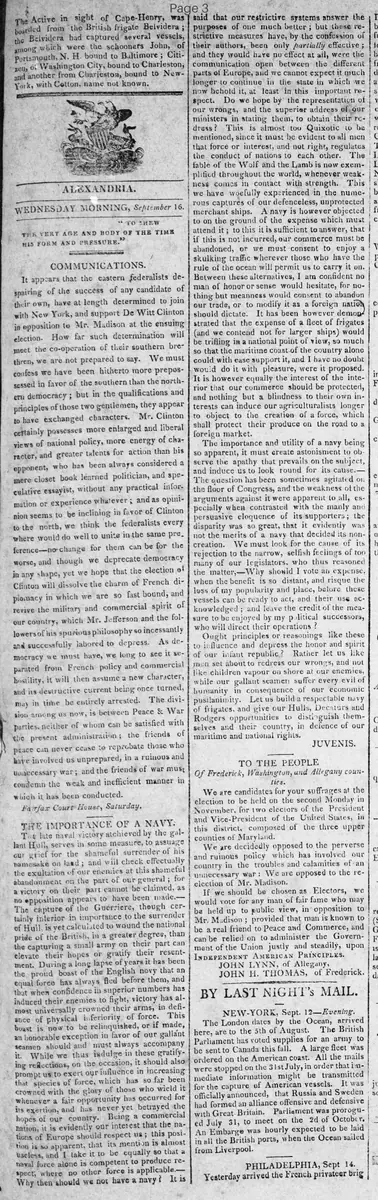
The late naval victory achieved by the gallant Hull, serves in some measure, to assuage our grief for the shameful surrender of his namesake on land: and will check effectually the exultation of our enemies at this shameful abandonment on the part of our general; for a victory on their part cannot be claimed, as no opposition appears to have been made.—The capture of the Guerriere, though certainly inferior in importance to the surrender of Hull, is yet calculated to wound the national pride of the British, in a greater degree, than the capturing a small army on their part can elevate their hopes or gratify their resentment. During a long lapse of years it has been the proud boast of the English navy that an equal force has always fled before them, and that when confidence in superior numbers has induced their enemies to fight, victory has almost universally crowned their arms, in defiance of physical inferiority of force. This boast is now to be relinquished, or if made, an honorable exception in favor of our gallant seamen should and must always accompany it. While we thus indulge in these gratifying reflections, on the occasion, it should also prompt us to exert our influence in increasing that species of force, which has so far been whenever a fair opportunity has occurred for its exertion, and has never yet betrayed the hopes of our country. Being a commercial nation, it is evidently our interest that the nations of Europe should respect us; this position is so apparent, that its mention is almost useless, and I take it to be equally so that a naval force alone is competent to produce respect, where no other force is applicable.—Why then should we not have a navy? It is said that our restrictive systems answer the purposes of one much better; but these restrictive measures have, by the confession of their authors, been only partially effective; and they would have no effect at all, were the communication open between the different parts of Europe, and we cannot expect it much longer to continue in the state in which we now behold it, at least in this important respect. Do we hope by the representation of our wrongs, and the superior address of our ministers in stating them, to obtain their redress? This is almost too Quixotic to be mentioned, since it must be evident to all men that force or interest, and not right, regulates the conduct of nations to each other. The fable of the Wolf and the Lamb is now exemplified throughout the world, whenever weakness comes in contact with strength. This we have woefully experienced in the numerous captures of our defenceless, unprotected merchant ships. A navy is however objected to on the ground of the expense which must attend it; to this it is sufficient to answer, that if this is not incurred, our commerce must be abandoned, or we must consent to enjoy a skulking traffic wherever those who have the rule of the ocean will permit us to carry it on. Between these alternatives, I am confident no man of honor or sense would hesitate, for nothing but meanness would consent to abandon our trade, or to modify it as a foreign nation should dictate. It has been however demonstrated that the expense of a fleet of frigates (and we contend not for larger ships) would be trifling in a national point of view, so much so that the maritime coast of the country alone could with ease support it, and I have no doubt would do it with pleasure, were it proposed. It is however equally the interest of the interior that our commerce should be protected, and nothing but a blindness to their own interests can induce our agriculturalists longer to object to the creation of a force, which shall protect their produce on the road to a foreign market. The importance and utility of a navy being so apparent, it must create astonishment to observe the apathy that prevails on the subject and induce us to look round for its cause.—The question has been sometimes agitated on the floor of Congress, and the weakness of the arguments against it were apparent to all, especially when contrasted with the manly and persuasive eloquence of its supporters; the disparity was so great, that it evidently was not the merits of a navy that decided its non-creation. We must look for the cause of its rejection to the narrow, selfish feelings of too many of our legislators, who thus reasoned the matter,—Why should I vote an expense, when the benefit is so distant, and risque the loss of my popularity and place, before these vessels can be ready to act, and their use acknowledged; and leave the credit of the measure to be enjoyed by my political successors, who will direct their operations? Ought principles or reasonings like these to influence and depress the honor and spirit of our infant republic? Rather let us like men set about to redress our wrongs, and not like children vapour on shore at our enemies, while our gallant seamen suffer every evil of humanity in consequence of our economic pusillanimity. Let us build a respectable navy of frigates, and give our Hulls, Decaturs and Rodgers opportunities to distinguish themselves and their country, in defence of our maritime and national rights.
JUVENIS.
THE IMPORTANCE OF A NAVY:
The late naval victory achieved by the gallant Hull, serves in some measure, to assuage our grief for the shameful surrender of his namesake on land: and will check effectually the exultation of our enemies at this shameful abandonment on the part of our general; for a victory on their part cannot be claimed, as no opposition appears to have been made.—The capture of the Guerriere, though certainly inferior in importance to the surrender of Hull, is yet calculated to wound the national pride of the British, in a greater degree, than the capturing a small army on their part can elevate their hopes or gratify their resentment. During a long lapse of years it has been the proud boast of the English navy that an equal force has always fled before them, and that when confidence in superior numbers has induced their enemies to fight, victory has almost universally crowned their arms, in defiance of physical inferiority of force. This boast is now to be relinquished, or if made, an honorable exception in favor of our gallant seamen should and must always accompany it. While we thus indulge in these gratifying reflections, on the occasion, it should also prompt us to exert our influence in increasing that species of force, which has so far been whenever a fair opportunity has occurred for its exertion, and has never yet betrayed the hopes of our country. Being a commercial nation, it is evidently our interest that the nations of Europe should respect us; this position is so apparent, that its mention is almost useless, and I take it to be equally so that a naval force alone is competent to produce respect, where no other force is applicable.—Why then should we not have a navy? It is said that our restrictive systems answer the purposes of one much better; but these restrictive measures have, by the confession of their authors, been only partially effective; and they would have no effect at all, were the communication open between the different parts of Europe, and we cannot expect it much longer to continue in the state in which we now behold it, at least in this important respect. Do we hope by the representation of our wrongs, and the superior address of our ministers in stating them, to obtain their redress? This is almost too Quixotic to be mentioned, since it must be evident to all men that force or interest, and not right, regulates the conduct of nations to each other. The fable of the Wolf and the Lamb is now exemplified throughout the world, whenever weakness comes in contact with strength. This we have woefully experienced in the numerous captures of our defenceless, unprotected merchant ships. A navy is however objected to on the ground of the expense which must attend it; to this it is sufficient to answer, that if this is not incurred, our commerce must be abandoned, or we must consent to enjoy a skulking traffic wherever those who have the rule of the ocean will permit us to carry it on. Between these alternatives, I am confident no man of honor or sense would hesitate, for nothing but meanness would consent to abandon our trade, or to modify it as a foreign nation should dictate. It has been however demonstrated that the expense of a fleet of frigates (and we contend not for larger ships) would be trifling in a national point of view, so much so that the maritime coast of the country alone could with ease support it, and I have no doubt would do it with pleasure, were it proposed. It is however equally the interest of the interior that our commerce should be protected, and nothing but a blindness to their own interests can induce our agriculturalists longer to object to the creation of a force, which shall protect their produce on the road to a foreign market. The importance and utility of a navy being so apparent, it must create astonishment to observe the apathy that prevails on the subject and induce us to look round for its cause.—The question has been sometimes agitated on the floor of Congress, and the weakness of the arguments against it were apparent to all, especially when contrasted with the manly and persuasive eloquence of its supporters; the disparity was so great, that it evidently was not the merits of a navy that decided its non-creation. We must look for the cause of its rejection to the narrow, selfish feelings of too many of our legislators, who thus reasoned the matter,—Why should I vote an expense, when the benefit is so distant, and risque the loss of my popularity and place, before these vessels can be ready to act, and their use acknowledged; and leave the credit of the measure to be enjoyed by my political successors, who will direct their operations? Ought principles or reasonings like these to influence and depress the honor and spirit of our infant republic? Rather let us like men set about to redress our wrongs, and not like children vapour on shore at our enemies, while our gallant seamen suffer every evil of humanity in consequence of our economic pusillanimity. Let us build a respectable navy of frigates, and give our Hulls, Decaturs and Rodgers opportunities to distinguish themselves and their country, in defence of our maritime and national rights.
JUVENIS.
What sub-type of article is it?
Military Affairs
Trade Or Commerce
Economic Policy
What keywords are associated?
Navy Importance
Naval Victory
Commerce Protection
British Navy
Congressional Apathy
Frigates
War Of 1812
National Honor
What entities or persons were involved?
Hull (Naval Captain)
Hull (General On Land)
Guerriere (British Ship)
Decaturs
Rodgers
British Navy
Congress Legislators
Agriculturalists
Editorial Details
Primary Topic
Importance Of Building A Navy To Protect Commerce And National Honor
Stance / Tone
Strongly Pro Navy, Urging Congressional Action Against Economic Pusillanimity
Key Figures
Hull (Naval Captain)
Hull (General On Land)
Guerriere (British Ship)
Decaturs
Rodgers
British Navy
Congress Legislators
Agriculturalists
Key Arguments
Naval Victory By Hull Assuages Grief Over Land Surrender And Wounds British Pride
English Navy Boast Of Superiority Is Now Challenged By American Seamen
As A Commercial Nation, Us Needs Navy For Respect From European Nations
Restrictive Systems Are Only Partially Effective And Temporary
Diplomacy Fails; Force Or Interest Regulates Nations, As In Wolf And Lamb Fable
Expense Of Navy Is Trifling; Commerce Must Be Protected Or Abandoned
Interior Agriculturalists Should Support Navy To Protect Produce To Markets
Apathy Stems From Selfish Legislators Fearing Loss Of Popularity
Build Frigates To Allow Heroes Like Hull, Decatur, Rodgers To Defend Rights