Thank you for visiting SNEWPapers!
Sign up free
Editorial
November 22, 1808
Virginia Argus
Richmond, Virginia
What is this article about?
Editorial from Public Ledger critiques US embargo's consequences, quoting a Jamaican merchant's letter (Aug 30, 1808) on how it diverts trade to Europe, boosts Jamaican self-sufficiency in provisions, and harms American exports.
Clipping
OCR Quality
98%
Excellent
Full Text
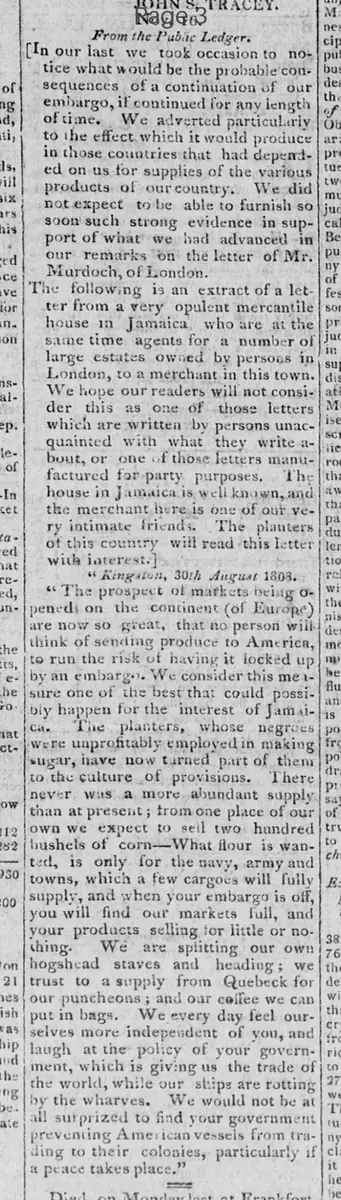
From the Public Ledger.
[In our last we took occasion to notice what would be the probable consequences of a continuation of our embargo, if continued for any length of time. We adverted particularly to the effect which it would produce in those countries that had depended on us for supplies of the various products of our country. We did not expect to be able to furnish so soon such strong evidence in support of what we had advanced in our remarks on the letter of Mr. Murdoch, of London.
The following is an extract of a letter from a very opulent mercantile house in Jamaica, who are at the same time agents for a number of large estates owned by persons in London, to a merchant in this town. We hope our readers will not consider this as one of those letters which are written by persons unacquainted with what they write about, or one of those letters manufactured for party purposes. The house in Jamaica is well known, and the merchant here is one of our very intimate friends. The planters of this country will read this letter with interest.]
"Kingston, 30th August 1808.
"The prospect of markets being opened on the continent (of Europe) are now so great, that no person will think of sending produce to America, to run the risk of having it locked up by an embargo. We consider this measure one of the best that could possibly happen for the interest of Jamaica. The planters, whose negroes were unprofitably employed in making sugar, have now turned part of them to the culture of provisions. There never was a more abundant supply than at present; from one place of our own we expect to sell two hundred bushels of corn. What flour is wanted, is only for the navy, army and towns, which a few cargoes will fully supply, and when your embargo is off, you will find our markets full, and your products selling for little or nothing. We are splitting our own hogshead staves and heading: we trust to a supply from Quebeck for our puncheons; and our coffee we can put in bags. We every day feel ourselves more independent of you, and laugh at the policy of your government, which is giving us the trade of the world, while our ships are rotting by the wharves. We would not be at all surprised to find your government preventing American vessels from trading to their colonies, particularly if a peace takes place."
[In our last we took occasion to notice what would be the probable consequences of a continuation of our embargo, if continued for any length of time. We adverted particularly to the effect which it would produce in those countries that had depended on us for supplies of the various products of our country. We did not expect to be able to furnish so soon such strong evidence in support of what we had advanced in our remarks on the letter of Mr. Murdoch, of London.
The following is an extract of a letter from a very opulent mercantile house in Jamaica, who are at the same time agents for a number of large estates owned by persons in London, to a merchant in this town. We hope our readers will not consider this as one of those letters which are written by persons unacquainted with what they write about, or one of those letters manufactured for party purposes. The house in Jamaica is well known, and the merchant here is one of our very intimate friends. The planters of this country will read this letter with interest.]
"Kingston, 30th August 1808.
"The prospect of markets being opened on the continent (of Europe) are now so great, that no person will think of sending produce to America, to run the risk of having it locked up by an embargo. We consider this measure one of the best that could possibly happen for the interest of Jamaica. The planters, whose negroes were unprofitably employed in making sugar, have now turned part of them to the culture of provisions. There never was a more abundant supply than at present; from one place of our own we expect to sell two hundred bushels of corn. What flour is wanted, is only for the navy, army and towns, which a few cargoes will fully supply, and when your embargo is off, you will find our markets full, and your products selling for little or nothing. We are splitting our own hogshead staves and heading: we trust to a supply from Quebeck for our puncheons; and our coffee we can put in bags. We every day feel ourselves more independent of you, and laugh at the policy of your government, which is giving us the trade of the world, while our ships are rotting by the wharves. We would not be at all surprised to find your government preventing American vessels from trading to their colonies, particularly if a peace takes place."
What sub-type of article is it?
Economic Policy
Trade Or Commerce
What keywords are associated?
Us Embargo
Jamaica Trade
European Markets
Provision Cultivation
Self Sufficiency
American Exports
What entities or persons were involved?
Public Ledger
Mr. Murdoch Of London
Jamaican Mercantile House
Us Government
Jamaican Planters
Editorial Details
Primary Topic
Consequences Of Us Embargo On Trade With Jamaica
Stance / Tone
Critical Of Us Embargo Policy
Key Figures
Public Ledger
Mr. Murdoch Of London
Jamaican Mercantile House
Us Government
Jamaican Planters
Key Arguments
Embargo Diverts Jamaican Produce To European Markets
Jamaica Benefits By Shifting Labor To Provision Cultivation
Abundant Local Supplies Reduce Dependence On Us Imports
Us Products Will Flood Markets And Sell Cheaply Post Embargo
Jamaica Becoming Independent Of Us Supplies
Us Policy Aids Jamaica's Global Trade Position