Thank you for visiting SNEWPapers!
Sign up free
The Rhode Island Republican
Newport, Newport County, Rhode Island
What is this article about?
Miscellany praises Malte Brun's scientific geography treatise, highlighting his interdisciplinary knowledge. Excerpts discuss transition from physical to political geography, role of language in society, origins of religions, government forms, national industry, intellectual progress, and civilization's advancement from Mediterranean to Atlantic eras.
Merged-components note: Continuation of the same essay on geography, language, religion, and society across columns and into the next page, with direct text flow.
Clippings
1 of 2
OCR Quality
Full Text
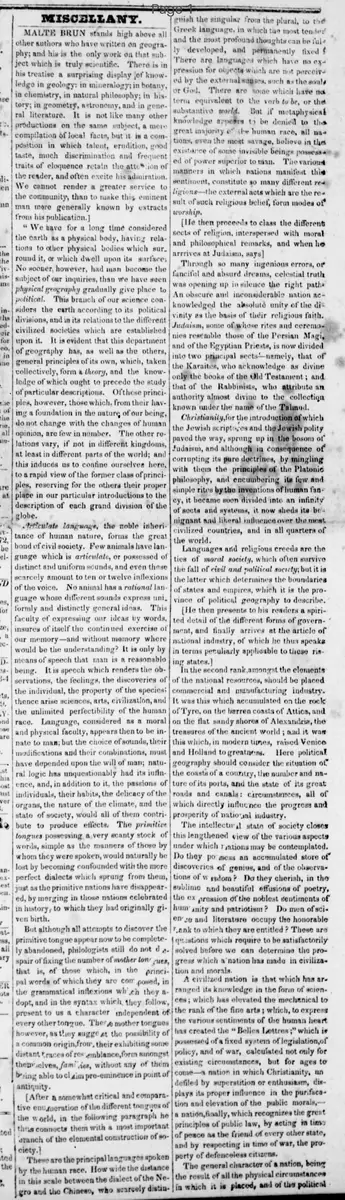
MALTE BRUN stands high above all other authors who have written on geography; and his is the only work on that subject which is truly scientific. There is in his treatise a surprising display of knowledge in geology: in mineralogy; in botany, in chemistry, in natural philosophy; in history; in geometry, astronomy, and in general literature. It is not like many other productions on the same subject, a mere compilation of local facts, but it is a composition in which talent, erudition, good taste, much discrimination and frequent traits of eloquence retain the attention of the reader, and often excite his admiration.
We cannot render a greater service to the community, than to make this eminent man more generally known by extracts from his publication.
"We have for a long time considered the earth as a physical body, having relations to other physical bodies which surround it, or which dwell upon its surface. No sooner, however, had man become the subject of our inquiries, than we have seen physical geography gradually give place to political. This branch of our science considers the earth according to its political divisions, and in its relations to the different civilized societies which are established upon it. It is evident that this department of geography has, as well as the others, general principles of its own, which, taken collectively, form a theory, and the knowledge of which ought to precede the study of particular descriptions. Of these principles, however, those which, from their having a foundation in the nature of our being, do not change with the changes of human opinion, are few in number. The other relations vary, if not in different kingdoms, at least in different parts of the world; and this induces us to confine ourselves here, to a rapid view of the former class of principles, reserving for the others their proper place in our particular introductions to the description of each grand division of the globe.
Articulate language, the noble inheritance of human nature, forms the great bond of civil society. Few animals have language which is articulate, or possessed of distinct and uniform sounds, and even these scarcely amount to ten or twelve inflexions of the voice. No animal has a rational language whose different sounds express uniformly and distinctly general ideas. This faculty of expressing our ideas by words, insures of itself the continued exercise of our memory—and without memory where would be the understanding? It is only by means of speech that man is a reasonable being. It is speech which renders the observations, the feelings, the discoveries of the individual, the property of the species; thence arise sciences, arts, civilization, and the unlimited perfectibility of the human race. Language, considered as a moral and physical faculty, appears then to be innate to man; but the choice of sounds, their modifications and their combinations, must have depended upon the will of man; natural logic has unquestionably had its influence, and, in addition to it, the passions of individuals, their habits, the delicacy of the organs, the nature of the climate, and the state of society, would all of them contribute to produce effects. The primitive tongues possessing a very scanty stock of words, simple as the manners of those by whom they were spoken, would naturally be lost by becoming confounded with the more perfect dialects which sprung from them, just as the primitive nations have disappeared, by merging in those nations celebrated in history, to which they had originally given birth.
But although all attempts to discover the primitive tongue appear now to be completely abandoned, philologists still do not despair of fixing the number of mother tongues, that is, of those which, in the principal words of which they are composed, in the grammatical inflexions which they adopt, and in the syntax which they follow, present to us a character independent of every other tongue. These mother tongues however, as they suggest the possibility of a common origin, from their exhibiting some distant traces of resemblance, form amongst themselves, families, without any of them being able to claim pre-eminence in point of antiquity.
[After a somewhat critical and comparative enumeration of the different tongues of the world, in the following paragraph he thus connects them with a most important branch of the elemental construction of society.]
These are the principal languages spoken by the human race. How wide the distance in this scale between the dialect of the Negro and the Chinese, whose scarcely distinguish the singular from the plural, to the Greek language, in which the most tender and the most profound thoughts can be fully developed, and permanently fixed.
There are languages which have no expression for objects which are not perceived by the external senses, such as the soul or God. There are some which have no term equivalent to the verb to be, or the substantive world. But if metaphysical knowledge appears to be denied to the great majority of the human race, all nations, even the most savage, believe in the existence of some invisible beings possessed of power superior to man. The various manners in which nations manifest this sentiment, constitute so many different religions; the external acts which are the result of such religious belief, form modes of worship.
[He then proceeds to class the different sects of religion, interspersed with moral and philosophical remarks, and when he arrives at Judaism, says]
Through so many ingenious errors, or fanciful and absurd dreams, celestial truth was opening up in silence the right path. An obscure and inconsiderable nation acknowledged the absolute unity of the divinity as the basis of their religious faith. Judaism, some of whose rites and ceremonies resemble those of the Persian Magi, and of the Egyptian Priests, is now divided into two principal sects'—namely, that of the Karaites, who acknowledge as divine only the books of the Old Testament; and that of the Rabbinists, who attribute an authority almost divine to the collection known under the name of the Talmud.
Christianity, for the introduction of which the Jewish scriptures and the Jewish polity paved the way, sprung up in the bosom of Judaism, and although in consequence of corrupting its pure doctrines, by mingling with them the principles of the Platonic philosophy, and encumbering its few and simple rites by the inventions of human fancy, it became soon divided into an infinity of sects and systems, it now sheds its benignant and liberal influence over the most civilized countries, and in all quarters of the world.
Languages and religious creeds are the ties of moral society, which often survive the fall of civil and political society; but it is the latter which determines the boundaries of states and empires, which it is the province of political geography to describe.
[He then presents to his readers a spirited detail of the different forms of government, and finally arrives at the article of national industry, of which he thus speaks in terms peculiarly applicable to these rising states.]
In the second rank, amongst the elements of the national resources, should be placed commercial and manufacturing industry. It was this which accumulated on the rock of Tyre, on the barren coasts of Attica, and on the flat sandy shores of Alexandria, the treasures of the ancient world; and it was this which, in modern times, raised Venice and Holland to greatness. Here political geography should consider the situation of the coasts of a country, the number and nature of its ports, and the state of its great roads and canals: circumstances, all of which directly influence the progress and prosperity of national industry.
The intellectual state of society closes this lengthened view of the various aspects under which nations may be contemplated. Do they possess an accumulated store of discoveries of genius, and of the observations of wisdom? Do they cherish, in the sublime and beautiful effusions of poetry, the expression of the noblest sentiments of humanity and patriotism? Do men of science and literature occupy the honorable rank to which they are entitled? These are questions which require to be satisfactorily solved before we can determine the progress which a nation has made in civilization and morals.
A civilized nation is that which has arranged its knowledge in the form of sciences: which has elevated the mechanical to the rank of the fine arts; which, to express the various sentiments of the human heart has created the "Belles Lettres;" which is possessed of a fixed system of legislation, of policy, and of war, calculated not only for existing circumstances, but for ages to come—a nation in which Christianity, undefiled by superstition or enthusiasm, displays its proper influence in the purification and elevation of the public morals, a nation, finally, which recognizes the great principles of public law, by acting in time of peace as the friend of every other state, and by respecting in time of war, the property of defenceless citizens.
The general character of a nation, being the result of all the physical circumstances in which it is placed, and of the political institutions, which modify these circumstances, it is absurd to make it depend upon climate alone. Extreme cold, as well as extreme heat, by enfeebling the constitution, seems to check and restrain that progress in improvement which a people might otherwise make; but institutions and manners struggle successfully against the climate. Egypt, under the tropic, and Scandinavia, under the polar circle, have equally given birth to heroes, men of genius, and philosophers.
The descendants of Canaan, the Phoenicians, soon lost the empire of the sea; Athens rivalled Tyre; a Grecian city ruled over conquered Egypt; Carthage submitted to Rome; Europe seized the sceptre of the world. At this first epoch, all civilization was collected around the Mediterranean; it was almost the only sea upon which there was any navigation. A second epoch commenced, and the march of civilization was still intimately connected with the progress of navigation. The compass and Columbus appeared. A new world saw our vessels land on its shores. A new Europe has arisen, and continues to advance with giant steps in the career of improvement. The Atlantic ocean has become what the Mediterranean was before, the great highway and thoroughfare of civilized nations.
What sub-type of article is it?
What themes does it cover?
What keywords are associated?
What entities or persons were involved?
Literary Details
Author
Malte Brun
Subject
Political Geography And Elements Of Society
Form / Style
Prose Treatise On Geography And Civilization
Key Lines