Thank you for visiting SNEWPapers!
Sign up free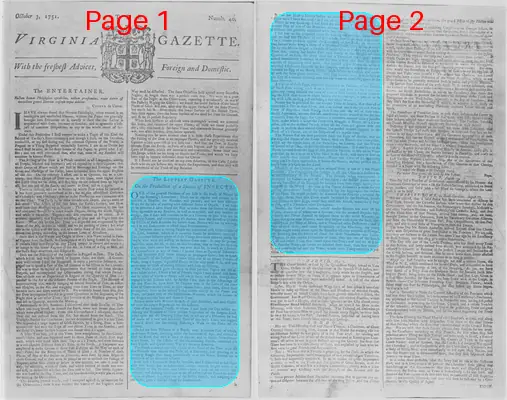
Literary
October 3, 1751
The Virginia Gazette
Richmond, Williamsburg, Richmond County, Virginia
What is this article about?
An essay describing morning nature walks and a discovery of a fly laying eggs on a willow branch over a brook, explaining the insect's life cycle and praising divine providence in natural design.
Merged-components note: This is a continuation of the literary essay on the production of a species of insects, spanning across page 1 and page 2, with sequential reading order and text that directly continues.
Clippings
1 of 2
OCR Quality
95%
Excellent
Full Text
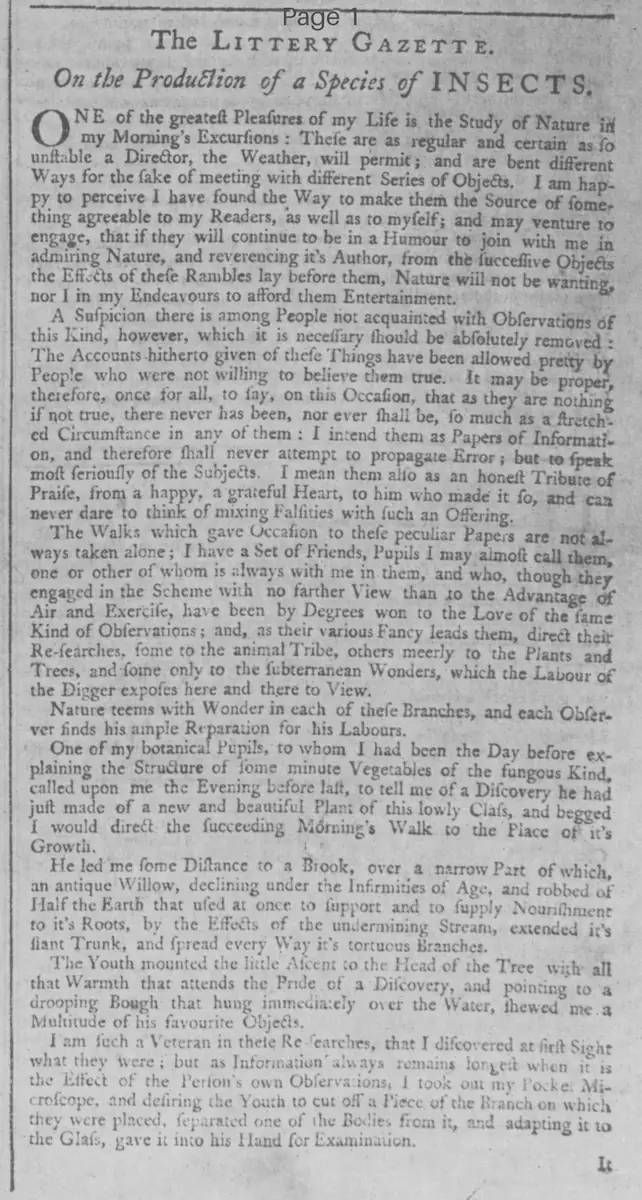
The Literary Gazette.
On the Production of a Species of Insects.
One of the greatest Pleasures of my Life is the Study of Nature in my Morning's Excursions: These are as regular and certain as so unstable a Director, the Weather, will permit; and are bent different Ways for the sake of meeting with different Series of Objects. I am happy to perceive I have found the Way to make them the Source of something agreeable to my Readers, as well as to myself; and may venture to engage, that if they will continue to be in a Humour to join with me in admiring Nature, and reverencing it's Author, from the successive Objects the Effects of these Rambles lay before them, Nature will not be wanting, nor I in my Endeavours to afford them Entertainment.
A Suspicion there is among People not acquainted with Observations of this Kind, however, which it is necessary should be absolutely removed: The Accounts hitherto given of these Things have been allowed pretty by People who were not willing to believe them true. It may be proper, therefore, once for all, to say, on this Occasion, that as they are nothing if not true, there never has been, nor ever shall be, so much as a stretched Circumstance in any of them: I intend them as Papers of Information, and therefore shall never attempt to propagate Error; but to speak most seriously of the Subjects. I mean them also as an honest Tribute of Praise, from a happy, a grateful Heart, to him who made it so, and can never dare to think of mixing Falsities with such an Offering.
The Walks which gave Occasion to these peculiar Papers are not always taken alone; I have a Set of Friends, Pupils I may almost call them, one or other of whom is always with me in them, and who, though they engaged in the Scheme with no farther View than to the Advantage of Air and Exercise, have been by Degrees won to the Love of the same Kind of Observations; and, as their various Fancy leads them, direct their Researches, some to the animal Tribe, others merely to the Plants and Trees, and one only to the subterranean Wonders, which the Labour of the Digger exposes here and there to View.
Nature teems with Wonder in each of these Branches, and each Observer finds his ample Reparation for his Labours.
One of my botanical Pupils, to whom I had been the Day before explaining the Structure of some minute Vegetables of the fungous Kind, called upon me the Evening before last, to tell me of a Discovery he had just made of a new and beautiful Plant of this lowly Class, and begged I would direct the succeeding Morning's Walk to the Place of it's Growth,
He led me some Distance to a Brook, over a narrow Part of which, an antique Willow, declining under the Infirmities of Age, and robbed of Half the Earth that used at once to support and to supply Nourishment to it's Roots, by the Effects of the undermining Stream, extended it's giant Trunk, and spread every Way it's tortuous Branches.
The Youth mounted the little Ascent to the Head of the Tree with all that Warmth that attends the Pride of a Discovery, and pointing to a drooping Bough that hung immediately over the Water, shewed me a Multitude of his favourite Objects.
I am such a Veteran in these Researches, that I discovered at first Sight what they were; but as Information always remains longest when it is the Effect of the Person's own Observations, I took out my Pocket Microscope, and desiring the Youth to cut off a Piece of the Branch on which they were placed, separated one of the Bodies from it, and adapting it to the Glass, gave it into his Hand for Examination.
It was not Half a Minute before he burst out into an Exclamation,
How have I been deceived! as I am alive, the Egg of some Animal.
While he was speaking, I had fixed my Eye upon a Fly, employed on another Part of one of the Branches, already loaded with these Bodies, in a Manner that perfectly explained what they were.
I led him to the properest Place for making the necessary Observation, and we had the Pleasure to see the whole Process of their Formation.
The Creature presently applied the Extremity of her Tail; to which at that Instant there hung a Drop of a glutinous Fluid, close to the Branch; she by this Means lodged a Particle of liquid Glue as it were on it's Bark: From this, raising her hinder Part very slowly to the Height of three Quarters of an Inch, she drew after her a Thread of the Liquid, which almost immediately hardened in the Air into a fine and solid Substance, capable of supporting itself erect. She paused a few Moments, while it acquired a sufficient Firmness for her Purpose, and there deposited upon it's Summit an Egg of an oblong Figure, Milk-White in Colour, and covered with the same gluey Moisture. The Egg became fixed in an Instant on the Top of a slender Pedestal, and the Fly went on depositing more in the same Manner.
A Cluster of these Eggs, regularly supported on Pedicles, of the Length of small Pins, arising each from a broad shining Base on the Bark, had given my young Botanist the Idea of a Set of little Fungi; but on examining the First that came to Hand before the Microscope, it proved to be big with Life, an Egg just disclosing a fine white Worm.
Nature has so provided for the winged Tribe of Insects, that they all of them pass a Part of their Lives, and that indeed much the greatest Part in Form of Reptiles; their Wings, their Eyes, and the rest of their wonderful Apparatus, are too delicate and tender to be trusted to the Air immediately from the Egg; the Creature is therefore covered with a peculiar Skin, under which it wears the Form of a Maggot, a Worm, or a Caterpillar, till at the destined Period, when all the Parts are grown firm and ready to perform their several Offices, the perfect Animal appears in the Form of it's Parent, out of the Disguise of it's reptile State.
The Worms that are thus produced from the Eggs of Beetles, and are the disguised Forms of the Beetle Brood, feed on Wood; the Caterpillars, which are the reptile State of the Butterflies, on Leaves, and the Worms of several other Flies, on several different Substances. It is the Fate of the Worm hatched from the Egg of this peculiar Species, to live under Water protected by the Covert of a Clay Shed in the Bank, and there to feed on lesser Insects that inhabit the Mud: When the Time of it's appearing under the Fly-State approaches, it leaves the Water; and the perfect Insect bursts from it's Case on dry Land.
The Life of the Creature, in this winged State, is but of a few Hours Duration: The Propagating the Species is all the Office it is destined to, In the OEconomy of the Animal: The Female, when impregnated, is prompted by Nature to get rid of her Load; and Instinct points out to her the Necessity of the Young to be hatched from these Eggs, finding their Support in the Water; but how is the Parent Animal to provide for the getting them there? should she attempt to lay her Eggs upon the Surface of the Fluid, she would probably be drowned in the Attempt; or could she lay them there, their thin Coats would be rotted by the Moisture, before their Time; or their Eggs, could they resist this Attack, would be a Prey to Fish, and a Thousand other Devourers.
Nature, the God of Nature, whose tender Mercies are over all his Works, unnoticed of whom not a Sparrow, not the meanest Reptile, falls, instructs the Parent Animal to suspend them in this artful Manner, on Trees that grow over Waters; were they lodged close upon the Bark, they would be in the Way of Mites, and a Thousand other Destroyers; and if they escaped these, and came favourably to the Hatching, the young Worms might crawl about upon the Branches till they perished of Hunger, not knowing that the Source of Food for their Necessaries was below.
Whereas, in this careful Disposition of them, they are out of the Reach of all the Insect Tribe that crawl upon the Tree; and are so situated, that the Worms no sooner are hatched from them, than they naturally and necessarily fall into the Water, where every Thing necessary is provided for them.
On the Production of a Species of Insects.
One of the greatest Pleasures of my Life is the Study of Nature in my Morning's Excursions: These are as regular and certain as so unstable a Director, the Weather, will permit; and are bent different Ways for the sake of meeting with different Series of Objects. I am happy to perceive I have found the Way to make them the Source of something agreeable to my Readers, as well as to myself; and may venture to engage, that if they will continue to be in a Humour to join with me in admiring Nature, and reverencing it's Author, from the successive Objects the Effects of these Rambles lay before them, Nature will not be wanting, nor I in my Endeavours to afford them Entertainment.
A Suspicion there is among People not acquainted with Observations of this Kind, however, which it is necessary should be absolutely removed: The Accounts hitherto given of these Things have been allowed pretty by People who were not willing to believe them true. It may be proper, therefore, once for all, to say, on this Occasion, that as they are nothing if not true, there never has been, nor ever shall be, so much as a stretched Circumstance in any of them: I intend them as Papers of Information, and therefore shall never attempt to propagate Error; but to speak most seriously of the Subjects. I mean them also as an honest Tribute of Praise, from a happy, a grateful Heart, to him who made it so, and can never dare to think of mixing Falsities with such an Offering.
The Walks which gave Occasion to these peculiar Papers are not always taken alone; I have a Set of Friends, Pupils I may almost call them, one or other of whom is always with me in them, and who, though they engaged in the Scheme with no farther View than to the Advantage of Air and Exercise, have been by Degrees won to the Love of the same Kind of Observations; and, as their various Fancy leads them, direct their Researches, some to the animal Tribe, others merely to the Plants and Trees, and one only to the subterranean Wonders, which the Labour of the Digger exposes here and there to View.
Nature teems with Wonder in each of these Branches, and each Observer finds his ample Reparation for his Labours.
One of my botanical Pupils, to whom I had been the Day before explaining the Structure of some minute Vegetables of the fungous Kind, called upon me the Evening before last, to tell me of a Discovery he had just made of a new and beautiful Plant of this lowly Class, and begged I would direct the succeeding Morning's Walk to the Place of it's Growth,
He led me some Distance to a Brook, over a narrow Part of which, an antique Willow, declining under the Infirmities of Age, and robbed of Half the Earth that used at once to support and to supply Nourishment to it's Roots, by the Effects of the undermining Stream, extended it's giant Trunk, and spread every Way it's tortuous Branches.
The Youth mounted the little Ascent to the Head of the Tree with all that Warmth that attends the Pride of a Discovery, and pointing to a drooping Bough that hung immediately over the Water, shewed me a Multitude of his favourite Objects.
I am such a Veteran in these Researches, that I discovered at first Sight what they were; but as Information always remains longest when it is the Effect of the Person's own Observations, I took out my Pocket Microscope, and desiring the Youth to cut off a Piece of the Branch on which they were placed, separated one of the Bodies from it, and adapting it to the Glass, gave it into his Hand for Examination.
It was not Half a Minute before he burst out into an Exclamation,
How have I been deceived! as I am alive, the Egg of some Animal.
While he was speaking, I had fixed my Eye upon a Fly, employed on another Part of one of the Branches, already loaded with these Bodies, in a Manner that perfectly explained what they were.
I led him to the properest Place for making the necessary Observation, and we had the Pleasure to see the whole Process of their Formation.
The Creature presently applied the Extremity of her Tail; to which at that Instant there hung a Drop of a glutinous Fluid, close to the Branch; she by this Means lodged a Particle of liquid Glue as it were on it's Bark: From this, raising her hinder Part very slowly to the Height of three Quarters of an Inch, she drew after her a Thread of the Liquid, which almost immediately hardened in the Air into a fine and solid Substance, capable of supporting itself erect. She paused a few Moments, while it acquired a sufficient Firmness for her Purpose, and there deposited upon it's Summit an Egg of an oblong Figure, Milk-White in Colour, and covered with the same gluey Moisture. The Egg became fixed in an Instant on the Top of a slender Pedestal, and the Fly went on depositing more in the same Manner.
A Cluster of these Eggs, regularly supported on Pedicles, of the Length of small Pins, arising each from a broad shining Base on the Bark, had given my young Botanist the Idea of a Set of little Fungi; but on examining the First that came to Hand before the Microscope, it proved to be big with Life, an Egg just disclosing a fine white Worm.
Nature has so provided for the winged Tribe of Insects, that they all of them pass a Part of their Lives, and that indeed much the greatest Part in Form of Reptiles; their Wings, their Eyes, and the rest of their wonderful Apparatus, are too delicate and tender to be trusted to the Air immediately from the Egg; the Creature is therefore covered with a peculiar Skin, under which it wears the Form of a Maggot, a Worm, or a Caterpillar, till at the destined Period, when all the Parts are grown firm and ready to perform their several Offices, the perfect Animal appears in the Form of it's Parent, out of the Disguise of it's reptile State.
The Worms that are thus produced from the Eggs of Beetles, and are the disguised Forms of the Beetle Brood, feed on Wood; the Caterpillars, which are the reptile State of the Butterflies, on Leaves, and the Worms of several other Flies, on several different Substances. It is the Fate of the Worm hatched from the Egg of this peculiar Species, to live under Water protected by the Covert of a Clay Shed in the Bank, and there to feed on lesser Insects that inhabit the Mud: When the Time of it's appearing under the Fly-State approaches, it leaves the Water; and the perfect Insect bursts from it's Case on dry Land.
The Life of the Creature, in this winged State, is but of a few Hours Duration: The Propagating the Species is all the Office it is destined to, In the OEconomy of the Animal: The Female, when impregnated, is prompted by Nature to get rid of her Load; and Instinct points out to her the Necessity of the Young to be hatched from these Eggs, finding their Support in the Water; but how is the Parent Animal to provide for the getting them there? should she attempt to lay her Eggs upon the Surface of the Fluid, she would probably be drowned in the Attempt; or could she lay them there, their thin Coats would be rotted by the Moisture, before their Time; or their Eggs, could they resist this Attack, would be a Prey to Fish, and a Thousand other Devourers.
Nature, the God of Nature, whose tender Mercies are over all his Works, unnoticed of whom not a Sparrow, not the meanest Reptile, falls, instructs the Parent Animal to suspend them in this artful Manner, on Trees that grow over Waters; were they lodged close upon the Bark, they would be in the Way of Mites, and a Thousand other Destroyers; and if they escaped these, and came favourably to the Hatching, the young Worms might crawl about upon the Branches till they perished of Hunger, not knowing that the Source of Food for their Necessaries was below.
Whereas, in this careful Disposition of them, they are out of the Reach of all the Insect Tribe that crawl upon the Tree; and are so situated, that the Worms no sooner are hatched from them, than they naturally and necessarily fall into the Water, where every Thing necessary is provided for them.
What sub-type of article is it?
Essay
What themes does it cover?
Nature
Religious
What keywords are associated?
Nature Observation
Insect Reproduction
Fly Eggs
Providence
Botanical Pupil
Willow Brook
Literary Details
Title
On The Production Of A Species Of Insects.
Subject
Observation Of A Fly Laying Eggs On A Willow Branch Over A Brook
Key Lines
One Of The Greatest Pleasures Of My Life Is The Study Of Nature In My Morning's Excursions
Nature, The God Of Nature, Whose Tender Mercies Are Over All His Works, Unnoticed Of Whom Not A Sparrow, Not The Meanest Reptile, Falls, Instructs The Parent Animal To Suspend Them In This Artful Manner, On Trees That Grow Over Waters
A Cluster Of These Eggs, Regularly Supported On Pedicles, Of The Length Of Small Pins, Arising Each From A Broad Shining Base On The Bark, Had Given My Young Botanist The Idea Of A Set Of Little Fungi
The Creature Presently Applied The Extremity Of Her Tail; To Which At That Instant There Hung A Drop Of A Glutinous Fluid, Close To The Branch; She By This Means Lodged A Particle Of Liquid Glue As It Were On It's Bark