Thank you for visiting SNEWPapers!
Sign up free
Editorial
June 19, 1802
Alexandria Advertiser And Commercial Intelligencer
Alexandria, Virginia
What is this article about?
Editorial defends U.S. Federal Government against baseless accusations of plotting monarchy by demagogues like Mr. Giles, exploiting post-Revolutionary fears. Cites lack of evidence, congressional debates, and historical confederacies showing risks of anarchy over tyranny.
Clipping
OCR Quality
70%
Good
Full Text
FROM THE PALLADIUM.
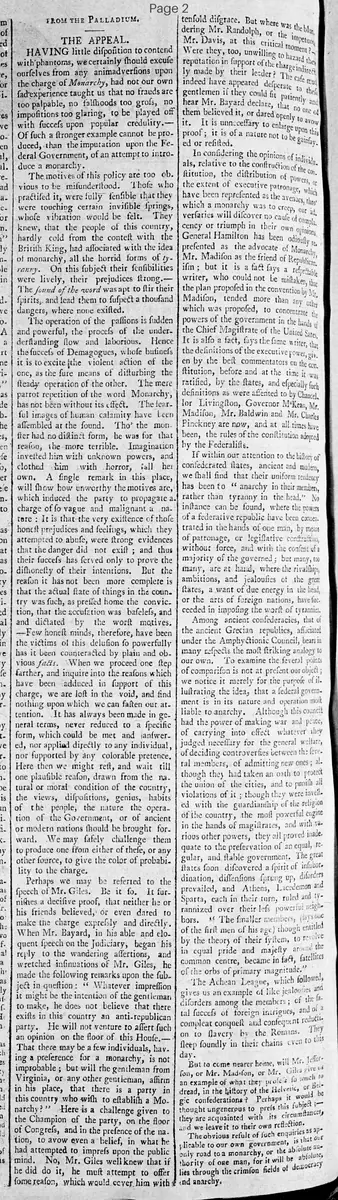
THE APPEAL.
HAVING little disposition to contend with phantoms, we certainly should excuse ourselves from any animadversions upon the charge of Monarchy, had not our own sad experience taught us that no frauds are too palpable, no falsehoods too gross, no impositions too glaring, to be played off with success upon popular credulity.—
Of such a stronger example cannot be produced, than the imputation upon the Federal Government, of an attempt to introduce a monarchy.
The motives of this policy are too obvious to be misunderstood. Those who practiced it, were fully sensible that they were touching certain invisible springs, whose vibration would be felt. They knew, that the people of this country, hardly cold from the contest with the British King, had associated with the idea of monarchy, all the horrid forms of tyranny. On this subject their sensibilities were lively, their prejudices strong. The sound of the word was apt to stir their spirits, and lead them to suspect a thousand dangers, where none existed.
The operation of the passions is sudden and powerful, the process of the understanding slow and laborious. Hence the success of Demagogues, whose business it is to excite the violent action of the one, as the sure means of disturbing the steady operation of the other. The mere parrot repetition of the word Monarchy, has not been without its effect. The fearful images of human calamity have been assembled at the sound. Though the monster had no distinct form, he was for that reason, the more terrible. Imagination invested him with unknown powers, and clothed him with horror, all his own. A single remark in this place, will show how unworthy the motives are, which induced the party to propagate a charge of so vague and malignant a nature: It is that—the very existence of those honest prejudices and feelings, which they attempted to abuse, were strong evidences that the danger did not exist; and thus their success has served only to prove the dishonesty of their intentions. But the reason it has not been more complete is that the actual state of things in the country was such, as pressed home the conviction, that the accusation was baseless, and dictated by the worst motives.
—Few honest minds, therefore, have been the victims of this delusion so powerfully has it been counteracted by plain and obvious facts. When we proceed one step farther, and inquire into the reasons which have been adduced in support of this charge, we are lost in the void, and find nothing upon which we can fasten our attention. It has always been made in general terms, never reduced to a specific form, which could be met and answered, nor applied directly to any individual, nor supported by any colorable pretence.
Here then we might rest, and wait till one plausible reason, drawn from the natural or moral condition of the country, the views, dispositions, genius, habits of the people, the nature the operation of the Government, or of ancient or modern nations should be brought forward. We may safely challenge them to produce one from either of these, or any other source, to give the color of probability to the charge.
Perhaps we may be referred to the speech of Mr. Giles. Be it so. It furnishes a decisive proof, that neither he or his friends believed, or even dared to make the charge expressly and directly.
When Mr. Bayard, in his able and eloquent speech on the Judiciary, began his reply to the wandering assertions, and wretched insinuations of Mr. Giles, he made the following remarks upon the subject in question: "Whatever impression it might be the intention of the gentleman to make, he does not believe that there exists in this country an anti-republican party. He will not venture to assert such an opinion on the floor of this House.—That there may be a few individuals, having a preference for a monarchy, is not improbable; but will the gentleman from Virginia, or any other gentleman, affirm in his place, that there is a party in this country who wish to establish a Monarchy?" Here is a challenge given to the Champion of the party, on the floor of Congress, and in the presence of the nation, to avow even a belief, in what he had attempted to impress upon the public mind. No, Mr. Giles well knew that if he did so it, he must attempt to offer some reason, which would cover him with tenfold disgrace. But rendering Mr. Randolph, or the Mr. Davis, at this critical moment—where was the blunder. impetuous Were they, too, unwilling to hazard the icn in support of the tharoeindi.. s ly made by their leader? The u indeed have appeared desperate to theft gentlemen if they could sit patiently and hear Mr. Bayard declare, that no one of them believed it, or dre openly t it. It is unnecessary to enlarge upon this pro; saue ot to ed or refisted.
In considering the opinions of individuals, relative conrcin stitution, the ditribution of powers, or the extent of executive patronage, which have been represented as the avenues, thr which a monarchy was to creep, our adversaries will discover no cause of complacency or triumph in their own opinions.
General Hamilton has been odiously preented as the advocate of Monarchy Mr. Madison as the friend of Republicanism; but it is a fact says a respectable writer, who could not be mistaken, that the plan proposed in the convention by Mr. Madison, tended more than any other which was proposed, to concentrate the powers of the government in the hands of the Chief Magistrate of the United States.
It is also a fact, says the same writer, that the definitions of the executive power, given by the best commentators on the constitution, before and at the time it was ratified, by the states, and especially such definitions as were assented to by Chancellor Livingston, Governor M'Kean, Mr. Madison. Mr. Baldwin and Mr. Charles Pinckney are now, and at all times have been, the rules of the constitution adopted by the Federalists.
If within our attention to the history of confederated states, ancient and modern, we shall find that their uniform tendency has been to "anarchy in their members, rather than tyranny in the head." No instance can be found, where the powers of a federative republic have been concentrated in the hands of one man, by means of patronage, or legislative construction without force. and with the consent of a majority of the governed ; but many, too many, are at hand, where the rivalships ambitions, and jealousies of the great states, a want of due energy in the head, or the arts of foreign nations, have succeeded in imposing the worst of tyrannies.
Among ancient confederacies, that of the ancient Grecian republics, associated under the Amphictyonic Council, bears in many respects the most striking analogy to our own. To examine the several points of comparison is not at present our object ; we notice it merely for the purpose of illustrating the idea, that a federal government is in its nature and operation most liable to -anarchy. Although this council had the power of making war and peace, of carrying into effect whatever they judged necessary for the general welfare, of deciding controversies between the several members, of admitting new ones ; al. though they had taken an oath to protect the union of the cities. and to punish all violations of it : though they were invested with the guardianship of the religion of the country, the most powerful engine in the hands of magistrates, and with various other powers, they all proved inadequate to the preservation of an equal, regular, and stable government. The great states soon discovered a spirit of insubordination, dissensions sprung up, disorders prevailed, and Athens, Lacedemon and Sparta, each in their turn. ruled and tyrannized over their less powerful neighbors. "The smaller members. (says one of the first men of his age) though entitled by the theory of their system, to revolve in equal pride and majesty around the common centre, became in fact. satellites of the orbs of primary magnitude."
disorders among the members ; cf the fa- gives us an example of like jealousies and The Achaean League, which followed, tal success of foreign intrigues, and of a compleat conquest and consequent reducti. on to slavery by the Romans. They fleep foundly in their chains even to this day.
an example of what they profess: so much to fon, or Mr. Madison, or Mr. Giles give us But to come nearer home, will Mr. Jefferson- gic confederations? Perhaps it would be dread, in the history of the Helvetic, or Bel- they are acquainted with its circumstances; thought ungenerous to press this subject j- and we leave it to their own reflection.
plicable to our own government, is that our The obvious result of such enquiries as ap- only road to a monarchy, or the absolute au- lies through the crimson fields of democracy thority of one man, for it will be absolute, and anarchy.
THE APPEAL.
HAVING little disposition to contend with phantoms, we certainly should excuse ourselves from any animadversions upon the charge of Monarchy, had not our own sad experience taught us that no frauds are too palpable, no falsehoods too gross, no impositions too glaring, to be played off with success upon popular credulity.—
Of such a stronger example cannot be produced, than the imputation upon the Federal Government, of an attempt to introduce a monarchy.
The motives of this policy are too obvious to be misunderstood. Those who practiced it, were fully sensible that they were touching certain invisible springs, whose vibration would be felt. They knew, that the people of this country, hardly cold from the contest with the British King, had associated with the idea of monarchy, all the horrid forms of tyranny. On this subject their sensibilities were lively, their prejudices strong. The sound of the word was apt to stir their spirits, and lead them to suspect a thousand dangers, where none existed.
The operation of the passions is sudden and powerful, the process of the understanding slow and laborious. Hence the success of Demagogues, whose business it is to excite the violent action of the one, as the sure means of disturbing the steady operation of the other. The mere parrot repetition of the word Monarchy, has not been without its effect. The fearful images of human calamity have been assembled at the sound. Though the monster had no distinct form, he was for that reason, the more terrible. Imagination invested him with unknown powers, and clothed him with horror, all his own. A single remark in this place, will show how unworthy the motives are, which induced the party to propagate a charge of so vague and malignant a nature: It is that—the very existence of those honest prejudices and feelings, which they attempted to abuse, were strong evidences that the danger did not exist; and thus their success has served only to prove the dishonesty of their intentions. But the reason it has not been more complete is that the actual state of things in the country was such, as pressed home the conviction, that the accusation was baseless, and dictated by the worst motives.
—Few honest minds, therefore, have been the victims of this delusion so powerfully has it been counteracted by plain and obvious facts. When we proceed one step farther, and inquire into the reasons which have been adduced in support of this charge, we are lost in the void, and find nothing upon which we can fasten our attention. It has always been made in general terms, never reduced to a specific form, which could be met and answered, nor applied directly to any individual, nor supported by any colorable pretence.
Here then we might rest, and wait till one plausible reason, drawn from the natural or moral condition of the country, the views, dispositions, genius, habits of the people, the nature the operation of the Government, or of ancient or modern nations should be brought forward. We may safely challenge them to produce one from either of these, or any other source, to give the color of probability to the charge.
Perhaps we may be referred to the speech of Mr. Giles. Be it so. It furnishes a decisive proof, that neither he or his friends believed, or even dared to make the charge expressly and directly.
When Mr. Bayard, in his able and eloquent speech on the Judiciary, began his reply to the wandering assertions, and wretched insinuations of Mr. Giles, he made the following remarks upon the subject in question: "Whatever impression it might be the intention of the gentleman to make, he does not believe that there exists in this country an anti-republican party. He will not venture to assert such an opinion on the floor of this House.—That there may be a few individuals, having a preference for a monarchy, is not improbable; but will the gentleman from Virginia, or any other gentleman, affirm in his place, that there is a party in this country who wish to establish a Monarchy?" Here is a challenge given to the Champion of the party, on the floor of Congress, and in the presence of the nation, to avow even a belief, in what he had attempted to impress upon the public mind. No, Mr. Giles well knew that if he did so it, he must attempt to offer some reason, which would cover him with tenfold disgrace. But rendering Mr. Randolph, or the Mr. Davis, at this critical moment—where was the blunder. impetuous Were they, too, unwilling to hazard the icn in support of the tharoeindi.. s ly made by their leader? The u indeed have appeared desperate to theft gentlemen if they could sit patiently and hear Mr. Bayard declare, that no one of them believed it, or dre openly t it. It is unnecessary to enlarge upon this pro; saue ot to ed or refisted.
In considering the opinions of individuals, relative conrcin stitution, the ditribution of powers, or the extent of executive patronage, which have been represented as the avenues, thr which a monarchy was to creep, our adversaries will discover no cause of complacency or triumph in their own opinions.
General Hamilton has been odiously preented as the advocate of Monarchy Mr. Madison as the friend of Republicanism; but it is a fact says a respectable writer, who could not be mistaken, that the plan proposed in the convention by Mr. Madison, tended more than any other which was proposed, to concentrate the powers of the government in the hands of the Chief Magistrate of the United States.
It is also a fact, says the same writer, that the definitions of the executive power, given by the best commentators on the constitution, before and at the time it was ratified, by the states, and especially such definitions as were assented to by Chancellor Livingston, Governor M'Kean, Mr. Madison. Mr. Baldwin and Mr. Charles Pinckney are now, and at all times have been, the rules of the constitution adopted by the Federalists.
If within our attention to the history of confederated states, ancient and modern, we shall find that their uniform tendency has been to "anarchy in their members, rather than tyranny in the head." No instance can be found, where the powers of a federative republic have been concentrated in the hands of one man, by means of patronage, or legislative construction without force. and with the consent of a majority of the governed ; but many, too many, are at hand, where the rivalships ambitions, and jealousies of the great states, a want of due energy in the head, or the arts of foreign nations, have succeeded in imposing the worst of tyrannies.
Among ancient confederacies, that of the ancient Grecian republics, associated under the Amphictyonic Council, bears in many respects the most striking analogy to our own. To examine the several points of comparison is not at present our object ; we notice it merely for the purpose of illustrating the idea, that a federal government is in its nature and operation most liable to -anarchy. Although this council had the power of making war and peace, of carrying into effect whatever they judged necessary for the general welfare, of deciding controversies between the several members, of admitting new ones ; al. though they had taken an oath to protect the union of the cities. and to punish all violations of it : though they were invested with the guardianship of the religion of the country, the most powerful engine in the hands of magistrates, and with various other powers, they all proved inadequate to the preservation of an equal, regular, and stable government. The great states soon discovered a spirit of insubordination, dissensions sprung up, disorders prevailed, and Athens, Lacedemon and Sparta, each in their turn. ruled and tyrannized over their less powerful neighbors. "The smaller members. (says one of the first men of his age) though entitled by the theory of their system, to revolve in equal pride and majesty around the common centre, became in fact. satellites of the orbs of primary magnitude."
disorders among the members ; cf the fa- gives us an example of like jealousies and The Achaean League, which followed, tal success of foreign intrigues, and of a compleat conquest and consequent reducti. on to slavery by the Romans. They fleep foundly in their chains even to this day.
an example of what they profess: so much to fon, or Mr. Madison, or Mr. Giles give us But to come nearer home, will Mr. Jefferson- gic confederations? Perhaps it would be dread, in the history of the Helvetic, or Bel- they are acquainted with its circumstances; thought ungenerous to press this subject j- and we leave it to their own reflection.
plicable to our own government, is that our The obvious result of such enquiries as ap- only road to a monarchy, or the absolute au- lies through the crimson fields of democracy thority of one man, for it will be absolute, and anarchy.
What sub-type of article is it?
Constitutional
Partisan Politics
What keywords are associated?
Monarchy Charge
Federal Government
Demagogues
Republicanism
Anarchy Risk
Confederacies
Partisan Motives
What entities or persons were involved?
Federal Government
Mr. Giles
Mr. Bayard
General Hamilton
Mr. Madison
Mr. Jefferson
Mr. Randolph
Mr. Davis
Chancellor Livingston
Governor M'kean
Mr. Baldwin
Mr. Charles Pinckney
Editorial Details
Primary Topic
Refutation Of Accusations That The Federal Government Seeks To Establish Monarchy
Stance / Tone
Defensive Of Federal Republicanism, Critical Of Demagogic Accusations
Key Figures
Federal Government
Mr. Giles
Mr. Bayard
General Hamilton
Mr. Madison
Mr. Jefferson
Mr. Randolph
Mr. Davis
Chancellor Livingston
Governor M'kean
Mr. Baldwin
Mr. Charles Pinckney
Key Arguments
Accusations Of Monarchy Are Vague, Baseless, And Exploit Public Prejudices Against Tyranny
Demagogues Succeed By Stirring Passions Over Reason
No Specific Evidence Or Direct Assertions From Accusers Like Mr. Giles In Congress
Federalists' Constitutional Views On Executive Power Are Standard And Ratified
Historical Confederacies Tend Toward Anarchy In Members Rather Than Tyranny In The Head
Path To Absolute Monarchy Lies Through Democracy And Anarchy, Not Federal Structure