Thank you for visiting SNEWPapers!
Sign up free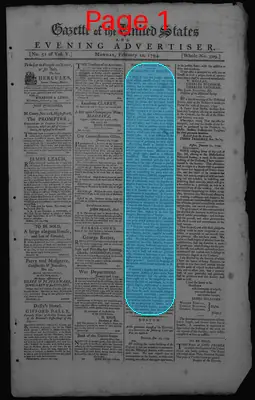
Editorial
February 10, 1794
Gazette Of The United States & Evening Advertiser
Philadelphia, Philadelphia County, Pennsylvania
What is this article about?
An editorial arguing that states, as moral persons, owe legal duties to citizens and should be suable in tribunals to enforce contracts and rights, criticizing the monarchical notion of state immunity as despotic and contrary to liberty.
Clipping
OCR Quality
95%
Excellent
Full Text
From the AMERICAN MINERVA.
SUABILITY OF STATES.
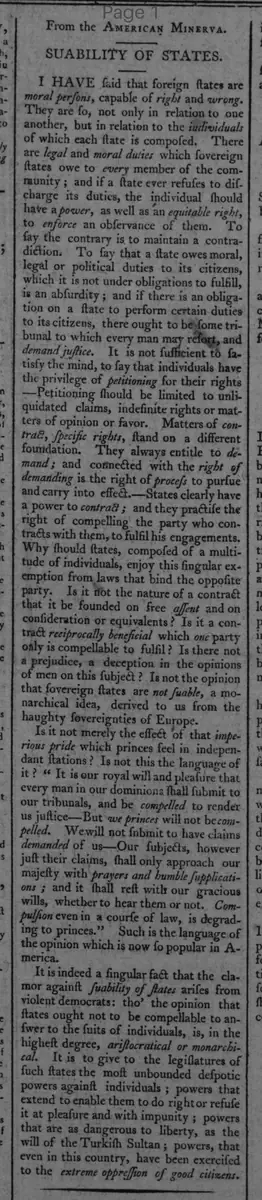
I HAVE said that foreign states are moral persons, capable of right and wrong. They are so, not only in relation to one another, but in relation to the individuals of which each state is composed. There are legal and moral duties which sovereign states owe to every member of the community; and if a state ever refuses to discharge its duties, the individual should have a power, as well as an equitable right, to enforce an observance of them. To say the contrary is to maintain a contradiction. To say that a state owes moral, legal or political duties to its citizens, which it is not under obligations to fulfill, is an absurdity; and if there is an obligation on a state to perform certain duties to its citizens, there ought to be some tribunal to which every man may resort, and demand justice. It is not sufficient to satisfy the mind, to say that individuals have the privilege of petitioning for their rights. Petitioning should be limited to unliquidated claims, indefinite rights or matters of opinion or favor. Matters of contract, specific rights, stand on a different foundation. They always entitle to demand; and connected with the right of demanding is the right of process to pursue and carry into effect. States clearly have a power to contract; and they practice the right of compelling the party who contracts with them, to fulfil his engagements. Why should states, composed of a multitude of individuals, enjoy this singular exemption from laws that bind the opposite party. Is it not the nature of a contract that it be founded on free assent and on consideration or equivalents? Is it a contract reciprocally beneficial which one party only is compellable to fulfil? Is there not a prejudice, a deception in the opinions of men on this subject? Is not the opinion that sovereign states are not suable, a monarchical idea, derived to us from the haughty sovereignties of Europe.
Is it not merely the effect of that imperious pride which princes feel in independent nations? Is not this the language of it? "It is our royal will and pleasure that every man in our dominions shall submit to our tribunals, and be compelled to render us justice. But we princes will not be compelled. We will not submit to have claims demanded of us. Our subjects, however just their claims, shall only approach our majesty with prayers and humble supplications; and it shall rest with our gracious wills, whether to hear them or not. Compulsion even in a course of law, is degrading to princes." Such is the language of the opinion which is now so popular in America.
It is indeed a singular fact that the clamor against suability of states arises from violent democrats: tho' the opinion that states ought not to be compellable to answer to the suits of individuals, is, in the highest degree, aristocratical or monarchical. It is to give to the Legislatures of such states the most unbounded despotic powers against individuals; powers that extend to enable them to do right or refuse it at pleasure and with impunity; powers that are as dangerous to liberty, as the will of the Turkish Sultan; powers, that even in this country, have been exercised to the extreme oppression of good citizens.
SUABILITY OF STATES.
I HAVE said that foreign states are moral persons, capable of right and wrong. They are so, not only in relation to one another, but in relation to the individuals of which each state is composed. There are legal and moral duties which sovereign states owe to every member of the community; and if a state ever refuses to discharge its duties, the individual should have a power, as well as an equitable right, to enforce an observance of them. To say the contrary is to maintain a contradiction. To say that a state owes moral, legal or political duties to its citizens, which it is not under obligations to fulfill, is an absurdity; and if there is an obligation on a state to perform certain duties to its citizens, there ought to be some tribunal to which every man may resort, and demand justice. It is not sufficient to satisfy the mind, to say that individuals have the privilege of petitioning for their rights. Petitioning should be limited to unliquidated claims, indefinite rights or matters of opinion or favor. Matters of contract, specific rights, stand on a different foundation. They always entitle to demand; and connected with the right of demanding is the right of process to pursue and carry into effect. States clearly have a power to contract; and they practice the right of compelling the party who contracts with them, to fulfil his engagements. Why should states, composed of a multitude of individuals, enjoy this singular exemption from laws that bind the opposite party. Is it not the nature of a contract that it be founded on free assent and on consideration or equivalents? Is it a contract reciprocally beneficial which one party only is compellable to fulfil? Is there not a prejudice, a deception in the opinions of men on this subject? Is not the opinion that sovereign states are not suable, a monarchical idea, derived to us from the haughty sovereignties of Europe.
Is it not merely the effect of that imperious pride which princes feel in independent nations? Is not this the language of it? "It is our royal will and pleasure that every man in our dominions shall submit to our tribunals, and be compelled to render us justice. But we princes will not be compelled. We will not submit to have claims demanded of us. Our subjects, however just their claims, shall only approach our majesty with prayers and humble supplications; and it shall rest with our gracious wills, whether to hear them or not. Compulsion even in a course of law, is degrading to princes." Such is the language of the opinion which is now so popular in America.
It is indeed a singular fact that the clamor against suability of states arises from violent democrats: tho' the opinion that states ought not to be compellable to answer to the suits of individuals, is, in the highest degree, aristocratical or monarchical. It is to give to the Legislatures of such states the most unbounded despotic powers against individuals; powers that extend to enable them to do right or refuse it at pleasure and with impunity; powers that are as dangerous to liberty, as the will of the Turkish Sultan; powers, that even in this country, have been exercised to the extreme oppression of good citizens.
What sub-type of article is it?
Constitutional
Legal Reform
What keywords are associated?
Suability Of States
State Duties
Individual Rights
Legal Enforcement
Monarchical Immunity
Despotic Powers
What entities or persons were involved?
Sovereign States
Legislatures
Princes
Violent Democrats
Editorial Details
Primary Topic
Suability Of States
Stance / Tone
Advocacy For Individual Right To Sue States
Key Figures
Sovereign States
Legislatures
Princes
Violent Democrats
Key Arguments
States Are Moral Persons Owing Duties To Citizens
Individuals Have Right To Enforce State Duties Via Tribunals
Petitioning Insufficient For Contracts And Specific Rights
State Immunity Is A Monarchical Idea From Europe
Opposition To Suability Empowers Despotic Legislative Powers
Such Powers Threaten Liberty Like Those Of A Turkish Sultan