Thank you for visiting SNEWPapers!
Sign up free
Weekly Independent
Elko, Elko County, Nevada
What is this article about?
Farmer Van Ryn in St. Croix County, Wisconsin, unearthed a bronze coin with Roman markings beneath a 20-foot rock ledge on Sand Creek, leading to theories of ancient Roman sailors reaching the continent.
Clipping
OCR Quality
Full Text
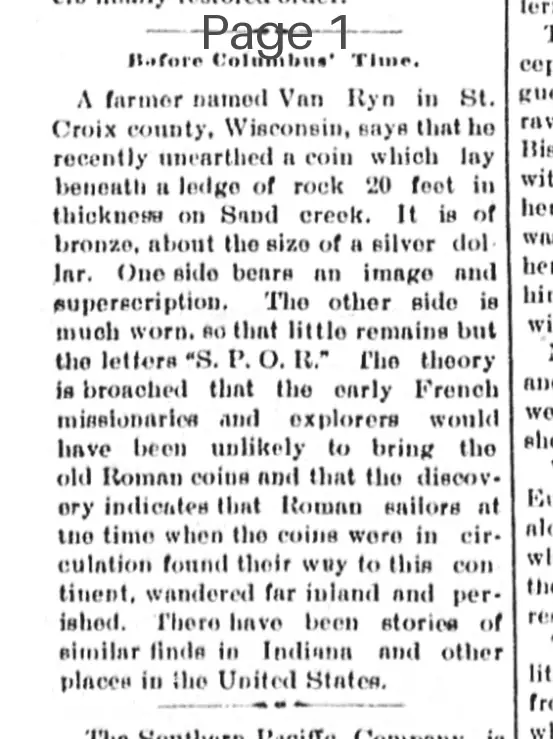
A farmer named Van Ryn in St. Croix county, Wisconsin, says that he recently unearthed a coin which lay beneath a ledge of rock 20 feet in thickness on Sand creek. It is of bronze, about the size of a silver dollar. One side bears an image and superscription. The other side is much worn, so that little remains but the letters "S. P. Q. R." The theory is broached that the early French missionaries and explorers would have been unlikely to bring the old Roman coins and that the discovery indicates that Roman sailors at the time when the coins were in circulation found their way to this continent, wandered far inland and perished. There have been stories of similar finds in Indiana and other places in the United States.
What sub-type of article is it?
What keywords are associated?
What entities or persons were involved?
Where did it happen?
Domestic News Details
Primary Location
St. Croix County, Wisconsin
Event Date
Recently
Key Persons
Event Details
A farmer named Van Ryn unearthed a bronze coin, about the size of a silver dollar, beneath a ledge of rock 20 feet in thickness on Sand creek. One side bears an image and superscription. The other side is much worn, showing letters "S. P. Q. R." The theory suggests Roman sailors reached the continent, wandered inland, and perished, as French missionaries were unlikely to bring such coins. Similar finds reported in Indiana and other U.S. places.