Thank you for visiting SNEWPapers!
Sign up free
Story
April 7, 1887
The Brookhaven Leader
Brookhaven, Lincoln County, Mississippi
What is this article about?
Promotional article by B. T. Hobbs describing Lincoln County, Mississippi's natural advantages, soil fertility, products like cotton and timber, population growth, topography, health, schools, and appeal to home-seekers from North and West. Created in 1870, area 593 sq mi, population ~17,000 by 1880s.
Clipping
OCR Quality
95%
Excellent
Full Text
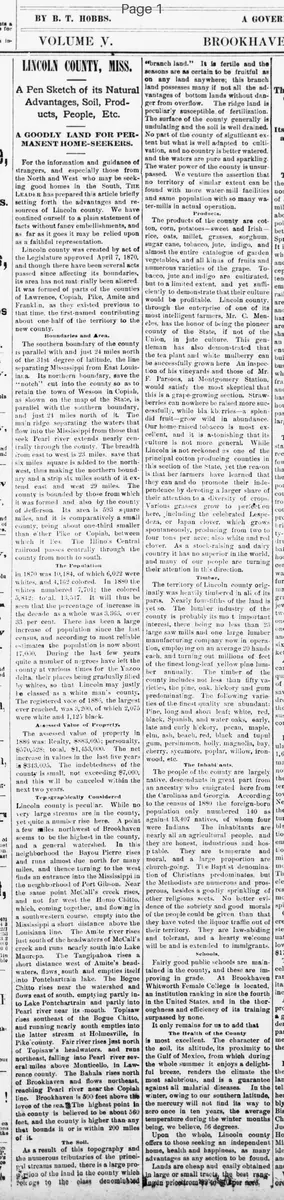
BY B. T. HOBBS.
VOLUME V.
LINCOLN COUNTY, MISS.
A Pen Sketch of its Natural
Advantages, Soil, Prod-
ucts, People, Etc.
A GOODLY LAND FOR PERMANENT HOME-SEEKERS.
For the information and guidance of strangers, and especially those from the North and West who may be seeking good homes in the South, THE LEADER has prepared this article briefly setting forth the advantages and resources of Lincoln county. We have confined ourself to a plain statement of facts without fancy embellishments, and as far as it goes it may be relied upon as a faithful representation.
Lincoln county was created by act of the Legislature approved April 7, 1870, and though there have been several acts passed since affecting its boundaries, its area has not materially been altered. It was formed of parts of the counties of Lawrence, Copiah, Pike, Amite and Franklin, as they existed previous to that time, the first-named contributing about one-half of the territory to the new county.
Boundaries and Area,
The southern boundary of the county is parallel with and just 24 miles north of the 31st degree of latitude, the line separating Mississippi from East Louisiana. Its northern boundary, save the "notch" cut into the county so as to retain the town of Wesson in Copiah, as shown on the map of the State, is parallel with the southern boundary, and just 21 miles north of it. The main ridge separating the waters that flow into the Mississippi from those that seek Pearl river extends nearly centrally through the county. The breadth from east to west is 23 miles, save that six miles square is added to the northwest, thus making the northern boundary and a strip six miles south of it extend east and west 29 miles. The county is bounded by those from which it was formed and also by the county of Jefferson. Its area is 593 square miles, and it is comparatively a small county, being about one-third smaller than either Pike or Copiah, between which it lies. The Illinois Central railroad passes centrally through the county from north to south
The Population
in 1870 was 10,184, of which 6,022 were whites, and 4,162 colored. In 1880 the whites numbered 7,701; the colored 5,812; total, 13,547. It will thus be seen that the percentage of increase in the decade as a whole was 3,363, over 33 per cent. There has been a large increase of population since the last census, and according to most reliable estimates the population is now about 17,000. During the last few years quite a number of negroes have left the county at various times for the Yazoo delta, their places being gradually filled by whites, so that Lincoln may justly be classed as a white man's county. The registered vote of 1886, the largest ever reached, was 3,200, of which 2,075 were white and 1,125 black.
Assessed Value of Property
The assessed value of property in 1886 was: Realty, $883,095; personalty, $570,528; total, $1,453,000. The net increase in values in the last five years is $343,095. The indebtedness of the county is small, not exceeding $7,000, and this will be canceled within the next two years.
Topographically Considered
Lincoln county is peculiar. While no very large streams are in the county, yet quite a number rise here. A point a few miles northwest of Brookhaven seems to be the highest in the county, and a general watershed. In this neighborhood the Bayou Pierre rises and runs almost due north for many miles, and thence turning to the west finds an entrance into the Mississippi in the neighborhood of Port Gibson. Near the same point McCall's creek rises, and not far west the Homochitto, which, coming together, and flowing in a southwestern course, empty into the Mississippi a short distance above the Louisiana line. The Amite river rises just south of the headwaters of McCall's creek and runs nearly south into Lake Maurepas. The Tangipahoa rises a short distance west of Amite's headwaters, flows south and empties itself into Pontchartrain lake. The Bogue Chitto rises near the watershed and flows east of south, emptying partly into Lake Pontchartrain and partly into Pearl river near its mouth. Topisaw rises southeast of the Bogue Chitto, and running nearly south empties into the latter stream at Holmesville, in Pike county. Fair river rises just north of Topisaw's headwaters, and runs northeast, falling into Pearl river several miles above Monticello, in Lawrence county. The Bahala rises north of Brookhaven and flows northeast, reaching Pearl river near the Copiah line. Brookhaven is 500 feet above the levee of the sea. The highest point in the county is believed to be about 560 feet, and the county is higher than any that bounds it or is within 200 miles of it
The Soil.
As a result of this topography and the numerous tributaries of the principal streams named, there is a large proportion of the land in the county which belongs to the class denominated "branch land." It is fertile and the seasons are as certain to be fruitful as on any land anywhere; this branch land possesses many if not all the advantages of bottom lands without danger from overflow. The ridge land is peculiarly susceptible of fertilization. The surface of the county generally is undulating and the soil is well drained. No part of the county of significant extent but what is well adapted to cultivation, and no country is better watered, and the waters are pure and sparkling
The water power of the county is unsurpassed. We venture the assertion that no territory of similar extent can be found with more water-mill facilities and same population with so many water-mills in actual operation.
Products.
The products of the county are cotton, corn, potatoes-sweet and Irish-rice, oats, millet, grasses, sorghum, sugar cane, tobacco, jute, indigo, and almost the entire catalogue of garden vegetables, and all kinds of fruits and numerous varieties of the grape. Tobacco, jute and indigo are cultivated, but to a limited extent, and yet sufficiently to demonstrate that their culture would be profitable. Lincoln county, through the enterprise of one of its most intelligent farmers, Mr. C. Mendele, has the honor of being the pioneer county of the State, if not of the Union, in jute culture. This gentleman has also demonstrated that the tea plant and white mulberry can be successfully grown here. An inspection of his vineyards and those of Mr. F. Parsons, at Montgomery Station, would satisfy the most skeptical that this is a grape-growing section. Strawberries can nowhere be raised more successfully, while blackberries-a splendid fruit-grow wild in abundance. Our home-raised tobacco is most excellent, and it is astonishing that its culture is not more general. While Lincoln is not reckoned as one of the principal cotton producing counties in this section of the State, yet the reason is that her farmers have learned that they can and do promote their independence by devoting a larger share of their attention to a diversity of crops. Various grasses grow to perfection here, including the celebrated Lespedeza, or Japan clover, which grows spontaneously, producing from two to four tons per acre; also white and red clover. As a stock-raising and dairy country it has no superior in the world, and many of our people are turning their attention in this direction.
Timber.
The territory of Lincoln county originally was heavily timbered in all of its parts. Nearly four-fifths of the land is yet so. The lumber industry of the county is probably its most important interest, there being no less than 23 large saw mills and one large lumber manufacturing company now in operation, employing on an average 20 hands each, and turning out millions of feet of the finest long-leaf yellow pine lumber annually. The timber of the county includes not less than fifty varieties, the pine, oak, hickory and gum predominating. The following varieties of the finest quality are abundant: Pine, long and short leaf; white, red, black, Spanish, and water oaks, early late and curly hickory, pecan, maple, elm, ash, beech, red, black and tupelo gum, persimmon, holly, magnolia, bay, cherry, sycamore, poplar, willow, iron wood, etc.
The Inhabitants.
The people of the county are largely native, descendants in great part from an ancestry who emigrated here from the Carolinas and Georgia. According to the census of 1880 the foreign-born population only numbered 140 as against 13,407 natives, of whom four were Indians. The inhabitants are nearly all an agricultural people, and they are honest, industrious and hospitable. They are temperate and moral, and a large proportion are church-going. The Baptist denomination of Christians predominates, but the Methodists are numerous and prosperous, besides a goodly sprinkling of other religious sects. No better evidence of the sobriety and good morals of the people could be given than that they have voted the liquor traffic out of their territory. They are law-abiding and tolerant, and a hearty welcome will be and is extended to immigrants.
Schools.
Fairly good public schools are maintained in the county, and these are improving in grade. At Brookhaven Whitworth Female College is located, an institution ranking in size the fourth in the United States, and in the thoroughness and efficiency of its training surpassed by none.
It only remains for us to add that
The Health of the County
is most excellent. The character of the soil, its altitude, its proximity to the Gulf of Mexico, from which during the whole summer it enjoys a delightful breeze, renders the climate the most salubrious, and is a guarantee against all malarial diseases.
In the winter, owing to our southern latitude, the mercury will not find its way to zero once in ten years, the average temperature during the winter months being, we believe, 56 degrees.
Upon the whole, Lincoln county offers to those seeking an independent home, health and happiness, as many advantages as any section to be found. Lands are cheap and easily obtained in large or small tracts, the best ranging in price from $9 to $15 per acre.
VOLUME V.
LINCOLN COUNTY, MISS.
A Pen Sketch of its Natural
Advantages, Soil, Prod-
ucts, People, Etc.
A GOODLY LAND FOR PERMANENT HOME-SEEKERS.
For the information and guidance of strangers, and especially those from the North and West who may be seeking good homes in the South, THE LEADER has prepared this article briefly setting forth the advantages and resources of Lincoln county. We have confined ourself to a plain statement of facts without fancy embellishments, and as far as it goes it may be relied upon as a faithful representation.
Lincoln county was created by act of the Legislature approved April 7, 1870, and though there have been several acts passed since affecting its boundaries, its area has not materially been altered. It was formed of parts of the counties of Lawrence, Copiah, Pike, Amite and Franklin, as they existed previous to that time, the first-named contributing about one-half of the territory to the new county.
Boundaries and Area,
The southern boundary of the county is parallel with and just 24 miles north of the 31st degree of latitude, the line separating Mississippi from East Louisiana. Its northern boundary, save the "notch" cut into the county so as to retain the town of Wesson in Copiah, as shown on the map of the State, is parallel with the southern boundary, and just 21 miles north of it. The main ridge separating the waters that flow into the Mississippi from those that seek Pearl river extends nearly centrally through the county. The breadth from east to west is 23 miles, save that six miles square is added to the northwest, thus making the northern boundary and a strip six miles south of it extend east and west 29 miles. The county is bounded by those from which it was formed and also by the county of Jefferson. Its area is 593 square miles, and it is comparatively a small county, being about one-third smaller than either Pike or Copiah, between which it lies. The Illinois Central railroad passes centrally through the county from north to south
The Population
in 1870 was 10,184, of which 6,022 were whites, and 4,162 colored. In 1880 the whites numbered 7,701; the colored 5,812; total, 13,547. It will thus be seen that the percentage of increase in the decade as a whole was 3,363, over 33 per cent. There has been a large increase of population since the last census, and according to most reliable estimates the population is now about 17,000. During the last few years quite a number of negroes have left the county at various times for the Yazoo delta, their places being gradually filled by whites, so that Lincoln may justly be classed as a white man's county. The registered vote of 1886, the largest ever reached, was 3,200, of which 2,075 were white and 1,125 black.
Assessed Value of Property
The assessed value of property in 1886 was: Realty, $883,095; personalty, $570,528; total, $1,453,000. The net increase in values in the last five years is $343,095. The indebtedness of the county is small, not exceeding $7,000, and this will be canceled within the next two years.
Topographically Considered
Lincoln county is peculiar. While no very large streams are in the county, yet quite a number rise here. A point a few miles northwest of Brookhaven seems to be the highest in the county, and a general watershed. In this neighborhood the Bayou Pierre rises and runs almost due north for many miles, and thence turning to the west finds an entrance into the Mississippi in the neighborhood of Port Gibson. Near the same point McCall's creek rises, and not far west the Homochitto, which, coming together, and flowing in a southwestern course, empty into the Mississippi a short distance above the Louisiana line. The Amite river rises just south of the headwaters of McCall's creek and runs nearly south into Lake Maurepas. The Tangipahoa rises a short distance west of Amite's headwaters, flows south and empties itself into Pontchartrain lake. The Bogue Chitto rises near the watershed and flows east of south, emptying partly into Lake Pontchartrain and partly into Pearl river near its mouth. Topisaw rises southeast of the Bogue Chitto, and running nearly south empties into the latter stream at Holmesville, in Pike county. Fair river rises just north of Topisaw's headwaters, and runs northeast, falling into Pearl river several miles above Monticello, in Lawrence county. The Bahala rises north of Brookhaven and flows northeast, reaching Pearl river near the Copiah line. Brookhaven is 500 feet above the levee of the sea. The highest point in the county is believed to be about 560 feet, and the county is higher than any that bounds it or is within 200 miles of it
The Soil.
As a result of this topography and the numerous tributaries of the principal streams named, there is a large proportion of the land in the county which belongs to the class denominated "branch land." It is fertile and the seasons are as certain to be fruitful as on any land anywhere; this branch land possesses many if not all the advantages of bottom lands without danger from overflow. The ridge land is peculiarly susceptible of fertilization. The surface of the county generally is undulating and the soil is well drained. No part of the county of significant extent but what is well adapted to cultivation, and no country is better watered, and the waters are pure and sparkling
The water power of the county is unsurpassed. We venture the assertion that no territory of similar extent can be found with more water-mill facilities and same population with so many water-mills in actual operation.
Products.
The products of the county are cotton, corn, potatoes-sweet and Irish-rice, oats, millet, grasses, sorghum, sugar cane, tobacco, jute, indigo, and almost the entire catalogue of garden vegetables, and all kinds of fruits and numerous varieties of the grape. Tobacco, jute and indigo are cultivated, but to a limited extent, and yet sufficiently to demonstrate that their culture would be profitable. Lincoln county, through the enterprise of one of its most intelligent farmers, Mr. C. Mendele, has the honor of being the pioneer county of the State, if not of the Union, in jute culture. This gentleman has also demonstrated that the tea plant and white mulberry can be successfully grown here. An inspection of his vineyards and those of Mr. F. Parsons, at Montgomery Station, would satisfy the most skeptical that this is a grape-growing section. Strawberries can nowhere be raised more successfully, while blackberries-a splendid fruit-grow wild in abundance. Our home-raised tobacco is most excellent, and it is astonishing that its culture is not more general. While Lincoln is not reckoned as one of the principal cotton producing counties in this section of the State, yet the reason is that her farmers have learned that they can and do promote their independence by devoting a larger share of their attention to a diversity of crops. Various grasses grow to perfection here, including the celebrated Lespedeza, or Japan clover, which grows spontaneously, producing from two to four tons per acre; also white and red clover. As a stock-raising and dairy country it has no superior in the world, and many of our people are turning their attention in this direction.
Timber.
The territory of Lincoln county originally was heavily timbered in all of its parts. Nearly four-fifths of the land is yet so. The lumber industry of the county is probably its most important interest, there being no less than 23 large saw mills and one large lumber manufacturing company now in operation, employing on an average 20 hands each, and turning out millions of feet of the finest long-leaf yellow pine lumber annually. The timber of the county includes not less than fifty varieties, the pine, oak, hickory and gum predominating. The following varieties of the finest quality are abundant: Pine, long and short leaf; white, red, black, Spanish, and water oaks, early late and curly hickory, pecan, maple, elm, ash, beech, red, black and tupelo gum, persimmon, holly, magnolia, bay, cherry, sycamore, poplar, willow, iron wood, etc.
The Inhabitants.
The people of the county are largely native, descendants in great part from an ancestry who emigrated here from the Carolinas and Georgia. According to the census of 1880 the foreign-born population only numbered 140 as against 13,407 natives, of whom four were Indians. The inhabitants are nearly all an agricultural people, and they are honest, industrious and hospitable. They are temperate and moral, and a large proportion are church-going. The Baptist denomination of Christians predominates, but the Methodists are numerous and prosperous, besides a goodly sprinkling of other religious sects. No better evidence of the sobriety and good morals of the people could be given than that they have voted the liquor traffic out of their territory. They are law-abiding and tolerant, and a hearty welcome will be and is extended to immigrants.
Schools.
Fairly good public schools are maintained in the county, and these are improving in grade. At Brookhaven Whitworth Female College is located, an institution ranking in size the fourth in the United States, and in the thoroughness and efficiency of its training surpassed by none.
It only remains for us to add that
The Health of the County
is most excellent. The character of the soil, its altitude, its proximity to the Gulf of Mexico, from which during the whole summer it enjoys a delightful breeze, renders the climate the most salubrious, and is a guarantee against all malarial diseases.
In the winter, owing to our southern latitude, the mercury will not find its way to zero once in ten years, the average temperature during the winter months being, we believe, 56 degrees.
Upon the whole, Lincoln county offers to those seeking an independent home, health and happiness, as many advantages as any section to be found. Lands are cheap and easily obtained in large or small tracts, the best ranging in price from $9 to $15 per acre.
What sub-type of article is it?
Regional Description
Promotional Guide
What keywords are associated?
Lincoln County
Mississippi
Agriculture
Timber Industry
Population Growth
Soil Fertility
Home Seekers
What entities or persons were involved?
B. T. Hobbs
C. Mendele
F. Parsons
Where did it happen?
Lincoln County, Mississippi
Story Details
Key Persons
B. T. Hobbs
C. Mendele
F. Parsons
Location
Lincoln County, Mississippi
Event Date
1880s
Story Details
Article details Lincoln County's creation in 1870, boundaries, population growth to ~17,000, fertile soils, diverse products including cotton, timber, fruits, excellent health, schools, and invitation to immigrants for cheap lands.