Thank you for visiting SNEWPapers!
Sign up free
Norfolk Gazette And Publick Ledger
Norfolk, Virginia
What is this article about?
In the U.S. House of Representatives on Dec. 30, Mr. Quincy debates against raising 50,000 volunteers, arguing the embargo laws unconstitutionally infringe on state rights and transfer commerce power to the executive. Debate includes interruptions and votes modifying the resolution, passing 76-34.
Merged-components note: These four components are sequential in reading order (9-12) and contain continuous text of the same House of Representatives debate on raising volunteers, with Mr. Quincy's speech flowing directly from one to the next.
Clipping
OCR Quality
Full Text
FRIDAY, Dec. 30.
Debate on the resolution to raise 50,000 Volunteers.
(CONCLUDED.)
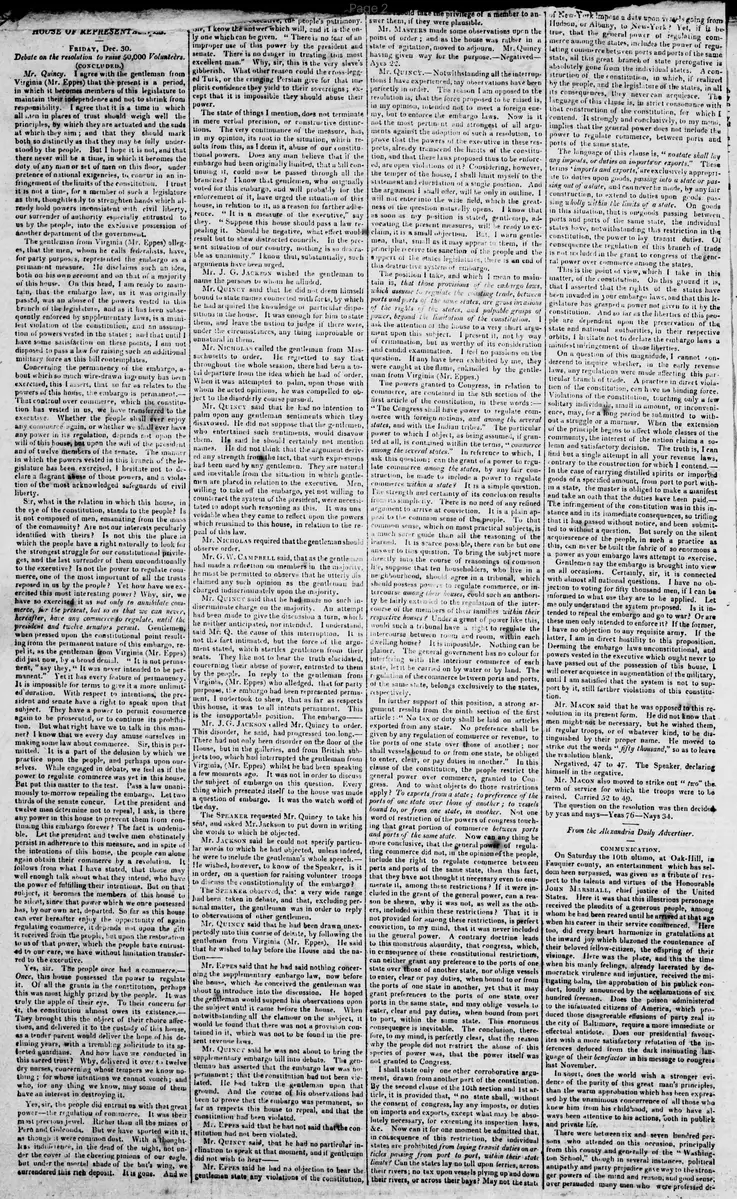
Mr. Quincy. I agree with the gentleman from Virginia (Mr. Eppes) that the present is a period, in which it becomes members of this legislature to maintain their independence and not to shrink from responsibility. I agree that it is a time in which all men in places of trust should weigh well the principles, by which they are actuated and the ends at which they aim: and that they should mark both so distinctly as that they may be fully understood by the people. But I hope it is not, and that there never will be a time, in which it becomes the duty of any man or set of men on this floor, under pretence of national exigencies, to concur in an infringement of the limits of the constitution. I trust it is not a time, or a member of such a legislature as this, thoughtlessly to strengthen bands which already hold powers inconsistent with civil liberty, our surrender of authority especially entrusted to us by the people, into the exclusive possession of another department of the government.
The gentleman from Virginia (Mr. Eppes) alleges, that the men, whom he calls federalists, have, for party purposes, represented the embargo as a permanent measure. He disclaims such an idea, both on his own account and on that of a majority of this house. On this head, I am ready to maintain, that the embargo law, as it was originally passed, was an abuse of the powers vested in this branch of the legislature, and as it has been subsequently enforced by supplementary laws, is a manifest violation of the constitution, and an assumption of powers vested in the states; and that until I have some satisfaction on these points, I am not disposed to pass a law for raising such an additional military force as this bill contemplates.
Concerning the permanency of the embargo, about which so much wire-drawn ingenuity has been exercised, this I assert, that so far as relates to the powers of this house, the embargo is permanent. That control over commerce, which the constitution has vested in us, we have transferred to the executive. Whether the people shall ever enjoy any commerce again, or whether we shall ever have any power in its regulation, depends not upon the will of this house, but upon the will of the president and of twelve members of the senate. The manner in which the powers vested in this branch of the legislature has been exercised, I hesitate not to declare a flagrant abuse of those powers, and a violation of the most acknowledged safeguards of civil liberty.
Sir, what is the relation in which this house, in the eye of the constitution, stands to the people? Is it not composed of men, emanating from the mass of the community? Are not our interests peculiarly identified with theirs? Is not this the place in which the people have a right naturally to look for the strongest struggle for our constitutional privileges, and the last surrender of them unconditionally to the executive? Is not the power to regulate commerce, one of the most important of all the trusts reposed in us by the people? Yet how have we exercised this most interesting power? Why, sir, we have so exercised it as not only to annihilate commerce, for the present, but so as that we can never, hereafter, have any commerce to regulate, until the president and twelve senators permit. Gentlemen, when pressed upon the constitutional point resulting from the permanent nature of this embargo, repel it, as the gentleman from Virginia (Mr. Eppes) did just now, by a broad denial. "It is not permanent," say they, "It was never intended to be permanent." Yet it has every feature of permanency. It is impossible for terms to give it a more unlimited duration. With respect to intentions, the president and senate have a right to speak upon that subject. They have a power to permit commerce again to be prosecuted, or to continue its prohibition. But what right have we to talk in this manner? I know that we every day amuse ourselves in making some law about commerce. Sir, this is permitted. It is a part of the delusion by which we practice upon the people, and perhaps upon ourselves. While engaged in debate, we feel as if the power to regulate commerce was yet in this house. But put this matter to the test. Pass a law unanimously to-morrow repealing the embargo. Let two thirds of the senate concur. Let the president and twelve men determine not to repeal, I ask, is there any power in this house to prevent them from continuing this embargo forever? The fact is undeniable. Let the president and twelve men obstinately persist in adherence to this measure, and in spite of the intentions of this house, the people can alone again obtain their commerce by a revolution. It follows from what I have stated, that those may well enough talk about what they intend, who have the power of fulfilling their intentions. But on that subject, it becomes the members of this house to be silent, since that power which we once possessed has, by our own act, departed. So far as this house can ever hereafter enjoy the opportunity of again regulating commerce, it depends not upon the gift it received from the people, but upon the restoration to us of that power, which the people have entrusted to our care, we have without hesitation transferred to the executive.
Yes, sir. The people once had a commerce. Once, this house possessed the power to regulate it. Of all the grants in the constitution, perhaps this was most highly prized by the people. It was truly the apple of their eye. To their concern for it, the constitution almost owes its existence. They brought this the object of their choice affections, and delivered it to the custody of this house, as a tender parent would deliver the hope of his declining years, with a trembling solicitude to its selected guardians. And how have we conducted in this sacred trust? Why, delivered it over to twelve dry nurses, concerning whose tempers we know nothing; for whose intentions we cannot vouch; and who, for any thing we know, may some of them have an interest in destroying it.
Yes, sir, the people did entrust us with that great power-the regulation of commerce. It was their most precious jewel. Richer than all the mines of Peru and Golconda. But we have sported with it, as though it were common dust. With a thoughtless indulgence, in the dead of the night, not under the cover of the cheering pinions of our eagle, but under the mortal shade of the bat's wing, we surrendered this rich deposit. It is gone. And we
sir, I know the answer which will, and it is-the only one which can be given. "There is no fear of an improper use of this power by the president and senate. There is no danger in trusting this most excellent man." Why, sir, this is the very slave's gibberish. What other reason could the cross-legged Turk, or the cringing Persian give for that implicit confidence they yield to their sovereigns; except that it is impossible they should abuse their power.
The state of things I mention, does not terminate in mere verbal precision, or constructive distinctions. The very continuance of the measure, has, in my opinion, its root in the situation, which results from this, as I deem it, abuse of our constitutional powers. Does any man believe that if the embargo had been originally limited, that a bill continuing it, could now be passed through all the branches? I know that gentlemen, who originally voted for this embargo, and will probably for the enforcement of it, have urged the situation of this house, in relation to it, as a reason for farther adherence.
"It is a measure of the executive," say they. "Suppose this house should pass a law repealing it. Should he negative, what effect would result but to shew distracted councils. In the present situation of our country, nothing is so desirable as unanimity." I know that, substantially, such arguments have been urged.
Mr. J. G. Jackson wished the gentleman to name the persons to whom he alluded.
Mr. Quincy said that he did not deem himself bound to state names connected with facts, by which he had acquired the knowledge of particular dispositions in the house. It was enough for him to state them, and leave the nation to judge if there were, under the circumstances, any thing improbable or unnatural in them.
Mr. Nicholas called the gentleman from Massachusetts to order. He regretted to say that throughout the whole session, there had been a total departure from the idea which he had of order. When it was attempted to palm, upon those with whom he acted opinions, he was compelled to object to the disorderly course pursued.
Mr. Quincy said that he had no intention to palm upon any gentleman sentiments which they disavowed. He did not suppose that the gentlemen who entertained such sentiments, would disavow them. He said he should certainly not mention names. He did not think that the argument derived any strength from the fact, that such expressions had been used by any gentlemen. They are natural and inevitable from the situation in which gentlemen are placed in relation to the executive. Men, willing to take off the embargo, yet not willing to counteract the system of the president, were necessitated to adopt such reasoning as this. It was unavoidable when they came to reflect upon the powers which remained to this house, in relation to the repeal of this law.
Mr. Nicholas required that the gentleman should observe order.
Mr. G. W. Campbell said, that as the gentleman had made a reflection on members in the majority, he must be permitted to observe that he utterly disclaimed any such opinion as the gentleman had charged indiscriminately upon the majority.
Mr. Quincy said that he had made no such indiscriminate charge on the majority. An attempt had been made to give the discussion a turn, which he neither anticipated, nor intended. I understand, said Mr. Q. the cause of this interruption. It is not the fact intimated, but the force of the argument stated, which startles gentlemen from their seats. They like not to hear the truth elucidated, concerning their abuse of power, entrusted to them by the people. In reply to the gentleman from Virginia, (Mr. Eppes) who alleged, that for party purposes, the embargo had been represented permanent, I undertook to shew, that as far as respects this house, it was to all intents permanent. This is the insupportable position. The embargo
Mr. J.G. Jackson called Mr. Quincy to order. This disorder, he said, had progressed too long. There had not only been disorder on the floor of the House, but in the galleries, and from British subjects too, which had interrupted the gentleman from Virginia, (Mr. Eppes) whilst he had been speaking a few moments ago. It was not in order to discuss the subject of embargo on this question. Every thing which presented itself to the house was made a question of embargo. It was the watch word of the day.
The Speaker requested Mr. Quincy to take his seat, and asked Mr. Jackson to put down in writing the words to which he objected.
Mr. Jackson said he could not specify particular words to which he had objected, unless indeed, he were to include the gentleman's whole speech. He wished, however, to know of the Speaker, is it in order, on a question for raising volunteer troops to discuss the constitutionality of the embargo?
The Speaker observed, that a very wide range had been taken in debate, and that, excluding personal matter, the gentleman was in order to reply to observations of other gentlemen.
Mr. Quincy said that he had been drawn unexpectedly into this course of debate, by following the gentleman from Virginia (Mr. Eppes). He said that he wished to lay before the House and the nation-
Mr. Eppes said that he had said nothing concerning the supplementary embargo law, now before the house, which he conceived the gentleman was about to introduce into the discussion. He hoped the gentleman would suspend his observations upon the subject until it came before the house. When notwithstanding all the clamour on the subject, it would be found that there was not a provision contained in it, which was not to be found in the present revenue laws.
Mr. Quincy said he was not about to bring the supplementary embargo bill into debate. The gentleman has asserted that the embargo law was not permanent; that the constitution had not been violated. He had taken the gentleman upon that ground. And the course of his observations had been to prove that the embargo was permanent, so far as respects this house to repeal, and that the constitution had been violated.
Mr. Eppes said that he had not said that the constitution had not been violated.
Mr. Quincy said, that he had no particular inclination to speak at that moment, and if gentlemen did not wish to hear-
Mr. Eppes said he had no objection to hear the gentleman state any violations of the constitution,
answer them, if they were plausible.
Mr. Madison made some observations upon the point of order; and as the house was rather in a state of agitation, moved to adjourn. Mr. Quincy having given way for the purpose.-Negatived-
Ayes 22.
Mr. Quincy.-Notwithstanding all the interruptions I have experienced, my observations have been perfectly in order. The reason I am opposed to the resolution is, that the force proposed to be raised is, in my opinion, intended not to meet a foreign enemy, but to enforce the embargo laws. Now is it not the most pertinent and strongest of all arguments against the adoption of such a resolution, to prove that the powers of the executive in these respects, already transcend the limits of the constitution, and that these laws proposed thus to be enforced, are open violations of it? Considering, however, the temper of the house, I shall limit myself to the statement and elucidation of a single position. And the argument I shall offer, will be only in outline. I will not enter into the wide field, which the greatness of the question naturally opens. I know that as soon as my position is stated, gentlemen, advocating the present measures, will be ready to exclaim, it is a small objection. But, I warn gentlemen, that, small as it may appear to them, if the principle receive the sanction of the people and the support of the state legislatures, there is an end of this destructive system of embargo.
The position I take, and which I mean to maintain is, that those provisions of the embargo laws, which assume to regulate the coasting trade, between ports and ports of the same states, are gross invasions of the rights of the states, and palpable grasps of power, beyond the limitation of the constitution.
I ask the attention of the house to a very short argument upon this subject. I present it, not by way of crimination, but as worthy of its consideration and candid examination. I feel no passions on the question. If any have been exhibited by me, they were caught at the flame, enkindled by the gentleman from Virginia (Mr. Eppes.)
The powers granted to Congress, in relation to commerce, are contained in the 8th section of the first article of the constitution, in these words:-- "The Congress shall have power to regulate commerce with foreign nations, and among the several states, and with the Indian tribes." The particular power to which I object, as being assumed, if granted at all, is contained within the terms, "commerce among the several states." In reference to which, I ask this question; can the grant of a power to regulate commerce among the states, by any fair construction, be made to include a power to regulate commerce within a state? It is a simple question. The strength and certainty of its conclusion results from its simplicity. There is no need of any refined argument to arrive at conviction. It is a plain appeal to the common sense of the people. To that common sense, which on most practical subjects, is a much surer guide than all the reasoning of the learned. It is scarce possible, there can be but one answer to this question. To bring the subject more directly into the course of reasonings of common life, suppose that ten householders, who live in a neighbourhood, should agree in a tribunal, which should possess powers to regulate commerce, or intercourse among their houses, could such an authority be fairly extended to the regulation of the intercourse of the members of their families within their respective houses? Under a grant of power like this, would such a tribunal have a right to regulate the intercourse between room and room, within each dwelling house? It is impossible. Nothing can be plainer. The general government has no colour for interfering with the interior commerce of each state, let it be carried on by water or by land. The regulation of the commerce between ports and ports, of the same state, belongs exclusively to the states, respectively.
In further support of this position, a strong argument results from the ninth section of the first article :." No tax or duty shall be laid on articles exported from any state. No preference shall be given by any regulation of commerce or revenue, to the ports of one state over those of another; nor shall vessels bound to or from one state, be obliged to enter, clear, or pay duties in another." In this clause of the constitution, the people restrict the general power over commerce, granted to Congress. And to what objects do those restrictions apply ? To exports from a state; to preference of the ports of one state over those of another ; to vessels bound to, or from one state, in another. Not one word of restriction of the powers of congress touching that great portion of commerce between ports and ports of the same state. Now can any thing be more conclusive, that the general power of regulating commerce did not, in the opinion of the people, include the right to regulate commerce between ports and ports of the same state, than this act, that they have not thought it necessary even to enumerate it, among these restrictions ? If it were included in the grant of the general power, can a reason be shewn, why it was not, as well as the others, included within these restrictions? That it is not provided for among these restrictions, is perfect conviction, to my mind, that it was never included in the general power. A contrary doctrine leads to this monstrous absurdity, that congress, which, in consequence of these constitutional restrictions, can neither grant any preference to the ports of one state over those of another state, nor oblige vessels to enter, clear or pay duties, when bound to or from the ports of one state in another, yet that it may grant preferences to the ports of one state over ports in the same state, and may oblige vessels to enter, clear and pay duties, when bound from port to port, within the same state. This enormous consequence is inevitable. The conclusion, therefore, to my mind, is perfectly clear, that the reason why the people did not restrict the abuse of this species of power was, that the power itself was not granted to Congress.
I shall state only one other corroborative argument, drawn from another part of the constitution. By the second clause of the 10th section and 1st article, it is provided that, " no state shall, without the consent of congress, lay any imposts, or duties on imports and exports, except what may be absolutely necessary, for executing its inspection laws, &c. Now can it for one moment be admitted that, in consequence of this restriction, the individual states are prohibited from laying transit duties on articles passing from port to port, within their state limits? Can the states lay no toll upon ferries, across their rivers; no tax upon vessels plying up and down their rivers, or across their bays? May not the state
of New-York impose a duty upon vessels going from Hudson, or Albany, to New-York? Yet, if it be true, that the general power of regulating commerce among the states, includes the power of regulating commerce between ports and ports of the same state, all this great branch of state prerogative is absolutely gone from the individual states. A construction of the constitution, in which, if realized by the people, and the legislature of the states, in all its consequences, they never can acquiesce. The language of this clause is, in strict consonance with that construction of the constitution, for which I contend. It strongly and conclusively, to my mind, implies that the general power does not include the power to regulate commerce, between ports and ports of the same state.
The language of this clause is, " no state shall lay any imposts, or duties on imports or exports." These terms 'imports and exports,' are exclusively appropriate to duties upon goods, passing into a state or passing out of a state, and can never be made, by any fair construction, to extend to duties upon goods passing wholly within the limits of a state. On goods in this situation, that is on goods passing between ports and ports of the same state, the individual states have, notwithstanding this restriction in the constitution, the power to lay transit duties. Of consequence the regulation of this branch of trade is not included in the grant to congress of the general power over commerce among the states.
This is the point of view, which I take in this matter, of the constitution. On this ground it is, that I asserted that the rights of the states have been invaded in your embargo laws, and that this legislature has grasped a power not given to it by the constitution. And so far as the liberties of this people are dependent upon the preservation of the state and national authorities, in their respective orbits, I hesitate not to declare the embargo laws a manifest infringement of those liberties.
On a question of this magnitude, I cannot condescend to inquire whether, in the early revenue laws, any regulations were made affecting this particular branch of trade. A practice in direct violation of the constitution, can have no binding force. Violations of the constitution, touching only a few solitary individuals, small in amount, or inconvenience, may, for a long period be submitted to without a struggle or a murmur. When the extension of the principle begins to affect whole classes of the community, the interest of the nation claims a solemn and satisfactory decision. The truth is, I can find but a single attempt in all your revenue laws, contrary to the construction for which I contend. In the case of carrying distilled spirits or imported goods of a specified amount, from port to port within a state, the master is obliged to make a manifest and take an oath that the duties have been paid. The infringement of the constitution was in this instance and in its immediate consequences, so trifling that it has passed without notice, and been submitted to without a question. But surely on the silent acquiescence of the people, in such a practice as this, can never be built the fabric of so enormous a power as your embargo laws attempt to exercise.
Gentlemen say the embargo is brought into view on all occasions. Certainly, sir, it is connected with almost all national questions. I have no objection to voting for fifty thousand men, if I can be informed to what use they are to be applied. Let me only understand the system proposed. Is it intended to repeal the embargo and go to war? Or are these men only intended to enforce it? If the former, I have no objection to any requisite army. If the latter, I am in direct hostility to this proposition. Deeming the embargo laws unconstitutional, and powers vested in the executive which ought never to have passed out of the possession of this house, I will never acquiesce in augmentation of the military, until I am satisfied that the system is not to support by it, still farther violations of this constitution.
Mr. Macon said that he was opposed to this resolution in its present form. He did not know that men might not be necessary, but he wished them, if regular troops, or of whatever kind, to be distinguished by their proper name. He moved to strike out the words " fifty thousand," so as to leave the resolution blank.
Negatived, 47 to 47. The Speaker, declaring himself in the negative.
Mr. Macon also moved to strike out " two" the term of service for which the troops were to be raised. Carried 52 to 49.
The question on the resolution was then decided by yeas and nays-Yeas 76-Nays 34.
What sub-type of article is it?
What themes does it cover?
What keywords are associated?
What entities or persons were involved?
Where did it happen?
Story Details
Key Persons
Location
House Of Representatives
Event Date
Dec. 30
Story Details
Mr. Quincy argues against the resolution to raise 50,000 volunteers, claiming the embargo unconstitutionally transfers commerce regulation to the executive and invades state rights over intrastate coasting trade. Debate involves points of order, interruptions, and amendments; resolution passes 76-34 after modifications.