Thank you for visiting SNEWPapers!
Sign up free
The Virginia Gazette
Richmond, Williamsburg, Richmond County, Virginia
What is this article about?
In London on April 25, Sir John Fielding delivered a charge to the Westminster Grand Jury, emphasizing proper evidence standards for indictments, witness separation, and addressing offences like frauds, felonies, and riots, condemning rioters against loyal subjects.
Clipping
OCR Quality
Full Text
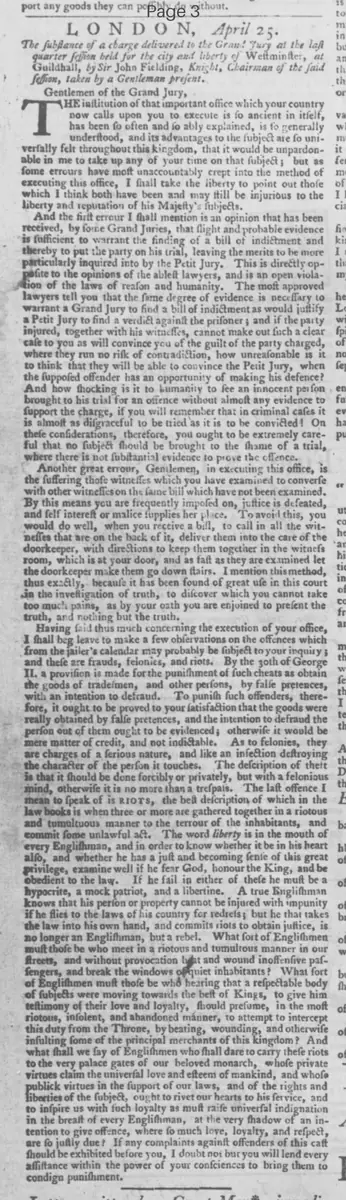
The substance of a charge delivered to the Grand Jury at the last quarter session held for the city and liberty of Westminster, at Guildhall, by Sir John Fielding, Knight, Chairman of the Said session, taken by a Gentleman present.
Gentlemen of the Grand Jury,
The institution of that important office which your country now calls upon you to execute is so ancient in itself, has been so often and so ably explained, is so generally understood, and its advantages to the subject are so universally felt throughout this kingdom, that it would be unpardonable in me to take up any of your time on that subject; but as some errors have most unaccountably crept into the method of executing this office, I shall take the liberty to point out those which I think both have been and may still be injurious to the liberty and reputation of his Majesty's subjects.
And the first error I shall mention is an opinion that has been received, by some Grand Juries, that slight and probable evidence is sufficient to warrant the finding of a bill of indictment and thereby to put the party on his trial, leaving the merits to be more particularly inquired into by the Petit Jury. This is directly opposite to the opinions of the ablest lawyers, and is an open violation of the laws of reason and humanity. The most approved lawyers tell you that the same degree of evidence is necessary to warrant a Grand Jury to find a bill of indictment as would justify a Petit Jury to find a verdict against the prisoner; and if the party injured, together with his witnesses, cannot make out such a clear case to you as will convince you of the guilt of the party charged, where they run no risk of contradiction, how unreasonable is it to think that they will be able to convince the Petit Jury, when the supposed offender has an opportunity of making his defence?
And how shocking is it to humanity to see an innocent person brought to his trial for an offence without almost any evidence to support the charge, if you will remember that in criminal cases it is almost as disgraceful to be tried as it is to be convicted! On these considerations, therefore, you ought to be extremely careful that no subject should be brought to the shame of a trial, where there is not substantial evidence to prove the offence.
Another great error, Gentlemen, in executing this office, is the suffering those witnesses which you have examined to converse with other witnesses on the same bill which have not been examined. By this means you are frequently imposed on, justice is defeated, and self interest or malice supplies her place. To avoid this, you would do well, when you receive a bill, to call in all the witnesses that are on the back of it, deliver them into the care of the doorkeeper, with directions to keep them together in the witness room, which is at your door, and as fast as they are examined let the doorkeeper make them go down stairs. I mention this method, thus exactly, because it has been found of great use in this court in the investigation of truth, to discover which you cannot take too much pains, as by your oath you are enjoined to present the truth, and nothing but the truth.
Having said thus much concerning the execution of your office, I shall beg leave to make a few observations on the offences which from the jailer's calendar may probably be subject to your inquiry; and these are frauds, felonies, and riots. By the 30th of George II. a provision is made for the punishment of such cheats as obtain the goods of tradesmen, and other persons, by false pretences, with an intention to defraud. To punish such offenders, therefore, it ought to be proved to your satisfaction that the goods were really obtained by false pretences, and the intention to defraud the person out of them ought to be evidenced; otherwise it would be mere matter of credit, and not indictable. As to felonies, they are charges of a serious nature, and like an infection destroying the character of the person it touches. The description of theft is that it should be done forcibly or privately, but with a felonious mind, otherwise it is no more than a trespass. The last offence I mean to speak of is Riots, the best description of which in the law books is when three or more are gathered together in a riotous and tumultuous manner to the terror of the inhabitants, and commit some unlawful act. The word liberty is in the mouth of every Englishman, and in order to know whether it be in his heart also, and whether he has a just and becoming sense of this great privilege, examine well if he fear God, honour the King, and be obedient to the law. If he fail in either of these he must be a hypocrite, a mock patriot, and a libertine. A true Englishman knows that his person or property cannot be injured with impunity if he flies to the laws of his country for redress; but he that takes the law into his own hand, and commits riots to obtain justice, is no longer an Englishman, but a rebel. What sort of Englishmen must those be who meet in a riotous and tumultuous manner in our streets, and without provocation beat and wound inoffensive passengers, and break the windows of quiet inhabitants? What sort of Englishmen must those be who hearing that a respectable body of subjects were moving towards the best of Kings, to give him testimony of their love and loyalty, should presume, in the most riotous, insolent, and abandoned manner, to attempt to intercept this duty from the Throne, by beating, wounding, and otherwise insulting some of the principal merchants of this kingdom? And what shall we say of Englishmen who shall dare to carry these riots to the very palace gates of our beloved monarch, whose private virtues claim the universal love and esteem of mankind, and whose public virtues in the support of our laws, and of the rights and liberties of the subject, ought to rivet our hearts to his service, and to inspire us with such loyalty as must raise universal indignation in the breast of every Englishman, at the very shadow of an intention to give offence, where so much love, loyalty, and respect, are so justly due? If any complaints against offenders of this cast should be exhibited before you, I doubt not but you will lend every assistance within the power of your consciences to bring them to condign punishment.
What sub-type of article is it?
What keywords are associated?
What entities or persons were involved?
Where did it happen?
Foreign News Details
Primary Location
Westminster, London
Event Date
April 25
Key Persons
Event Details
Sir John Fielding delivered a charge to the Grand Jury at the quarter session in Westminster, Guildhall, advising on proper execution of duties including evidence standards for indictments, witness management, and observations on offences such as frauds under 30th George II, felonies, and riots, urging punishment for rioters insulting loyal subjects near the palace.