Thank you for visiting SNEWPapers!
Sign up free
Story
March 1, 1864
Daily State Sentinel
Indianapolis, Marion County, Indiana
What is this article about?
Account of General McClellan's mistreatment by War Department officials in late August 1862, leading to Pope's defeat at Manassas, McClellan's disgrace and quick restoration to save Washington, culminating in victories at South Mountain and Antietam.
Clipping
OCR Quality
95%
Excellent
Full Text
[From the New York Journal of Commerce.]
A Page of History.
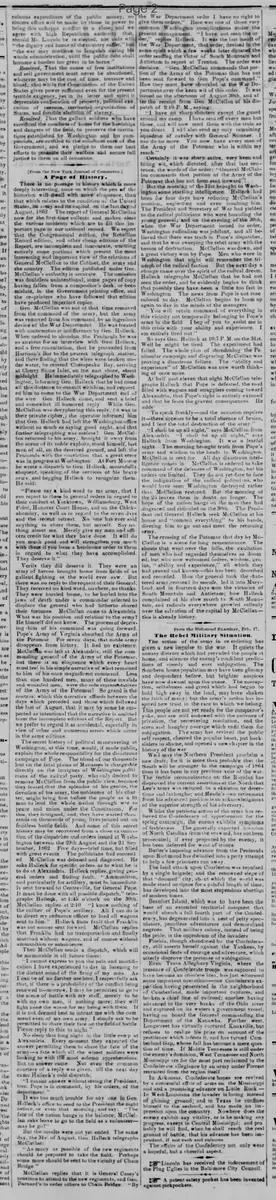
There is no passage in history which is more deeply interesting, none on which the pen of the historian will dwell with more eloquence, than that which relates to the condition of the United States, its army and its capitol, on the last day of August, 1862. The report of General McClellan now for the first time collects and makes clear the various incidents which are to fill this important page in our national record. We regret that the Congressional edition, the Rebellion Record edition, and other cheap editions of the Report, are incomplete and inaccurate, omitting entirely some portions which present the most interesting and important view of the relations of General McClellan to the Cabinet, the army and the country. The edition published under Gen. McClellan's authority is accurate. The omission was doubtless unintentional, some pages of copy having fallen from a compositor's desk; or been mislaid, in the Government printing office, and the re-printers who have followed that edition have produced imperfect copies.
Gen. McClellan was not at that time removed from the command of the army, but the army was removed from his command by an ingenious device of the War Department. He was treated with contemptuous indifference by Gen. Halleck. When ordered to abandon the Peninsula he was so anxious for an interview with Gen. Halleck, and a free consultation, that he proceeded from Harrison's Bar to the nearest telegraph station, and there finding that the wires were broken under water, he crossed Chesapeake Bay, arriving at Cherry Stone Inlet, on the east shore, about midnight. He immediately telegraphed to Washington, informing Gen. Halleck that he had come all this distance to consult with him, and requested him to come to the War Department end of the wire. Gen. Halleck came, and sent a brief and somewhat ill-humored reply. While Gen. McClellan was deciphering this reply (it was in their private cipher,) the operator informed him that Gen. Halleck had left the Washington office without so much as saying good night, and that further telegraphing was useless! Gen. McClellan returned to his army, brought it away from the scene of its noble exploits, stood himself last man of all, on the deserted ground, and left the Peninsula with the conviction that a great error was in progress at Washington. At Fort Monroe he wrote a dispatch to Gen. Halleck, mournfully eloquent, speaking of the services of his brave army, and begging Halleck to recognize them. He said:
"Please say a kind word to my army, that I can report to them in general orders in regard to their conduct at Yorktown, Williamsburg, West Point, Hanover Court House, and on the Chickahominy, as well as in regard to the seven days and the recent retreat. No one has ever said anything to cheer them, but myself. Say nothing about me. Merely give my men and officers credit for what they have done. It will do you much good and will strengthen you much with them if you issue a handsome order to them in regard to what they have accomplished. They deserve it."
Verily they did deserve it. They were an army of heroes brought home from fields of as gallant fighting as the world ever saw. But there was no reply to the request of their General. They received no kind word, no cheer, no thanks. They were hurried home, to be hurled into the jaws of death under a commander selected to displace the general who had hitherto shared their fortunes. McClellan came to Alexandria. What was his position and relation to the army? He himself did not know. The process of depriving him of his command was going forward. Pope's Army of Virginia absorbed the Army of the Potomac. For seven days, that noble army disappears from history. It had no existence. McClellan was left at Alexandria, still the commanding general of the Army of the Potomac, but there is an eloquence which every heart must feel in his simple narrative of what remained to him of his once magnificent command. Less than one hundred men, many of these invalids and wounded men, were the sole representatives of the Army of the Potomac! So grand is the contrast which this narrative affords between the days which preceded and those which followed the last of August, that it may by some be suspected as intentional that the narrative is omitted from the incomplete editions of the Report. But we prefer to regard it as accidental, especially in view of other and numerous errors which occur in the same editions.
The secret history of political maneuvering at Washington, at this time, would, if made public, explain the whole responsibility for the disastrous campaign of Pope. The blood of our thousands lost on the fatal plains of Manassas is chargeable directly on the intrigues of Washington politicians of the radical party, who only desired to remove McClellan from the public view, because they feared that the splendor of his genius, the devotion of his army, the nobleness of his character, might bring him before the people as a fit man to lead the whole nation through war to peace and union under the Constitution. For this, they intrigued, and they have wasted thousands on thousands of young lives poured out on fruitless battle fields. And some of this secret history may be recovered from a close examination of the dispatches and orders issued at Washington between the 29th August and the 21st September, 1862. Five days—brief time, but filled with great events. The politicians had succeeded. McClellan was debased and disgraced. He asks Halleck for specific orders as to what he is to do at Alexandria. Halleck replies, giving general orders and finding fault. "Ammunition, and particularly for artillery, must be immediately sent forward to Centreville, for General Pope. It must be done with all possible dispatch," telegraphs Halleck, at 1:45 o'clock on the 30th. McClellan replies at 2:10 "I know nothing of the caliber of Pope's artillery. All I can do is to direct my ordnance officer to load all wagons sent to him." Halleck finds fault that Franklin was not sooner sent forward. McClellan replies that Franklin had no transportation and finally marched without wagons, and of course without ammunition or subsistence.
Then McClellan sends a dispatch, which will be memorable in all future times:
"…I cannot express to you the pain and mortification I have experienced to-day in listening to the distant sound of the firing of my men. As I can be of no further use here, I respectfully ask that, if there is a probability of the conflict being renewed to-morrow, I may be permitted to go to the scene of battle with my staff, merely to be with my own men, if nothing more; they will fight none the worse for my being with them. If it is not deemed best to intrust me with the command even of my own army, I simply ask to be permitted to share their fate on the field of battle. Please reply to this to-night."
No sleep that long night in the little camp at Alexandria. Every moment they expected the answer permitting them to share the fate of the army—a fate which all the wisest soldiers were looking to with the most solemn apprehensions. But no answer came. Not even the common courtesy of a reply was given, till the next day came Halleck's cold dispatch:
"I cannot answer without seeing the President. Gen. Pope is in command, by his orders, of the department."
It was too much trouble for any one in Gen. Halleck's office to send to the President the night before, or even that morning, and say: "The fate of the nation hangs in the balance; McClellan asks leave to go to the field as a volunteer—may he go?"
But the insults were not yet ended. The same day, the 31st of August, Gen. Halleck telegraphs McClellan:
"As many as possible of the new regiments should be prepared to take the field. Perhaps some more should be sent to the vicinity of Chain Bridge."
McClellan replies that it is General Casey's province to attend to the new regiments, and Gen. Barnard's to order others to Chain Bridge. "By the War Department order I have no right to give them orders." Here was one of those very common Washington complications under the present management. "I have not seen the order," replies Halleck. It was the last insult of the War Department, that order, devised in the same spirit which a few weeks later dictated the order sending the victor of South Mountain and Antietam to report at Trenton. The order was decisive. "Gen. McClellan commands that portion of the Army of the Potomac that has not been sent forward to Gen. Pope's command."
How they must have chuckled at the War Department over the keen wit of this order. It was issued on the afternoon of August 30th, and after the receipt from Gen. McClellan of his dispatch of 2:10 P.M., saying:
"…I have no sharp shooters except the guard around my camp. I have sent off every man but those, and will now send them with the train as you direct. I will also send my only remaining squadron of cavalry with General Sumner. I can do no more. You now have every man of the Army of the Potomac who is within my reach."
Certainly it was sharp satire, very keen and biting wit, which dictated, after that last sentence, the words of the order: "General McClellan commands that portion of the Army of the Potomac that has not been sent forward"!
But the morning of the 31st brought to Washington some startling intelligence. Halleck had been for four days busy reducing McClellan's position, neglecting and even insulting him. The President and Secretary of War had yielded to the radical politicians who were hounding the young general; and on the evening of the 30th, when the War Department issued its order, Washington radicalism was jubilant, and all believed that there was truth in Pope's dispatches, and that he was sweeping the rebel army with the besom of destruction. McClellan was down, and a great victory won by Pope. Men who were in Washington that night will remember the triumph of the radical faction. But the next day a change came over the spirit of the radical dream. Halleck telegraphs McClellan that he had not seen the order, and he evidently begins to think that possibly they have been a little too fast in Washington. The news from Pope is not rose-colored to-day. McClellan begins to loom up again to-day in the minds of the managers. "You will retain command of everything in this vicinity not temporarily belonging to Pope's army. In the field I beg of you to assist me in this crisis with your ability and experience. I am entirely tired out."
So says Gen. Halleck at 10:47 P.M. on the 31st. Well he might be tired. The experiment had failed. The whole plan of abandoning the Peninsular campaign and disgracing McClellan was proving a disastrous failure. The "ability and experience" of McClellan was now worth thinking of once more.
At half past eleven that night McClellan telegraphs Halleck that Pope is defeated, the road filled with wagons and stragglers coming toward Alexandria, that Pope's right is entirely exposed and that he fears the gravest consequences. He adds:
"To speak frankly—and the occasion requires it—there appears to be a total absence of brains, and I fear the total destruction of the army."
"I shall be up all night," says McClellan—from Alexandria. "I shall be up all night," says Halleck from Washington. It was a fearful night. The morning brought truth from Pope's army and wisdom to the heads in Washington. McClellan is sent for. All day disastrous intelligence comes in. McClellan is ordered to take command of the defences of Washington, but his orders are limited. They do not yet dare to face the indignation of the radical politicians, who would have seen Washington destroyed rather than McClellan restored. But the morning of the 2d leaves them in doubt no longer. The hope of the nation hangs on the man they had disgraced and ridiculed on the 30th. The President and General Halleck seek McClellan at his house and "commit everything" to his hands, directing him to go out and meet the returning army.
The crossing of the Potomac that day by McClellan is a scene for long remembrance. The shouts that went over the hills, the exultation of men who had regarded themselves as doomed, but who now welcomed orders, wisdom, genius, "ability and experience," all which they had proved and known—this has been described and recorded. How the general took the shattered army, restored its morale, led it into Maryland, and in fourteen days won the victories of South Mountain and Antietam; how Halleck complained of his slow march to South Mountain, and radicals everywhere growled sullenly over the salvation of the capital by McClellan—this is already history.
A Page of History.
There is no passage in history which is more deeply interesting, none on which the pen of the historian will dwell with more eloquence, than that which relates to the condition of the United States, its army and its capitol, on the last day of August, 1862. The report of General McClellan now for the first time collects and makes clear the various incidents which are to fill this important page in our national record. We regret that the Congressional edition, the Rebellion Record edition, and other cheap editions of the Report, are incomplete and inaccurate, omitting entirely some portions which present the most interesting and important view of the relations of General McClellan to the Cabinet, the army and the country. The edition published under Gen. McClellan's authority is accurate. The omission was doubtless unintentional, some pages of copy having fallen from a compositor's desk; or been mislaid, in the Government printing office, and the re-printers who have followed that edition have produced imperfect copies.
Gen. McClellan was not at that time removed from the command of the army, but the army was removed from his command by an ingenious device of the War Department. He was treated with contemptuous indifference by Gen. Halleck. When ordered to abandon the Peninsula he was so anxious for an interview with Gen. Halleck, and a free consultation, that he proceeded from Harrison's Bar to the nearest telegraph station, and there finding that the wires were broken under water, he crossed Chesapeake Bay, arriving at Cherry Stone Inlet, on the east shore, about midnight. He immediately telegraphed to Washington, informing Gen. Halleck that he had come all this distance to consult with him, and requested him to come to the War Department end of the wire. Gen. Halleck came, and sent a brief and somewhat ill-humored reply. While Gen. McClellan was deciphering this reply (it was in their private cipher,) the operator informed him that Gen. Halleck had left the Washington office without so much as saying good night, and that further telegraphing was useless! Gen. McClellan returned to his army, brought it away from the scene of its noble exploits, stood himself last man of all, on the deserted ground, and left the Peninsula with the conviction that a great error was in progress at Washington. At Fort Monroe he wrote a dispatch to Gen. Halleck, mournfully eloquent, speaking of the services of his brave army, and begging Halleck to recognize them. He said:
"Please say a kind word to my army, that I can report to them in general orders in regard to their conduct at Yorktown, Williamsburg, West Point, Hanover Court House, and on the Chickahominy, as well as in regard to the seven days and the recent retreat. No one has ever said anything to cheer them, but myself. Say nothing about me. Merely give my men and officers credit for what they have done. It will do you much good and will strengthen you much with them if you issue a handsome order to them in regard to what they have accomplished. They deserve it."
Verily they did deserve it. They were an army of heroes brought home from fields of as gallant fighting as the world ever saw. But there was no reply to the request of their General. They received no kind word, no cheer, no thanks. They were hurried home, to be hurled into the jaws of death under a commander selected to displace the general who had hitherto shared their fortunes. McClellan came to Alexandria. What was his position and relation to the army? He himself did not know. The process of depriving him of his command was going forward. Pope's Army of Virginia absorbed the Army of the Potomac. For seven days, that noble army disappears from history. It had no existence. McClellan was left at Alexandria, still the commanding general of the Army of the Potomac, but there is an eloquence which every heart must feel in his simple narrative of what remained to him of his once magnificent command. Less than one hundred men, many of these invalids and wounded men, were the sole representatives of the Army of the Potomac! So grand is the contrast which this narrative affords between the days which preceded and those which followed the last of August, that it may by some be suspected as intentional that the narrative is omitted from the incomplete editions of the Report. But we prefer to regard it as accidental, especially in view of other and numerous errors which occur in the same editions.
The secret history of political maneuvering at Washington, at this time, would, if made public, explain the whole responsibility for the disastrous campaign of Pope. The blood of our thousands lost on the fatal plains of Manassas is chargeable directly on the intrigues of Washington politicians of the radical party, who only desired to remove McClellan from the public view, because they feared that the splendor of his genius, the devotion of his army, the nobleness of his character, might bring him before the people as a fit man to lead the whole nation through war to peace and union under the Constitution. For this, they intrigued, and they have wasted thousands on thousands of young lives poured out on fruitless battle fields. And some of this secret history may be recovered from a close examination of the dispatches and orders issued at Washington between the 29th August and the 21st September, 1862. Five days—brief time, but filled with great events. The politicians had succeeded. McClellan was debased and disgraced. He asks Halleck for specific orders as to what he is to do at Alexandria. Halleck replies, giving general orders and finding fault. "Ammunition, and particularly for artillery, must be immediately sent forward to Centreville, for General Pope. It must be done with all possible dispatch," telegraphs Halleck, at 1:45 o'clock on the 30th. McClellan replies at 2:10 "I know nothing of the caliber of Pope's artillery. All I can do is to direct my ordnance officer to load all wagons sent to him." Halleck finds fault that Franklin was not sooner sent forward. McClellan replies that Franklin had no transportation and finally marched without wagons, and of course without ammunition or subsistence.
Then McClellan sends a dispatch, which will be memorable in all future times:
"…I cannot express to you the pain and mortification I have experienced to-day in listening to the distant sound of the firing of my men. As I can be of no further use here, I respectfully ask that, if there is a probability of the conflict being renewed to-morrow, I may be permitted to go to the scene of battle with my staff, merely to be with my own men, if nothing more; they will fight none the worse for my being with them. If it is not deemed best to intrust me with the command even of my own army, I simply ask to be permitted to share their fate on the field of battle. Please reply to this to-night."
No sleep that long night in the little camp at Alexandria. Every moment they expected the answer permitting them to share the fate of the army—a fate which all the wisest soldiers were looking to with the most solemn apprehensions. But no answer came. Not even the common courtesy of a reply was given, till the next day came Halleck's cold dispatch:
"I cannot answer without seeing the President. Gen. Pope is in command, by his orders, of the department."
It was too much trouble for any one in Gen. Halleck's office to send to the President the night before, or even that morning, and say: "The fate of the nation hangs in the balance; McClellan asks leave to go to the field as a volunteer—may he go?"
But the insults were not yet ended. The same day, the 31st of August, Gen. Halleck telegraphs McClellan:
"As many as possible of the new regiments should be prepared to take the field. Perhaps some more should be sent to the vicinity of Chain Bridge."
McClellan replies that it is General Casey's province to attend to the new regiments, and Gen. Barnard's to order others to Chain Bridge. "By the War Department order I have no right to give them orders." Here was one of those very common Washington complications under the present management. "I have not seen the order," replies Halleck. It was the last insult of the War Department, that order, devised in the same spirit which a few weeks later dictated the order sending the victor of South Mountain and Antietam to report at Trenton. The order was decisive. "Gen. McClellan commands that portion of the Army of the Potomac that has not been sent forward to Gen. Pope's command."
How they must have chuckled at the War Department over the keen wit of this order. It was issued on the afternoon of August 30th, and after the receipt from Gen. McClellan of his dispatch of 2:10 P.M., saying:
"…I have no sharp shooters except the guard around my camp. I have sent off every man but those, and will now send them with the train as you direct. I will also send my only remaining squadron of cavalry with General Sumner. I can do no more. You now have every man of the Army of the Potomac who is within my reach."
Certainly it was sharp satire, very keen and biting wit, which dictated, after that last sentence, the words of the order: "General McClellan commands that portion of the Army of the Potomac that has not been sent forward"!
But the morning of the 31st brought to Washington some startling intelligence. Halleck had been for four days busy reducing McClellan's position, neglecting and even insulting him. The President and Secretary of War had yielded to the radical politicians who were hounding the young general; and on the evening of the 30th, when the War Department issued its order, Washington radicalism was jubilant, and all believed that there was truth in Pope's dispatches, and that he was sweeping the rebel army with the besom of destruction. McClellan was down, and a great victory won by Pope. Men who were in Washington that night will remember the triumph of the radical faction. But the next day a change came over the spirit of the radical dream. Halleck telegraphs McClellan that he had not seen the order, and he evidently begins to think that possibly they have been a little too fast in Washington. The news from Pope is not rose-colored to-day. McClellan begins to loom up again to-day in the minds of the managers. "You will retain command of everything in this vicinity not temporarily belonging to Pope's army. In the field I beg of you to assist me in this crisis with your ability and experience. I am entirely tired out."
So says Gen. Halleck at 10:47 P.M. on the 31st. Well he might be tired. The experiment had failed. The whole plan of abandoning the Peninsular campaign and disgracing McClellan was proving a disastrous failure. The "ability and experience" of McClellan was now worth thinking of once more.
At half past eleven that night McClellan telegraphs Halleck that Pope is defeated, the road filled with wagons and stragglers coming toward Alexandria, that Pope's right is entirely exposed and that he fears the gravest consequences. He adds:
"To speak frankly—and the occasion requires it—there appears to be a total absence of brains, and I fear the total destruction of the army."
"I shall be up all night," says McClellan—from Alexandria. "I shall be up all night," says Halleck from Washington. It was a fearful night. The morning brought truth from Pope's army and wisdom to the heads in Washington. McClellan is sent for. All day disastrous intelligence comes in. McClellan is ordered to take command of the defences of Washington, but his orders are limited. They do not yet dare to face the indignation of the radical politicians, who would have seen Washington destroyed rather than McClellan restored. But the morning of the 2d leaves them in doubt no longer. The hope of the nation hangs on the man they had disgraced and ridiculed on the 30th. The President and General Halleck seek McClellan at his house and "commit everything" to his hands, directing him to go out and meet the returning army.
The crossing of the Potomac that day by McClellan is a scene for long remembrance. The shouts that went over the hills, the exultation of men who had regarded themselves as doomed, but who now welcomed orders, wisdom, genius, "ability and experience," all which they had proved and known—this has been described and recorded. How the general took the shattered army, restored its morale, led it into Maryland, and in fourteen days won the victories of South Mountain and Antietam; how Halleck complained of his slow march to South Mountain, and radicals everywhere growled sullenly over the salvation of the capital by McClellan—this is already history.
What sub-type of article is it?
Historical Event
Military Action
Biography
What themes does it cover?
Fortune Reversal
Betrayal
Triumph
What keywords are associated?
Mcclellan
Civil War
Peninsular Campaign
Pope Defeat
Washington Politics
Manassas
South Mountain
Antietam
What entities or persons were involved?
Mcclellan
Halleck
Pope
Lincoln
Where did it happen?
Washington, Alexandria, Peninsula
Story Details
Key Persons
Mcclellan
Halleck
Pope
Lincoln
Location
Washington, Alexandria, Peninsula
Event Date
Last Day Of August, 1862
Story Details
McClellan is sidelined by War Department intrigues, his army absorbed into Pope's command leading to defeat at Manassas; McClellan pleads to join the battle but is ignored, then hastily restored to save Washington and leads victories at South Mountain and Antietam.