Thank you for visiting SNEWPapers!
Sign up free
Weekly National Intelligencer
Washington, District Of Columbia
What is this article about?
Article defends Gen. Winfield Scott against a German Locofoco newspaper's false claims of mistreating German deserters during the Mexican-American War. It reproduces his 1847 order commuting death sentences for some of 29 captured deserters from the Battalion of St. Patrick, highlighting his adherence to law and mercy. (248 characters)
Clipping
OCR Quality
Full Text
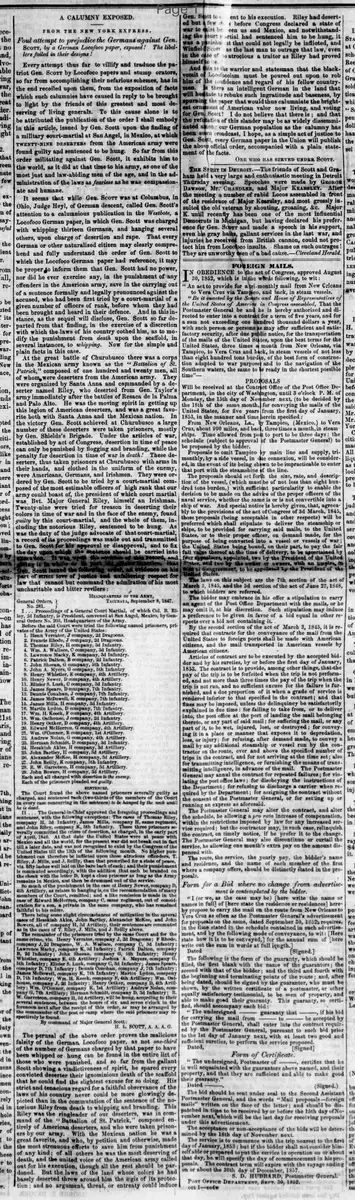
Every attempt thus far to villify and traduce the patriot Gen. SCOTT by Locofoco papers and stump orators, so far from accomplishing their nefarious schemes, has in the end recoiled upon them, from the exposition of facts which such calumnies have caused in reply to be brought to light by the friends of this greatest and most deserving of living generals. To this cause alone is to be attributed the publication of the order I shall embody in this article, issued by Gen. Scott upon the finding of a military court-martial at San Angel, in Mexico, at which TWENTY-NINE DESERTERS from the American army were found guilty and sentenced to be hung. So far from this order militating against Gen. Scott, it exhibits him to the world, as it did at that time to his army, as one of the most just and law-abiding men of the age, and in the administration of the laws as fearless as he was compassionate and humane.
It seems that while Gen. SCOTT was at Columbus, in Ohio, Judge Heyl, of German descent, called Gen. Scott's attention to a calumnious publication in the Westbote, a Locofoco German paper, in which Gen. Scott was charged with whipping thirteen Germans, and hanging several others, upon charge of desertion and rape. That every German or other naturalized citizen may clearly comprehend and fully understand the order of Gen. Scott to which the Locofoco German paper had reference, it may be proper to inform them that Gen. Scott had no power, nor did he ever exercise any, in the punishment of any offenders in the American army, save in the carrying out of a sentence formally and legally pronounced against the accused, who had been first tried by a court-martial of a given number of officers of rank, before whom they had been brought and heard in their defence. And in this instance, as the sequel will disclose, Gen. Scott so far departed from that finding, in the exercise of a discretion with which the laws of his country clothed him, as to modify the punishment from death upon the scaffold, in several instances, to whipping. Now for the simple and plain facts in this case.
At the great battle of Churubusco there was a corps in the Mexican army known as the "Battalion of St. Patrick," composed of one hundred and twenty men, all of whom were deserters from the American army. They were organized by Santa Anna and commanded by a deserter named Riley, who deserted from Gen. Taylor's army immediately after the battles of Resaca de la Palma and Palo Alto. He was the moving spirit in getting up this legion of American deserters, and was a great favorite both with Santa Anna and the Mexican nation. In the victory Gen. Scott achieved at Churubusco a large number of these deserters were taken prisoners, mostly by Gen. Shields's Brigade. Under the articles of war, established by act of Congress, desertion in time of peace can only be punished by flogging and branding, while the penalty for desertion in time of war is death! These deserters, thus taken prisoners at Churubusco with arms in their hands, and clothed in the uniform of the enemy, were Americans, Germans, and Irishmen. They were ordered by Gen. Scott to be tried by a court-martial composed of the most estimable officers of high rank that our army could boast of, the president of which court martial was Bvt. Major General Riley, himself an Irishman.
Twenty-nine were tried for treason in deserting their colors in time of war and in the face of the enemy, found guilty by this court-martial, and the whole of them, including the notorious Riley, sentenced to be hung. As was the duty of the judge advocate of that court-martial, a record of its proceedings was made out and transmitted to Gen. Scott for his approval or disapproval, and to fix the day upon which the sentence should be carried into execution.
It was ordered at San Angel in whole, after evidence on his part of strict love of justice unfaltering respect for law that cannot but command the admiration of his most uncharitable and bitter revilers:
Headquarters of the Army,
General Orders,
Tacubaya, September 8, 1847.
No. 281.
I. Proceedings of a General Court Martial, of which Col. B. Riley, 2d Infantry, is President, convened at San Angel, Mexico, by General Orders No. 203, Headquarters of the Army.
Before the said Court were tried the following named prisoners, privates of the Army of the United States:
1. Henry Verrator, J company, 2d Dragoons.
2. Francis Rhode, J company, 2d Dragoons.
3. Thomas Riley, H company, 3d Infantry.
4. Lawrence Macky, K company, 3d Infantry.
5. Wm. A. Wallace, C company, 3d Infantry.
6. Patrick Dalton, B company, 2d Infantry.
7. John Sheean, G company, 5th Infantry.
8. John A. Myers, G company, 5th Infantry.
9. Henry Whistler, E company, 4th Artillery.
10. Henry Newer, D company, 4th Artillery.
11. Elizier S. Lusk, C company, 3d Infantry.
12. James Spears, D company, 7th Infantry.
13. Dennis Conahan, J company, 7th Infantry.
14. James McDowell, K company, 7th Infantry.
15. James Mille, H company, 3d Infantry.
16. Martin Lydon, D company, 7th Infantry.
17. Wm. H. Keeck, F company, 4th Artillery.
18. Wm. Oathouse, J company, 2d Infantry.
19. Henry Octker, D company, 4th Artillery.
20. Edward McHerron, company, 4th Artillery.
21. Wm. O'Connor, R company, 1st Artillery.
22. Andrew Nolan, G company, 3d Infantry.
23. Herman Schmidt, D company, 3d Infantry.
24. Hezekiah Akles, I company, 3d Artillery.
25. John Bartley, H company, 3d Artillery.
26. Alexander McKee, H company, 3d Artillery.
27. John Reilly, K company, 5th Infantry.
28. R. W. Garretson, H company, 3d Artillery.
29. John Bowers, H company, 3d Artillery.
Each and all charged with desertion to the enemy.
Each of the prisoners pleaded not guilty.
SENTENCES.
The Court found the above named prisoners severally guilty as charged, and sentenced each (two-thirds of the members of the Court in every case concurring in the sentence) to be hanged by the neck until he is dead.
II. The General-in-Chief approved the foregoing proceedings and sentences, with the following exceptions: The cases of Thomas Riley, company H, 3d Infantry, James Mills, company H, same regiment, and John Riley, company K, 5th Infantry.
These three prisoners severally committed the crime of desertion, as charged, in the early part of April, 1846. At that date the United States were at peace with Mexico and all the world, for the present war did not break out in fact till a later date, and was not recognised to exist by the Congress of the United States till the 13th of the following month. No higher punishment can therefore be inflicted upon those atrocious offenders, T. Riley, J. Mills, and J. Reilly, than that prescribed for a state of peace, viz. fifty lashes well laid on the bare back of each; and their punishment is commuted accordingly, with the addition that each be branded on the cheek with the letter D, kept a close prisoner as long as the Army remains in Mexico, and then be drummed out of the service.
So much of the punishment in the case of Henry Newer, company D, 4th Artillery, as relates to hanging is, on the recommendation of many members of the Court, remitted; and like remission is made in the case of Edward McHerron, company, 4th Artillery, out of consideration for a private in the army who has remained faithful to his colors.
There being some slight circumstances of mitigation in the several cases of Hezekiah Akles, John Bartley, Alexander McKee, and John Bowers, all of company H, 3d Artillery, their sentences are commuted as in the cases of T. Riley, J. Mills, and J. Reilly above.
The remainder of the prisoners tried by the same Court and for the same crime, viz. Henry Verrator, company J, 2d Dragoons; Francis Rhode, company J, 2d Dragoons; W. A. Wallace, company C, 3d Infantry; Lawrence Macky, company K, 3d Infantry; Patrick Dalton, company B, 2d Infantry; John Sheean, company G, 5th Infantry; Henry Whistler, company E, 4th Artillery; Joshua A. Myers, company G, 5th Infantry; Elizier S. Lusk, company C, 3d Infantry; James Spears, company D, 7th Infantry; Dennis Conahan, company J, 7th Infantry; James McDowell, company K, 7th Infantry; Martin Lydon, company D, 7th Infantry; Wm. H. Keeck, company F, 4th Artillery; Wm. Oathouse, company J, 2d Infantry; Henry Octker, company D, 4th Artillery; Wm. O'Connor, company K, 1st Artillery; Andrew Nolan, company G, 7th Artillery; Herman Schmidt, company D, 3d Infantry; R. W. Garretson, company H, 3d Artillery, will be hung, according to their several sentences, between the hours of six and seven o'clock in the forenoon next after the receipt of this order, as may be arranged by the commander of the post or camp where the said prisoners may respectively be found.
By command of Major General Scott:
H. L. SCOTT, A. A. A. G.
The perusal of the above order proves the malicious falsity of the German, Locofoco paper, as not one-third of the number of Germans charged by that paper to have been whipped or hung can be found in the entire list of those who were punished, and so far from the gallant Scott showing a vindictiveness of spirit, he spared every convicted deserter their ignominious death of the scaffold that he could find the slightest excuse for so doing. His strict and tenacious regard for a faithful observance of the laws of his country never could be more glowingly depicted than in the commutation of the sentence of the notorious Riley from death to whipping and branding. This Riley was the ringleader of our deserters, was in command of the "Battalion of St. Patrick," composed entirely of American deserters, and who were taken prisoners by our army. With the Mexican nation he was a great favorite, and who, by petition and otherwise, made the most strenuous efforts to save him from punishment of any kind; of all others he was the most deserving of death, and the united voice of the American army called out for his execution, though all the rest should be pardoned. But the laws of the land whose colors he had basely deserted threw around him the aegis of its protection; and no argument, threat or entreaty could induce Gen. Scott to his execution. Riley had deserted but few days before Congress declared a state of war to exist between us and Mexico, and notwithstanding the court martial had sentenced him to be hung, it was a punishment that could not legally be inflicted, and Winfield Scott was the last man to outrage that law, even in the case of so atrocious a traitor as Riley had proved himself to be.
And this is the warrior and statesman that the black vomit of Locofocoism must be poured out upon to rob him of the confidence and regard of his fellow countrymen. Is there an intelligent German in the land that will hesitate to rebuke such ingratitude and baseness, by spurning the paper that would thus calumniate the brightest ornament of American valor now living, and voting for Gen. Scott? I do not believe that there is; and that the refutation of this slander may be as widely disseminated among our German population as the calumny has been sown broadcast, I hope, as a simple act of justice to Gen. Scott, every German paper in the Union will publish the above official order, accompanied with a plain statement of the facts.
ONE WHO HAS SERVED UNDER SCOTT.
What sub-type of article is it?
What themes does it cover?
What keywords are associated?
What entities or persons were involved?
Where did it happen?
Story Details
Key Persons
Location
San Angel, Mexico; Tacubaya, Mexico; Churubusco, Mexico; Columbus, Ohio
Event Date
September 8, 1847; Early Part Of April, 1846
Story Details
A German Locofoco paper falsely accused Gen. Scott of whipping thirteen Germans and hanging several for desertion and rape. The article exposes this libel by detailing Gen. Scott's General Order No. 281, approving a court-martial that sentenced 29 deserters from the Battalion of St. Patrick to hang, but commuting sentences for several, including leader Riley, to whipping and branding due to legal distinctions between peace and war times, demonstrating Scott's justice and humanity.