Thank you for visiting SNEWPapers!
Sign up free
Editorial
January 22, 1816
Kentucky Gazette
Lexington, Fayette County, Kentucky
What is this article about?
An editorial criticizes the U.S. Post Office for charging postage on letters delivered late or not at all, despite promises of timely service, especially as the Treasury Secretary proposes using it as a revenue source. It cites examples of delays and urges a law for justice to customers.
Clipping
OCR Quality
95%
Excellent
Full Text
THE POST OFFICE.
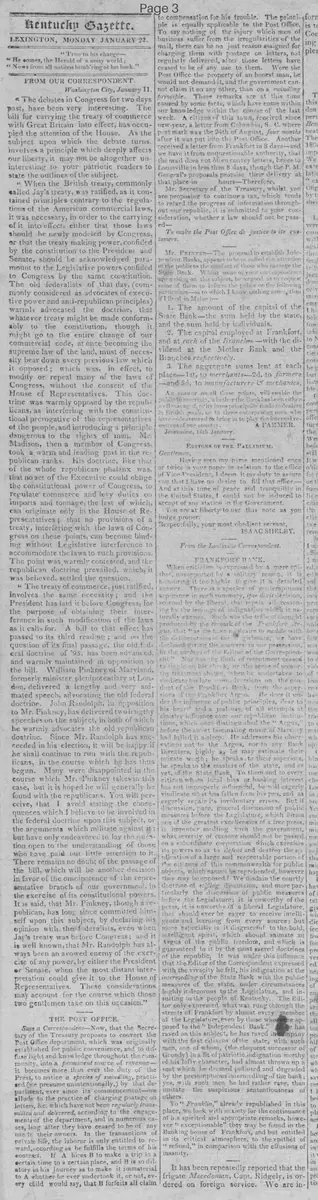
Says a Correspondent—Now, that the Secretary of the Treasury proposes to convert the Post Office department, which was originally established for public convenience, and to diffuse light and knowledge throughout the community, into a permanent source of revenue—it becomes more than ever the duty of the Press, to notice a species of swindling, practiced (we presume unintentionally,) by that department, ever since its commencement—we allude to the practice of charging postage on letters, &c. which have not been regularly transmitted and delivered, according to the engagements of the department, and in numerous cases, long after they have ceased to be of any use to their owners. In the transactions of private life, the laborer is only entitled to reward, according as he fulfills the terms of his contract. If A hires B to make a trip in a certain time to a certain place, and B is so dilatory on his journey as to make it immaterial to A whether he ever undertook it, or not, every child would say, that B forfeits all claim to compensation for his trouble. The principle is equally applicable to the Post Office. To say nothing of the injury which men of business suffer from the irregularities of the mail, there can be no just reason assigned for charging them with postage on letters, not regularly delivered, after those letters have ceased to be of any use to them. Were the Post Office the property of an honest man, he would not demand it, and the government cannot claim it on any other, than on a swindling principle. These remarks are at this time caused by some facts, which have come within our knowledge within the course of the last week. A citizen of this town, received since new-year, a letter from Columbia, S. C. where post mark was the 24th of August four months after it was put into the Post Office. Another received a letter from Frankfort in 8 days—and we have it from unquestionable authority, that the mail does not often convey letters, hence to Louisville in less than 8 days, though the P. M. General's proposals promise their delivery at that place in 48 hours—Therefore.
Mr. Secretary of the Treasury, whilst you are proposing to continue a tax, which tends to retard the progress of information throughout our republic, it is submitted to your consideration, whether a law should not be passed—
To make the Post Office do justice to its customers.
Says a Correspondent—Now, that the Secretary of the Treasury proposes to convert the Post Office department, which was originally established for public convenience, and to diffuse light and knowledge throughout the community, into a permanent source of revenue—it becomes more than ever the duty of the Press, to notice a species of swindling, practiced (we presume unintentionally,) by that department, ever since its commencement—we allude to the practice of charging postage on letters, &c. which have not been regularly transmitted and delivered, according to the engagements of the department, and in numerous cases, long after they have ceased to be of any use to their owners. In the transactions of private life, the laborer is only entitled to reward, according as he fulfills the terms of his contract. If A hires B to make a trip in a certain time to a certain place, and B is so dilatory on his journey as to make it immaterial to A whether he ever undertook it, or not, every child would say, that B forfeits all claim to compensation for his trouble. The principle is equally applicable to the Post Office. To say nothing of the injury which men of business suffer from the irregularities of the mail, there can be no just reason assigned for charging them with postage on letters, not regularly delivered, after those letters have ceased to be of any use to them. Were the Post Office the property of an honest man, he would not demand it, and the government cannot claim it on any other, than on a swindling principle. These remarks are at this time caused by some facts, which have come within our knowledge within the course of the last week. A citizen of this town, received since new-year, a letter from Columbia, S. C. where post mark was the 24th of August four months after it was put into the Post Office. Another received a letter from Frankfort in 8 days—and we have it from unquestionable authority, that the mail does not often convey letters, hence to Louisville in less than 8 days, though the P. M. General's proposals promise their delivery at that place in 48 hours—Therefore.
Mr. Secretary of the Treasury, whilst you are proposing to continue a tax, which tends to retard the progress of information throughout our republic, it is submitted to your consideration, whether a law should not be passed—
To make the Post Office do justice to its customers.
What sub-type of article is it?
Economic Policy
Taxation
Infrastructure
What keywords are associated?
Post Office
Postage Charges
Mail Delays
Treasury Secretary
Postal Revenue
Government Swindling
What entities or persons were involved?
Secretary Of The Treasury
Post Office Department
P. M. General
Editorial Details
Primary Topic
Criticism Of Post Office Inefficiencies And Unjust Postage Charges
Stance / Tone
Strongly Critical Of Post Office Practices And Revenue Proposals
Key Figures
Secretary Of The Treasury
Post Office Department
P. M. General
Key Arguments
Post Office Was Meant For Public Convenience, Not Revenue
Charging Postage For Undelivered Or Late Letters Is Swindling
Private Contract Principles Apply: No Fulfillment, No Payment
Examples Of Delays: Letter From Columbia S.C. Took 4 Months, Frankfort 8 Days, Louisville Over 8 Days Vs. Promised 48 Hours
Suggest Law To Ensure Post Office Justice To Customers