Thank you for visiting SNEWPapers!
Sign up free
Literary
August 10, 1803
The National Intelligencer And Washington Advertiser
Washington, District Of Columbia
What is this article about?
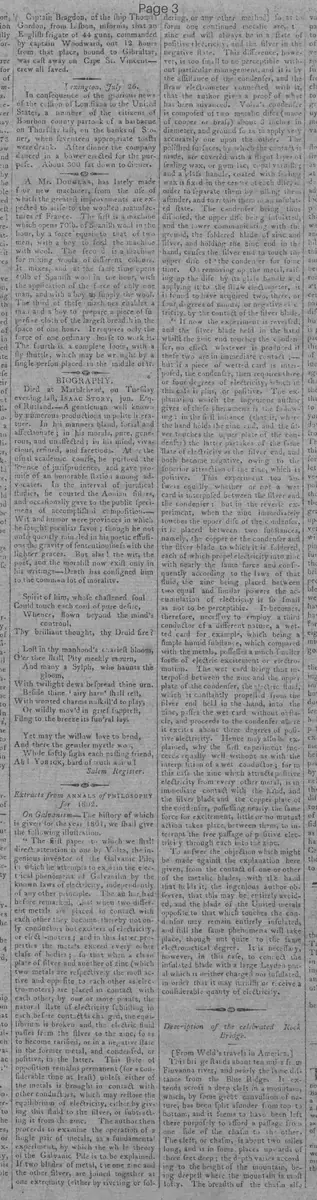
Extract from Annals of Philosophy (1802) detailing Volta's explanation of Galvanism through electrical principles. Describes experiments with zinc and silver metals, their contact effects on electricity, using a condenser and electrometer to demonstrate positive and negative states, with or without interposed wet card.
Clipping
OCR Quality
95%
Excellent
Full Text
Extracts from ANNALS of PHILOSOPHY
for 1802.
On Galvanism—The history of which
is given for the year 1801, we shall give
the following illustration.
"The first paper to which we shall
direct attention is one by Volta, the ingenious
inventor of the Galvanic Pile,
in which he attempts to explain the electrical
phenomena of Galvanism by the
known laws of electricity, independently
of any other principle. The author had
before remarked, that when two different
metals are placed in contact with
each other they become thereby not only
conductors but exciters of electricity,
or electro-motors; and in this latter property
the metals exceed every other
class of bodies: so that when a clean
plate of silver and another of zinc (which
two metals are respectively the most active
and opposite to each other as electro-motors)
are placed in contact with
each other, by one or more points, the
natural state of electricity subsisting in
each before contact is changed, the equilibrium
is broken and the electric fluid
passes from the silver to the zinc, so as
to become rarefied, or in a negative state
in the former metal, and condensed, or
positive, in the latter. This state of
opposition remains permanent (for a considerable
time at least) unless either of
the metals is brought in contact with
other conductors, which may restore the
equilibrium of electricity, either by giving
this fluid to the silver, or subtracting
it from the zinc. The author then
proceeds to examine the operation of a
single pair of metals, as a fundamental
experiment, by which the whole theory
of the Galvanic Pile is to be explained.
If two blades of metal, the one zinc and
the other silver, are joined together at
one extremity (either by riveting or soldering,
or any other method) so as to
form one continued metallic arc, the
zinc end will always be in a state of
positive electricity, and the silver in the
negative state. This difference, however,
is too small to be perceptible without
particular management, and it is by
the assistance of the condenser, and the
straw electrometer connected with it,
that the author gives a proof of what
has been advanced. Volta's condenser
is composed of two metallic discs (made
of copper or brass) about 3 inches in
diameter, and ground so as to apply very
accurately one upon the other. The
polished surfaces, by which the contact is
made, are covered with a slight layer of
sealing wax, or gum lac, copal varnish;
and a glass handle, coated with sealing
wax is fixed in the center of each disc, in
order to separate them by pulling them
asunder, and to retain them in an insulated
state. The condenser being thus
dissolved, the upper disc being insulated,
and the lower communicating with the
ground, the soldered blade of zinc and
silver, and holding the zinc end in the
hand, causes the silver end to touch the
upper disc of the condenser for some
time. On removing up the metal, raising
up the disc by its glass handle and
applying it to the straw electrometer, it
is found to have acquired two, three, or
four degrees of minus, or negative electricity,
by the contact of the silver blade.
If now the experiment is reversed,
and the silver blade held in the hand
whilst the zinc end touches the condenser,
no effect whatever is produced if
these two are in immediate contact;—
but if a piece of wetted card is interposed,
the condenser then requires three
or four degrees of electricity, which in
this case is plus, or positive. The explanation
which the ingenious author
gives of these phenomena is the following:
in the first instance (that is, where
the hand holds the zinc end, and the silver
touches the upper plate of the condenser)
the latter partakes of the same
state of electricity as the silver end, and
both become negative, owing to the
superior attraction of the zinc, which is
positive. This experiment too answers
equally, whether or not a wet
card is interposed between the silver and
the condenser; but in the reverse experiment,
when the zinc immediately
touches the upper disc of the condenser,
it is placed between two substances,
namely, the copper of the condenser and
the silver blade to which it is soldered,
each of which propel electricity into zinc
with nearly the same force and consequently
according to the laws of that
fluid, the zinc being placed between
two equal and similar powers the accumulation
of electricity is so small
as not to be perceptible. It becomes,
therefore, necessary to employ a third
conductor of a different nature, a wetted
card for example, which being a
simple humid substance, which compared
with the metals possesses a much smaller
force of electric excitement or electro-motion.
The wet card being thus interposed
between the zinc and the upper
plate of the condenser, the electric fluid,
which is constantly propelled from the
silver end held in the hand, into the
zinc, passes the wet card without obstacle,
and proceeds to the condenser where
it excites about three degrees of positive
electricity. Hence may also be explained,
why the first experiment succeeds
equally well without as with the
interposition of a wet conductor; for in
this case the zinc which attracts positive
electricity from every other metal, is in
immediate contact with the hand, and
the silver blade and the copper plate of
the condenser, possessing nearly the same
force or excitement, little or no mutual
action takes place, between them, to interrupt
the free passage of positive electricity
through each into the zinc.
To answer the objection which might
be made against the explanation here
given, from the contact of one or other
of the metallic blades, with the hand
that holds it, the ingenious author observes,
that this may be entirely avoided,
and the blade of the united metals
opposite to that which touches the condenser
may remain entirely insulated,
and still the same phenomena will take
place, though not quite to the same
electrometrical degree. It is necessary,
however, in this case, to connect the
insulated blade with a large Leyden phial
which is neither charged nor insulated,
in order that it may furnish or receive a
considerable quantity of electricity.
for 1802.
On Galvanism—The history of which
is given for the year 1801, we shall give
the following illustration.
"The first paper to which we shall
direct attention is one by Volta, the ingenious
inventor of the Galvanic Pile,
in which he attempts to explain the electrical
phenomena of Galvanism by the
known laws of electricity, independently
of any other principle. The author had
before remarked, that when two different
metals are placed in contact with
each other they become thereby not only
conductors but exciters of electricity,
or electro-motors; and in this latter property
the metals exceed every other
class of bodies: so that when a clean
plate of silver and another of zinc (which
two metals are respectively the most active
and opposite to each other as electro-motors)
are placed in contact with
each other, by one or more points, the
natural state of electricity subsisting in
each before contact is changed, the equilibrium
is broken and the electric fluid
passes from the silver to the zinc, so as
to become rarefied, or in a negative state
in the former metal, and condensed, or
positive, in the latter. This state of
opposition remains permanent (for a considerable
time at least) unless either of
the metals is brought in contact with
other conductors, which may restore the
equilibrium of electricity, either by giving
this fluid to the silver, or subtracting
it from the zinc. The author then
proceeds to examine the operation of a
single pair of metals, as a fundamental
experiment, by which the whole theory
of the Galvanic Pile is to be explained.
If two blades of metal, the one zinc and
the other silver, are joined together at
one extremity (either by riveting or soldering,
or any other method) so as to
form one continued metallic arc, the
zinc end will always be in a state of
positive electricity, and the silver in the
negative state. This difference, however,
is too small to be perceptible without
particular management, and it is by
the assistance of the condenser, and the
straw electrometer connected with it,
that the author gives a proof of what
has been advanced. Volta's condenser
is composed of two metallic discs (made
of copper or brass) about 3 inches in
diameter, and ground so as to apply very
accurately one upon the other. The
polished surfaces, by which the contact is
made, are covered with a slight layer of
sealing wax, or gum lac, copal varnish;
and a glass handle, coated with sealing
wax is fixed in the center of each disc, in
order to separate them by pulling them
asunder, and to retain them in an insulated
state. The condenser being thus
dissolved, the upper disc being insulated,
and the lower communicating with the
ground, the soldered blade of zinc and
silver, and holding the zinc end in the
hand, causes the silver end to touch the
upper disc of the condenser for some
time. On removing up the metal, raising
up the disc by its glass handle and
applying it to the straw electrometer, it
is found to have acquired two, three, or
four degrees of minus, or negative electricity,
by the contact of the silver blade.
If now the experiment is reversed,
and the silver blade held in the hand
whilst the zinc end touches the condenser,
no effect whatever is produced if
these two are in immediate contact;—
but if a piece of wetted card is interposed,
the condenser then requires three
or four degrees of electricity, which in
this case is plus, or positive. The explanation
which the ingenious author
gives of these phenomena is the following:
in the first instance (that is, where
the hand holds the zinc end, and the silver
touches the upper plate of the condenser)
the latter partakes of the same
state of electricity as the silver end, and
both become negative, owing to the
superior attraction of the zinc, which is
positive. This experiment too answers
equally, whether or not a wet
card is interposed between the silver and
the condenser; but in the reverse experiment,
when the zinc immediately
touches the upper disc of the condenser,
it is placed between two substances,
namely, the copper of the condenser and
the silver blade to which it is soldered,
each of which propel electricity into zinc
with nearly the same force and consequently
according to the laws of that
fluid, the zinc being placed between
two equal and similar powers the accumulation
of electricity is so small
as not to be perceptible. It becomes,
therefore, necessary to employ a third
conductor of a different nature, a wetted
card for example, which being a
simple humid substance, which compared
with the metals possesses a much smaller
force of electric excitement or electro-motion.
The wet card being thus interposed
between the zinc and the upper
plate of the condenser, the electric fluid,
which is constantly propelled from the
silver end held in the hand, into the
zinc, passes the wet card without obstacle,
and proceeds to the condenser where
it excites about three degrees of positive
electricity. Hence may also be explained,
why the first experiment succeeds
equally well without as with the
interposition of a wet conductor; for in
this case the zinc which attracts positive
electricity from every other metal, is in
immediate contact with the hand, and
the silver blade and the copper plate of
the condenser, possessing nearly the same
force or excitement, little or no mutual
action takes place, between them, to interrupt
the free passage of positive electricity
through each into the zinc.
To answer the objection which might
be made against the explanation here
given, from the contact of one or other
of the metallic blades, with the hand
that holds it, the ingenious author observes,
that this may be entirely avoided,
and the blade of the united metals
opposite to that which touches the condenser
may remain entirely insulated,
and still the same phenomena will take
place, though not quite to the same
electrometrical degree. It is necessary,
however, in this case, to connect the
insulated blade with a large Leyden phial
which is neither charged nor insulated,
in order that it may furnish or receive a
considerable quantity of electricity.
What sub-type of article is it?
Essay
What keywords are associated?
Galvanism
Volta
Galvanic Pile
Electricity
Zinc
Silver
Condenser
Electrometer
What entities or persons were involved?
Volta
Literary Details
Title
Extracts From Annals Of Philosophy For 1802. On Galvanism
Author
Volta
Subject
History Of Galvanism For The Year 1801
Form / Style
Prose Scientific Explanation
Key Lines
The First Paper To Which We Shall Direct Attention Is One By Volta, The Ingenious Inventor Of The Galvanic Pile, In Which He Attempts To Explain The Electrical Phenomena Of Galvanism By The Known Laws Of Electricity, Independently Of Any Other Principle.
If Two Blades Of Metal, The One Zinc And The Other Silver, Are Joined Together At One Extremity... The Zinc End Will Always Be In A State Of Positive Electricity, And The Silver In The Negative State.
Hence May Also Be Explained, Why The First Experiment Succeeds Equally Well Without As With The Interposition Of A Wet Conductor...