Thank you for visiting SNEWPapers!
Sign up free
Norfolk Gazette And Publick Ledger
Norfolk, Virginia
What is this article about?
In 1808, the U.S. Supreme Court, led by Chief Justice Marshall, reversed a lower court ruling in Fitzsimmons v. Newport Insurance Co. The case involved an insurance claim on the brig John, captured by British forces for attempting to enter blockaded Cadiz in 1800. The Court held the foreign condemnation did not falsify the warranty of American ownership, allowing recovery.
Clipping
OCR Quality
Full Text
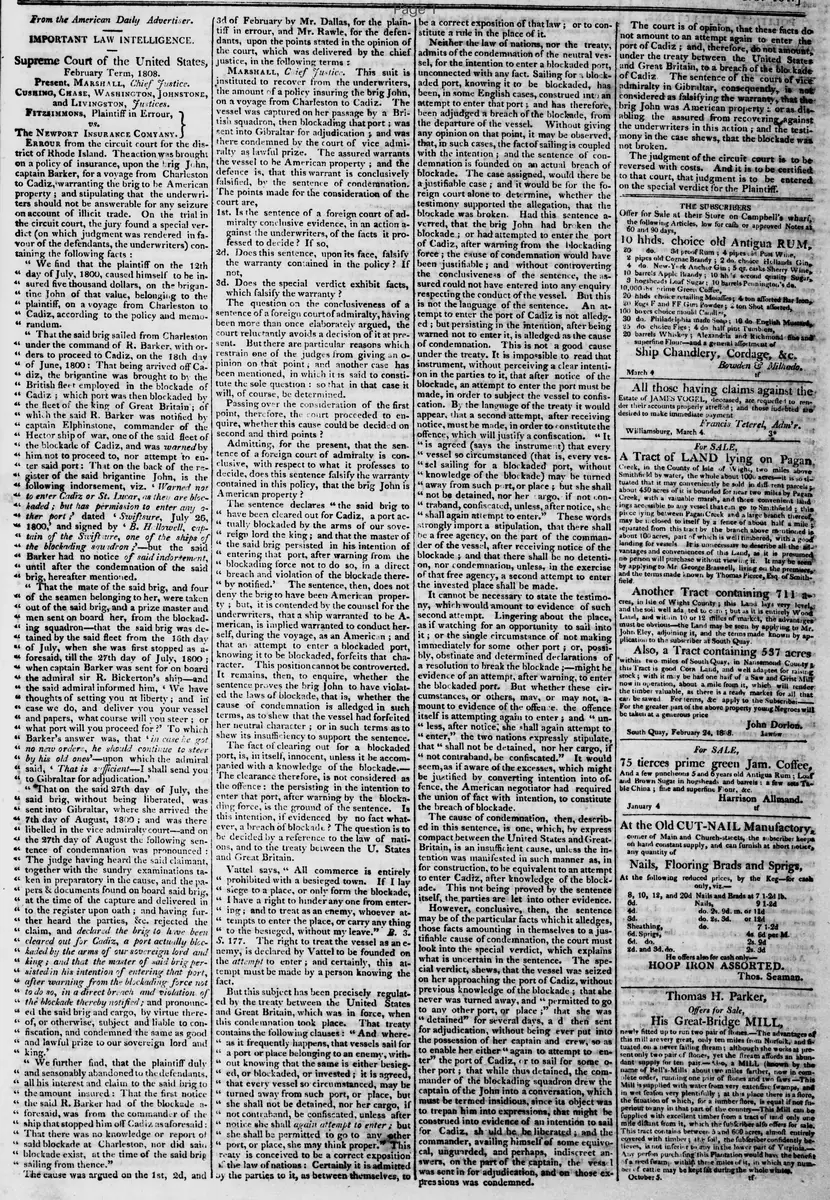
IMPORTANT LAW INTELLIGENCE.
Supreme Court of the United States,
February Term, 1808.
Present. MARSHALL, Chief Justice.
Cushing, Chase, Washington, Johnstone,
and Livingston, Justices.
Fitzsimmons, Plaintiff in Error,
vs.
The Newport Insurance Company.
Error from the circuit court for the district of Rhode Island. The action was brought on a policy of insurance, upon the brig John, captain Barker, for a voyage from Charleston to Cadiz, warranting the brig to be American property; and stipulating that the underwriters should not be answerable for any seizure on account of illicit trade. On the trial in the circuit court, the jury found a special verdict (on which judgment was rendered in favour of the defendants, the underwriters) containing the following facts:
"We find that the plaintiff on the 12th
day of July, 1800, caused himself to be insured five thousand dollars, on the brigantine John of that value, belonging to the
plaintiff, on a voyage
from Charleston to
Cadiz, according to the policy and memorandum.
"That the said brig sailed from Charleston under the command of R. Barker, with orders to proceed to Cadiz, on the 18th day of June, 1800: That being arrived off Cadiz, the brigantine was brought to by the British fleet employed in the blockade of Cadiz; which port was then blockaded by the fleet of the king of Great Britain; of which the said R. Barker was notified by captain Elphinstone, commander of the Hector ship of war, one of the said fleet of the blockade of Cadiz, and was warned by him not to proceed to, nor attempt to enter said port: That on the back of the register of the said brigantine John, is the following indorsement, viz. 'Warned not to enter Cadiz or St. Lucar, as they are blockaded; but has permission to enter any other port; dated Swiftsure, July 26, 1800,' and signed by 'B. Hallowell, captain of the Swiftsure, one of the ships of the blockading squadron;---but the said Barker had no notice of said indorsement, until after the condemnation of the said brig, hereafter mentioned.
"That the mate of the said brig, and four of the seamen belonging to her, were taken out of the said brig, and a prize master and men sent on board her, from the blockading squadron--that the said brig was detained by the said fleet from the 15th day of July, when she was first stopped as aforesaid, till the 27th day of July, 1800; when captain Barker was sent for on board the admiral sir R. Bickerton's ship and the said admiral informed him, 'We have thoughts of setting you at liberty; and in case we do, and deliver you your vessel and papers, what course will you steer; or what port will you proceed for?' To which Barker's answer was, that 'in case he got no new orders, he should continue to steer by his old ones'--upon which the admiral said, 'That is sufficient--I shall send you to Gibraltar for adjudication.'
"That on the said 27th day of July, the said brig, without being liberated, was sent into Gibraltar, where she arrived the 7th day of August, 1800; and was there libelled in the vice admiralty court--and on the 27th day of August the following sentence of condemnation was pronounced:
The judge having heard the said claimant, together with the sundry examinations taken in preparatory in the cause, and the papers & documents found on board said brig, at the time of the capture and delivered into the register upon oath; and having further heard the parties, &c. rejected the claim, and declared the brig to have been cleared out for Cadiz, a port actually blockaded by the arms of our sovereign lord the king; and that the master of said brig persisted in his intention of entering that port, after warning from the blockading force not to do so, in a direct breach and violation of the blockade thereby notified; and pronounced the said brig and cargo, by virtue thereof, or otherwise, subject and liable to confiscation, and condemned the same as good and lawful prize to our sovereign lord the king.
"We further find, that the plaintiff duly and seasonably abandoned to the defendants, all his interest and claim to the said brig to the amount insured: That the first notice the said R. Barker had of the blockade aforesaid, was from the commander of the ship that stopped him off Cadiz, as aforesaid: That there was no knowledge or report of said blockade at Charleston, nor did said blockade exist, at the time of the said brig sailing from thence.
The cause was argued on the 1st, 2d, and 3d of February by Mr. Dallas, for the plaintiff in error, and Mr. Rawle, for the defendants, upon the points stated in the opinion of the court, which was delivered by the chief justice, in the following terms:
MARSHALL, Chief Justice. This suit is instituted to recover from the underwriters, the amount of a policy insuring the brig John, on a voyage from Charleston to Cadiz. The vessel was captured on her passage by a British squadron, then blockading that port; was sent into Gibraltar for adjudication: and was there condemned by the court of vice admiralty as lawful prize. The assured warrants the vessel to be American property; and the defence is, that this warrant is conclusively falsified by the sentence of condemnation.
The points made for the consideration of the court are,
1st. Is the sentence of a foreign court of admiralty conclusive evidence, in an action against the underwriters, of the facts it professed to decide? If so,
2d. Does this sentence, upon its face, falsify the warranty contained in the policy? If not,
3d. Does the special verdict exhibit facts, which falsify the warranty
The question on the conclusiveness of a sentence of a foreign court of admiralty, having been more than once elaborately argued, the court reluctantly avoids a decision of it at present. But there are particular reasons which restrain one of the judges from giving an opinion on that point: and another case has been mentioned, in which it is said to constitute the sole question: so that in that case it will, of course, be determined.
Passing over the consideration of the first point, therefore, the court proceeded to enquire, whether this cause could be decided on the second and third points?
Admitting, for the present, that the sentence of a foreign court of admiralty is conclusive, with respect to what it professes to decide, does this sentence falsify the warranty contained in this policy, that the brig John is American property?
The sentence declares "the said brig to have been cleared out for Cadiz, a port actually blockaded by the arms of our sovereign lord the king; and that the master of the said brig persisted in his intention of entering that port, after warning from the blockading force not to do so, in a direct breach and violation of the blockade thereby notified." The sentence, then, does not deny the brig to have been American property; but, it is contended by the counsel for the underwriters, that a ship warranted to be American, is impliedly warranted to conduct herself, during the voyage, as an American; and that an attempt to enter a blockaded port, knowing it to be blockaded, forfeits that character. This position cannot be controverted.
It remains, then, to enquire, whether the sentence proves the brig John to have violated the laws of blockade, that is, whether the cause of condemnation is alleged in such terms, as to shew that the vessel had forfeited her neutral character; or in such terms as to shew its insufficiency to support the sentence.
The fact of clearing out for a blockaded port, is, in itself, innocent, unless it be accompanied with a knowledge of the blockade.-- The clearance therefore, is not considered as the offence: the persisting in the intention to enter that port, after warning by the blockading force, is the ground of the sentence. Is this intention, if evidenced by no fact whatever, a breach of blockade? The question is to be decided by a reference to the law of nations, and to the treaty between the U. States and Great Britain.
Vattel says, "All commerce is entirely prohibited with a besieged town. If I lay siege to a place, or only form the blockade, I have a right to hinder any one from entering; and to treat as an enemy, whoever attempts to enter the place, or carry any thing to the besieged, without my leave." B. 3. S. 177. The right to treat the vessel as an enemy, is declared by Vattel to be founded on the attempt to enter; and certainly, this attempt must be made by a person knowing the fact.
But this subject has been precisely regulated by the treaty between the United States and Great Britain, which was in force, when this condemnation took place. That treaty contains the following clauses: "And whereas it frequently happens, that vessels sail for a port or place belonging to an enemy, without knowing that the same is either besieged, or blockaded, or invested; it is agreed, that every vessel so circumstanced, may be turned away from such port, or place, but she shall not be detained, nor her cargo, if not contraband, be confiscated, unless after notice she shall again attempt to enter; but she shall be permitted to go to any other port, or place, she may think proper." This treaty is conceived to be a correct exposition of the law of nations: Certainly it is admitted by the parties to it, as between themselves, to be a correct exposition of that law; or to constitute a rule in the place of it.
Neither the law of nations, nor the treaty, admits of the condemnation of the neutral vessel, for the intention to enter a blockaded port, unconnected with any act. Sailing for a blockaded port, knowing it to be blockaded, has been, in some English cases, construed into an attempt to enter that port; and has therefore been adjudged a breach of the blockade, from the departure of the vessel. Without giving any opinion on that point, it may be observed, that, in such cases, the fact of sailing is coupled with the intention; and the sentence of condemnation is founded on an actual breach of blockade. The case assigned, would then be a justifiable case; and it would be for the foreign court alone to determine, whether the testimony supported the allegation, that the blockade was broken. Had this sentence averred, that the brig John had broken the blockade; or had attempted to enter the port of Cadiz, after warning from the blockading force; the cause of condemnation would have been justifiable; and without controverting the conclusiveness of the sentence, the assured could not have entered into any enquiry respecting the conduct of the vessel. But this is not the language of the sentence. An attempt to enter the port of Cadiz is not alleged; but persisting in the intention, after being warned not to enter it, is alleged as the cause of condemnation. This is not a good cause under the treaty. It is impossible to read that instrument, without perceiving a clear intention in the parties to it, that after notice of the blockade, an attempt to enter the port must be made, in order to subject the vessel to confiscation. By the language of the treaty it would appear, that a second attempt, after receiving notice, must be made, in order to constitute the offence, which will justify a confiscation. "It is agreed (says the instrument) that every vessel so circumstanced (that is, every vessel sailing for a blockaded port, without knowledge of the blockade) may be turned away from such port, or place; but she shall not be detained, nor her cargo, if not contraband, confiscated, unless, after notice, she shall again attempt to enter." These words strongly import a stipulation, that there shall be a free agency, on the part of the commander of the vessel, after receiving notice of the blockade; and that there shall be no detention, nor condemnation, unless, in the exercise of that free agency, a second attempt to enter the invested place shall be made.
It cannot be necessary to state the testimony, which would amount to evidence of such second attempt. Lingering about the place, as if watching for an opportunity to sail into it; or the single circumstance of not making immediately for some other port; or, possibly, obstinate and determined declarations of a resolution to break the blockade;--might be evidence of an attempt, after warning, to enter the blockaded port. But whether these circumstances, or others, may, or may not, amount to evidence of the offence, the offence itself is attempting again to enter; and "unless, after notice, she shall again attempt to enter," the two nations expressly stipulate, that "she shall not be detained, nor her cargo, if not contraband, be confiscated." It would seem, as if aware of the excesses, which might be justified by converting intention into offence, the American negotiator had required the union of fact with intention, to constitute the breach of blockade.
The cause of condemnation, then, described in this sentence, is one, which, by express compact between the United States and Great Britain, is an insufficient cause, unless the intention was manifested in such manner as, in law, to be equivalent to an attempt to enter Cadiz, after knowledge of the blockade. This not being proved by the sentence itself, the parties are let into other evidence.
However conclusive, then, the sentence may be of the particular facts which it alleges, those facts amounting in themselves to a justifiable cause of condemnation, the court must look into the special verdict, which explains what is uncertain in the sentence. The special verdict, shews, that the vessel was seized on her approaching the port of Cadiz, without previous knowledge of the blockade; that she never was turned away, and "permitted to go to any other port, or place;" that she was "detained" for several days, and then sent for adjudication, without being ever put into the possession of her captain and crew, so as to enable her either "again to attempt to enter" the port of Cadiz, or to sail for some other port; that while thus detained, the commander of the blockading squadron drew the captain of the John into a conversation, which must be termed insidious, since its object was to trepan him into expressions, that might be construed into evidence of an intention to sail for Cadiz, should he be liberated; and the commander, availing himself of some equivocal, unguarded, and perhaps, indiscreet answers, on the part of the captain, the vessel was sent in for adjudication, and on those expressions was condemned.
The court is of opinion, that these facts do not amount to an attempt again to enter the port of Cadiz; and, therefore, do not amount, under the treaty between the United States and Great Britain, to a breach of the blockade of Cadiz. The sentence of the court of vice admiralty in Gibraltar, consequently, is not considered as falsifying the warranty, that the brig John was American property: or as disabling the assured from recovering against the underwriters in this action; and the testimony in the case shews, that the blockade was not broken.
The judgment of the circuit court is to be reversed with costs. And it is to be certified to that court, that judgment is to be entered on the special verdict for the Plaintiff.
What sub-type of article is it?
What themes does it cover?
What keywords are associated?
What entities or persons were involved?
Where did it happen?
Story Details
Key Persons
Location
Voyage From Charleston To Cadiz, Blockaded Off Cadiz, Adjudicated In Gibraltar
Event Date
February Term, 1808
Story Details
The brig John, insured by Fitzsimmons as American property for a voyage from Charleston to Cadiz, was stopped by the British blockading fleet off Cadiz in July 1800, warned of the blockade, detained, and condemned in Gibraltar for persisting in intent to enter despite warning. The U.S. Supreme Court ruled this did not constitute a breach under the U.S.-British treaty, as no actual attempt after notice occurred, reversing the lower court's denial of the insurance claim.