Thank you for visiting SNEWPapers!
Sign up free
Norfolk Gazette And Publick Ledger
Norfolk, Virginia
What is this article about?
In the U.S. House of Representatives on February 20, Mr. Gardenier of New York delivers a speech opposing a bill to extend the embargo act by prohibiting land exports, arguing it promotes non-intercourse, harms national resources, and deviates from President Jefferson's original intent to protect vessels at sea.
Clipping
OCR Quality
Full Text
Reported for the United States' Gazette.
Saturday, February 20.
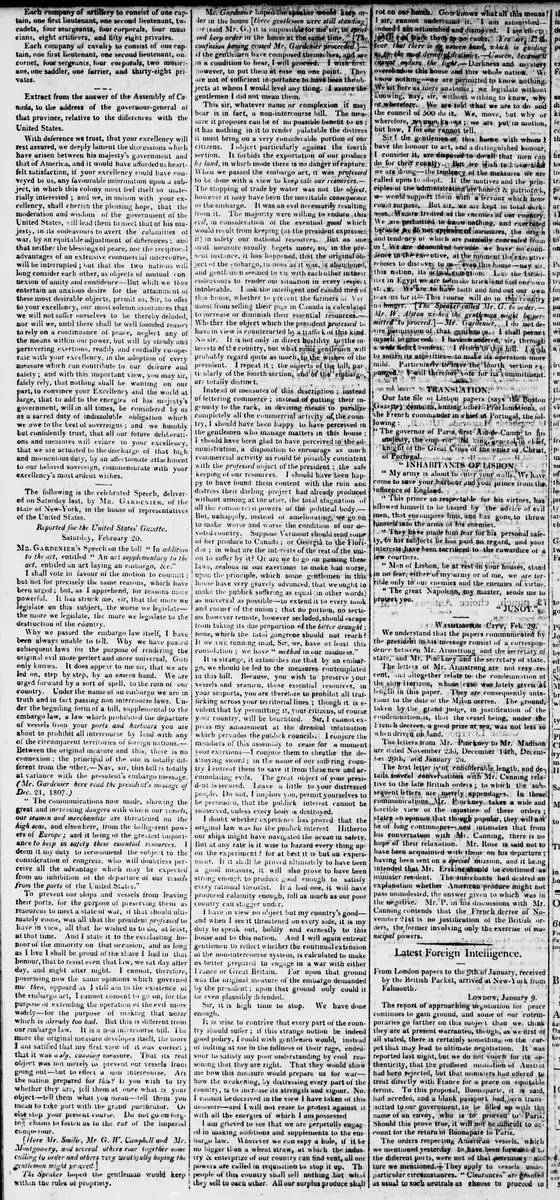
Mr. Gardenier's Speech on the bill "In addition to the act, entitled "An act supplementary to the act, entitled an act laying an embargo, &c."
I shall vote in favour of the motion to commit; but not for precisely the same reasons, which have been urged; but, as I apprehend, for reasons more powerful. It has struck me, sir, that the more we legislate on this subject, the worse we legislate--the more we legislate, the more we legislate to the destruction of the country.
Why we passed the embargo law itself, I have been always unable to tell. Why we have passed subsequent laws for the purpose of rendering the original evil more perfect and more universal, God only knows. It does appear to me sir, that we are led on, step by step, by an unseen hand. We are urged forward by a sort of spell, to the ruin of our country. Under the name of an embargo we are in truth and in fact passing non intercourse laws. Under the beguiling form of a bill, supplemental to the embargo law, a law which prohibited the departure of vessels from your ports and harbours you are about to prohibit all intercourse by land with any of the circumjacent territories of foreign nations.
Between the original measure and this, there is no connexion: the principle of the one is totally different from the other.--Nay, sir, this bill is totally at variance with the president's embargo message.
(Mr. Gardenier here read the president's message of Dec. 21, 1807.)
"The communications now made, showing the great and increasing dangers with which our vessels, our seamen and merchandise are threatened on the high seas, and elsewhere, from the belligerent powers of Europe; and it being of the greatest importance to keep in safety these essential resources. I deem it my duty to recommend the subject to the consideration of congress, who will doubtless perceive all the advantage which may be expected from an inhibition of the departure of our vessels from the ports of the United States."
To prevent our ships and vessels from leaving their ports, for the purpose of preserving them as resources to meet a state of war, if that should ultimately come, was all that the president professed to have in view, all that he wished us to do, at least, at that time. And I state it to the everlasting honour of the minority on that occasion, and as long as I live I shall be proud of the share I had in that honour, that to resist even that law, we sat day after day, and night after night. I cannot, therefore, possessing now the same opinions which governed me then, opposed as I still am to the existence of the embargo act, I cannot consent to go on, for the purpose of extending the operation or the evil more widely--for the purpose of making that worse which is already too bad. But this is different from our embargo law. It is a non intercourse bill. The more the original measure develops itself, the more I am satisfied that my first view of it was correct; that it was a sly, cunning measure. That its real object was not merely to prevent our vessels from going out--but to effect a non intercourse. Are the nation prepared for this? If you wish to try whether they are, tell them at once what is your object--tell them what you mean--tell them you mean to take part with the grand pacificator. Or else stop your present course. Do not go on forging chains to fasten us to the car of the imperial conqueror.
[Here Mr. Smilie, Mr. G. W. Campbell and Mr. Montgomery, and several others rose together some calling to order and others very wrathfully hoping the gentleman might proceed.]
The Speaker hoped the gentleman would keep within the rules of propriety.
Mr. Gardenier hoped the speaker would keep order in the house [three gentlemen were still standing]: or (said Mr. G.) it is impossible for me sir, to speak and keep order in the house at the same time. [The confusion having ceased Mr. Gardenier proceeded.]
If the gentlemen have composed themselves, and are in a condition to hear, I will proceed:--wish first however, to put them at ease on one point. They are not of sufficient importance to have been the objects at whom I would level any thing. I assure the gentlemen I did not mean them.
This sir, whatever name or complexion it may bear is in fact, a non-intercourse bill. The measure it proposes can be of no possible benefit to us; it has nothing in it to render palatable the distress it must bring on a very considerable portion of our citizens. I object particularly against the fourth section. It forbids the exportation of our produce by land, in which mode there is no danger of capture.
When we passed the embargo act, it was professed to be done with a view to keep safe our resources.--The stopping of trade by water was not the object, however it may have been the inevitable consequence of the embargo. It was an evil necessarily resulting from it. The majority were willing to endure this evil, in consideration of the eventual good which would result from keeping (as the president expresses it) in safety our national resources. But as one mad measure usually begets more, so, in the present instance, it has happened, that the original object of the embargo, ruinous as it was, is abandoned, and gentlemen seemed to vie with each other in their endeavours to render our situation in every respect intolerable. I ask the intelligent and candid men of this house, whether to prevent the farmers of Vermont from selling their pigs in Canada is calculated to increase or diminish their essential resources.= Whether the object which the president professed to have in view is counteracted by a traffic of this kind.
No sir. It is not only in direct hostility to the interests of the country, but what some gentlemen will probably regard quite as much, to the wishes of the president. I repeat it; the objects of the bill, particularly of the fourth section, and of the embargo, are totally distinct.
Instead of measures of this description; instead of fettering commerce; instead of putting their ingenuity to the rack, in devising means to paralyze completely all the commercial activity of the country, I should have been happy to have perceived in the gentlemen who manage matters in this house; I should have been glad to have perceived in the administration, a disposition to encourage as much commercial activity as could be possibly consistent with the professed object of the president: the safe keeping of our resources. I should have been happy to have found them content with the ruin and distress their darling project had already produced without aiming at the utter, the total stagnation of all the commercial powers of the political body.--
But, unhappily, instead of ameliorating, we go on to make worse and worse the condition of our devoted country. Suppose Vermont should send some of her produce to Canada; or Georgia to the Floridas; in what are the interests of the rest of the union to suffer by it? Or are we to go on passing these laws, zealous in our exertions to make bad worse, upon the principle, which some gentlemen in this house have very gravely advanced, that we ought to make the publick suffering as equal (in other words) as universal as possible--to extend it to every nook and corner of the union; that no portion, no section however remote, however secluded, should escape from taking its due proportion of the bitter draught; none, which the fatal gangrene should not reach?
If we are running mad, Sir, we have at least this consolation; we have "method in our madness."
It is strange, it astonishes me that by an embargo, we should be led to the measures contemplated in this bill. Because, your wish to preserve your vessels and seamen, those essential resources, in your seaports, you are therefore to prohibit all trafficking across your territorial lines; though it is evident that by permitting it, your citizens, of course your country, will be benefitted. Sir, I cannot express my amazement at the dreadful infatuation which pervades the publick councils.; I conjure the members of this assembly to cease for a moment your exertions--I conjure them to sheathe the destroying sword; in the name of our suffering country I entreat them to save it from these new and accumulating evils. The great object of your president is secured. Leave a little to your distressed people. Do not, I implore you, permit yourselves to be persuaded, that the publick interest cannot be subserved, unless every body is destroyed.
I doubt whether experience has proved that the original law was for the publick interest Hitherto our ships might have navigated the ocean in safety. But at any rate is it wise to hazard every thing upon the experiment? for at best it is but an experiment. If it shall be proved ultimately to have been a good measure, it will also prove to have been strong enough to produce good enough to satisfy every rational theorist. If a bad one, it will have produced calamity enough, full as much as our poor country can stagger under.
I have in view no object but my country's good-- and when I see it threatened on every side, it is my duty to speak out, boldly and earnestly to this house and to this nation. And I will again entreat gentlemen to reflect whether the continual extension of the non-intercourse system, is calculated to make us better prepared to engage in a war with either France or Great Britain. For upon that ground was the original measure of the embargo demanded by the president; upon that ground only could it be even plausibly defended.
Sir, it is high time to stop. We have done enough.
It is wise to contrive that every part of the country should suffer; if this strange notion be indeed good policy, I could wish gentlemen would, instead of bolting at me in the fullness of their rage, endeavour to satisfy my poor understanding by cool reasoning that they are right. That they would show me how this measure would prepare us for war-- how the weakening, by distressing every part of the country, is to increase its strength and vigour. No. I cannot be deceived in the view I have taken of this measure--and I will not cease to protest against it with all the energies of which I am possessed
I am grieved to see that we are perpetually engaged in making additions and supplements to the embargo law. Wherever we can espy a hole, if it be no bigger than a wheat straw, at which the industry & enterprize of our country can find vent, all our powers are called in requisition to stop it up. The people of this country shall sell nothing but what they sell to each other. All our surplus produce shall
What sub-type of article is it?
What themes does it cover?
What keywords are associated?
What entities or persons were involved?
Where did it happen?
Story Details
Key Persons
Location
House Of Representatives Of The United States
Event Date
Saturday, February 20
Story Details
Mr. Gardenier speaks against a bill extending the embargo to land trade, arguing it creates non-intercourse, harms citizens like Vermont farmers, contradicts the President's December 1807 message on protecting sea resources, and urges stopping further restrictions to avoid national ruin.