Thank you for visiting SNEWPapers!
Sign up free
The Herald And News
Newberry, Newberry County, South Carolina
What is this article about?
Increase in rabies cases in England and France following the Great War, due to westward migration of unsupervised dogs from Belgium and northern France. The disease is virulent with short incubation. Lenoir, who suppressed rabies in South Africa in 1902, reports on the matter.
Clipping
OCR Quality
Full Text
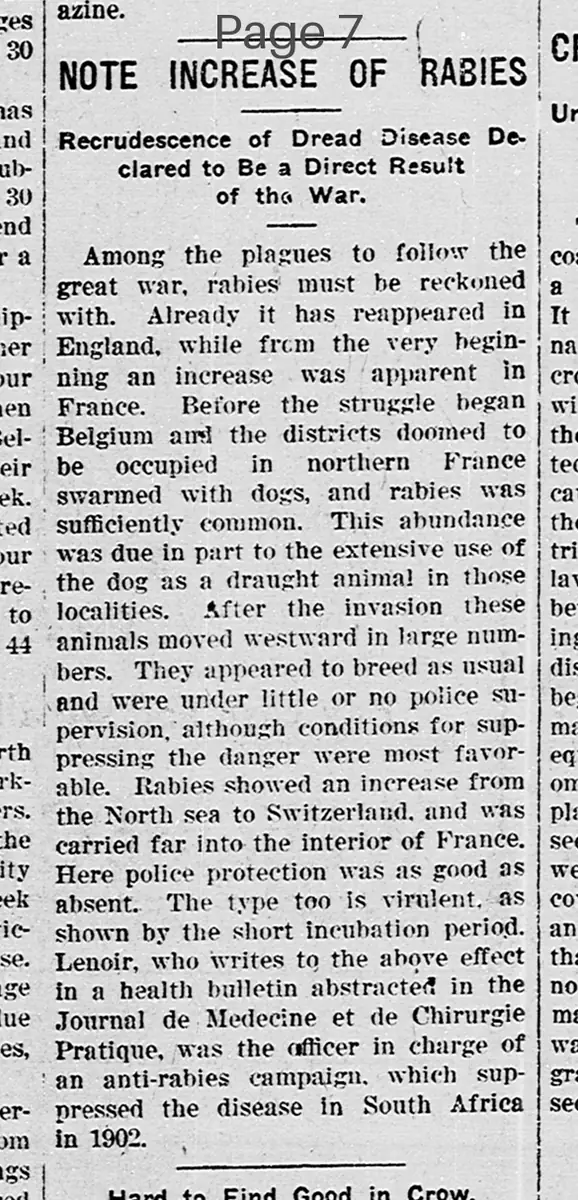
Recrudescence of Dread Disease Declared to Be a Direct Result of the War.
Among the plagues to follow the great war, rabies must be reckoned with. Already it has reappeared in England, while from the very beginning an increase was apparent in France.
Before the struggle began Belgium and the districts doomed to be occupied in northern France swarmed with dogs, and rabies was sufficiently common. This abundance was due in part to the extensive use of the dog as a draught animal in those localities.
After the invasion these animals moved westward in large numbers. They appeared to breed as usual and were under little or no police supervision, although conditions for suppressing the danger were most favorable. Rabies showed an increase from the North sea to Switzerland, and was carried far into the interior of France. Here police protection was as good as absent. The type too is virulent, as shown by the short incubation period.
Lenoir, who writes to the above effect in a health bulletin abstracted in the Journal de Medecine et de Chirurgie Pratique, was the officer in charge of an anti-rabies campaign, which suppressed the disease in South Africa in 1902.
What sub-type of article is it?
What keywords are associated?
What entities or persons were involved?
Where did it happen?
Foreign News Details
Primary Location
France
Key Persons
Outcome
increase in rabies from the north sea to switzerland, carried into interior of france; virulent type with short incubation period; previously suppressed in south africa in 1902
Event Details
Rabies reappeared in England and increased in France as a direct result of the great war. Before the war, Belgium and northern France had many dogs used as draught animals, with common rabies. After invasion, dogs moved westward, bred without supervision, leading to rabies spread despite favorable suppression conditions. Police protection was absent in interior France.