Thank you for visiting SNEWPapers!
Sign up free
Wheeling Register
Wheeling, Ohio County, West Virginia
What is this article about?
The United States offers to mediate peace between China and Japan in their ongoing war, contingent on requests from both sides. Secretary Gresham proposes terms including recognition of Corea's independence and a cash indemnity from China, likely $100,000,000. France's intervention proposal is rejected amid European threats of force.
Clipping
OCR Quality
Full Text
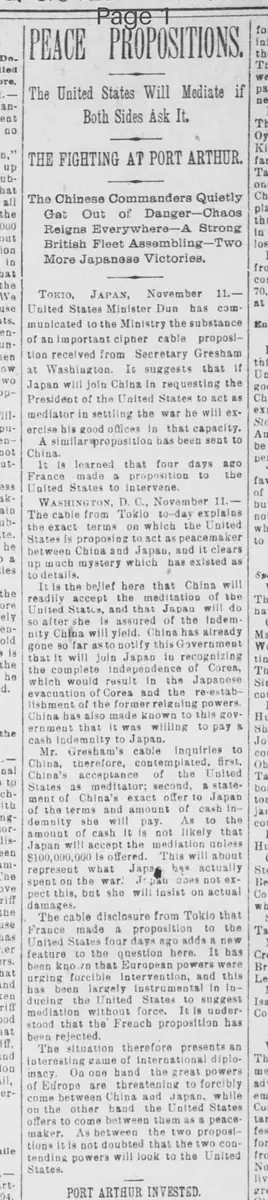
The United States Will Mediate if
Both Sides Ask It.
THE FIGHTING AT PORT ARTHUR.
The Chinese Commanders Quietly
Got Out of Danger—Chaos
Reigns Everywhere—A Strong
British Fleet Assembling—Two
More Japanese Victories.
TOKIO,
JAPAN,
November
11.
United States Minister Dun has communicated to the Ministry the substance of an important cipher cable proposition received from Secretary Gresham at Washington. It suggests that if Japan will join China in requesting the President of the United States to act as mediator in settling the war he will exercise his good offices in that capacity. A similar proposition has been sent to China. It is learned that four days ago France made a proposition to the United States to intervene.
WASHINGTON, D. C., November 11.
The cable from Tokio to-day explains the exact terms on which the United States is proposing to act as peacemaker between China and Japan, and it clears up much mystery which has existed as to details. It is the belief here that China will readily accept the mediation of the United States, and that Japan will do so after she is assured of the indemnity China will yield. China has already gone so far as to notify this Government that it will join Japan in recognizing the complete independence of Corea, which would result in the Japanese evacuation of Corea and the re-establishment of the former reigning powers. China has also made known to this government that it was willing to pay a cash indemnity to Japan.
Mr. Gresham's cable inquiries to China, therefore, contemplated, first, China's acceptance of the United States as mediator; second, a statement of China's exact offer to Japan of the terms and amount of cash indemnity she will pay. As to the amount of cash it is not likely that Japan will accept the mediation unless $100,000,000 is offered. This will about represent what Japan has actually spent on the war. Japan does not expect this, but she will insist on actual damages.
The cable disclosure from Tokio that France made a proposition to the United States four days ago adds a new feature to the question here. It has been known that European powers were urging forcible intervention, and this has been largely instrumental in inducing the United States to suggest mediation without force. It is understood that the French proposition has been rejected.
The situation therefore presents an interesting game of international diplomacy. On one hand the great powers of Europe are threatening to forcibly come between China and Japan, while on the other hand the United States offers to come between them as a peacemaker. As between the two propositions it is not doubted that the two contending powers will look to the United States.
What sub-type of article is it?
What keywords are associated?
What entities or persons were involved?
Where did it happen?
Foreign News Details
Primary Location
Japan
Event Date
November 11
Key Persons
Outcome
china willing to recognize corea's independence and pay cash indemnity to japan, likely $100,000,000; france's intervention proposal rejected; us mediation offered without force amid european threats.
Event Details
US Minister Dun relays Secretary Gresham's proposal to Japan for US mediation in the Sino-Japanese War if requested by both sides. Similar offer sent to China. Terms include Corea's independence and indemnity. France proposed intervention four days prior, rejected by US. European powers urge force, but US suggests peaceful mediation.