Thank you for visiting SNEWPapers!
Sign up free
Norfolk Gazette And Publick Ledger
Norfolk, Virginia
What is this article about?
In a private audience in Paris around late April 1816, Louis XVIII confided to a French nobleman his deep frustrations with ruling France: balancing royalists and revolutionaries, facing foreign allies' conflicting demands, religious tensions, and family divisions, likening his crown to one of thorns and longing for death.
Clipping
OCR Quality
Full Text
London, June 30.
Extract of a letter from a French Nobleman, dated Paris, May 6, 1816.
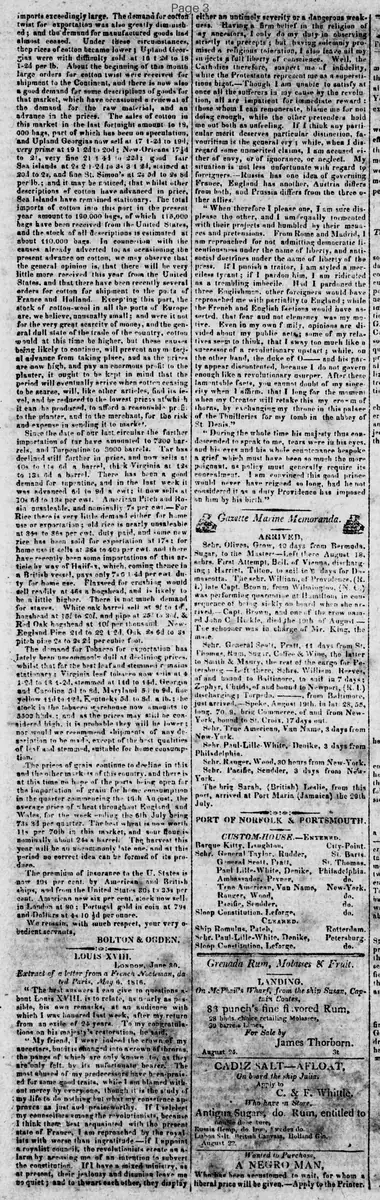
The best answers I can give to questions about Louis XVIII. is to relate, as nearly as possible, his own remarks, at an audience with which I was honored last week, after my return from an exile of 25 years. In my congratulations on his majesty's restoration, he said: "My friend, I wear indeed the crown of my ancestors, but it is changed into a crown of thorns, the pangs of which are only known to, as they are only felt, by its unfortunate bearer. The most abused of my predecessors have been praised for some good traits, while I am blamed without mercy by every one, though it is the study of my life to do nothing but what my conscience approves as just and praiseworthy. If I select my counsellors among the revolutionists, because I think them best acquainted with the present state of France, I am reproached by the royalists with worse than ingratitude -- if I appoint a royalist council, the revolutionists create an alarm by accusing me of an intention to subvert the constitution. If I have a mixed ministry, as at present, their jealousy and disunion leave me no quiet; and to thwart each other, they display either an untimely severity or a dangerous weakness. Having a firm belief in the religion of my ancestors, I only do my duty in observing strictly its precepts; but having solemnly promised a religious toleration, I also leave all my subjects a full liberty of conscience. Well, the Catholics therefore, suspect me of infidelity, while the Protestants represent me as a superstitious bigot. Though I am unable to satisfy at once all the sufferers in my cause by the revolution, all are impatient for immediate reward: those whom I can remunerate, blame me for not doing enough, while the other pretenders hold me out both as unfeeling. If I think any particular merit deserves particular distinction, favoritism is the general cry; while, when I disregard some unmerited claims, I am accused either of envy, or of ignorance, or neglect. My situation is not less unfortunate with regard to foreigners. Russia has one idea of governing France, England has another, Austria differs from both, and Prussia differs from the three other allies. When therefore I please one, I am sure to displease the other, and I am equally tormented with their projects and humbled by their manners and pretensions. From Rome and Madrid, I am reproached for not admitting democratic licentiousness under the name of liberty, and anti-social doctrines under the name of liberty of the press. If I punish a traitor, I am styled a merciless tyrant; if I pardon him, I am ridiculed as a trembling imbecile. Had I pardoned the three Englishmen, other foreigners would have reproached me with partiality to England: while the French and English factions would have asserted, that fear and not clemency was my motive. Even in my own family, opinions are divided about my public acts; some of my relatives seem to think, that I sway too much like a successor of a revolutionary upstart; while, on the other hand, the duke of Orleans and his party appear discontented, because I do not govern enough like a revolutionary usurper. After these lamentable facts, you cannot doubt of my sincerity when I affirm, that I long for the moment when my Creator will retake this my crown of thorns, by exchanging my throne in this palace of the Tuilleries for my tomb in the abbey of St. Denis."
During the whole time his majesty thus condescended to speak to me, tears were in his eyes, and his voice and his whole countenance bespoke a grief which must have been so much the more poignant, as policy must generally require its concealment. I am convinced this good prince would never have reigned so long, had he not considered it as a duty Providence has imposed on him by his birth.
What sub-type of article is it?
What keywords are associated?
What entities or persons were involved?
Where did it happen?
Foreign News Details
Primary Location
Paris
Event Date
May 6, 1816
Key Persons
Event Details
A French nobleman recounts Louis XVIII's remarks during a private audience last week, expressing frustrations with balancing royalists and revolutionaries in government, religious toleration suspicions, rewarding supporters, favoritism accusations, conflicting foreign allies' influences from Russia, England, Austria, Prussia, Rome, and Madrid, decisions on punishing traitors including three Englishmen, and family divisions; he describes his crown as one of thorns and longs for death.