Thank you for visiting SNEWPapers!
Sign up free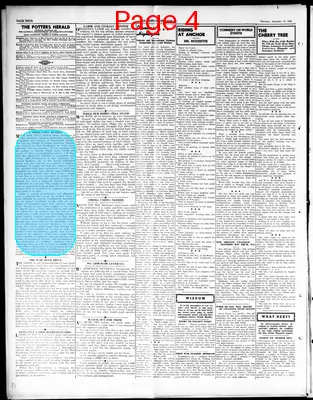
Story
September 10, 1942
The Potters Herald
East Liverpool, Columbiana County, Ohio
What is this article about?
Wartime material shortages challenge the automotive industry's just-in-time production for war vehicles, leading to imbalances and shutdowns, despite scrap recovery efforts and adaptations urged by Donald M. Nelson.
Clipping
OCR Quality
98%
Excellent
Full Text
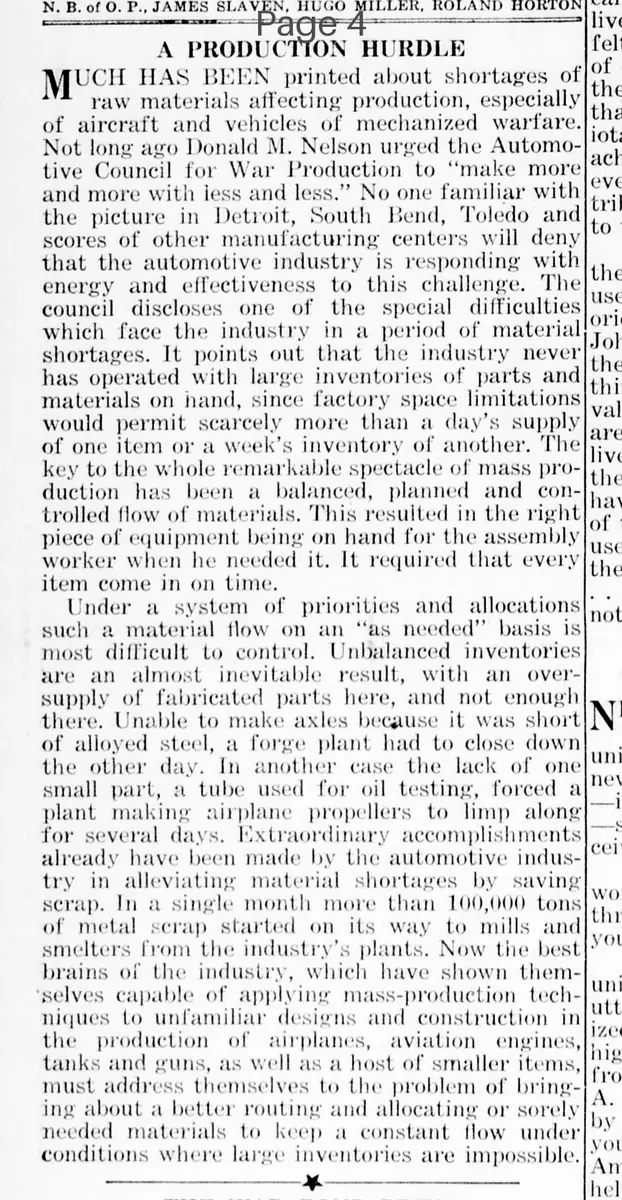
A PRODUCTION HURDLE
MUCH HAS BEEN printed about shortages of raw materials affecting production, especially of aircraft and vehicles of mechanized warfare.
Not long ago Donald M. Nelson urged the Automotive Council for War Production to "make more and more with less and less." No one familiar with the picture in Detroit. South Bend, Toledo and scores of other manufacturing centers will deny that the automotive industry is responding with energy and effectiveness to this challenge. The council discloses one of the special difficulties which face the industry in a period of material shortages. It points out that the industry never has operated with large inventories of parts and materials on hand, since factory space limitations would permit scarcely more than a day's supply of one item or a week's inventory of another. The key to the whole remarkable spectacle of mass production has been a balanced, planned and controlled flow of materials. This resulted in the right piece of equipment being on hand for the assembly worker when he needed it. It required that every item come in on time.
Under a system of priorities and allocations such a material flow on an "as needed" basis is most difficult to control. Unbalanced inventories are an almost inevitable result, with an over-supply of fabricated parts here, and not enough there. Unable to make axles because it was short of alloyed steel, a forge plant had to close down the other day. In another case the lack of one small part, a tube used for oil testing. forced a plant making airplane propellers to limp along for several days. Extraordinary accomplishments already have been made by the automotive industry in alleviating material shortages by saving scrap. In a single month more than 100,000 tons of metal scrap started on its way to mills and smelters from the industry's plants. Now the best brains of the industry. which have shown themselves capable of applying mass-production techniques to unfamiliar designs and construction in the production of airplanes, aviation engines, tanks and guns, as well as a host of smaller items, must address themselves to the problem of bringing about a better routing and allocating or sorely needed materials to keep a constant flow under conditions where large inventories are impossible.
MUCH HAS BEEN printed about shortages of raw materials affecting production, especially of aircraft and vehicles of mechanized warfare.
Not long ago Donald M. Nelson urged the Automotive Council for War Production to "make more and more with less and less." No one familiar with the picture in Detroit. South Bend, Toledo and scores of other manufacturing centers will deny that the automotive industry is responding with energy and effectiveness to this challenge. The council discloses one of the special difficulties which face the industry in a period of material shortages. It points out that the industry never has operated with large inventories of parts and materials on hand, since factory space limitations would permit scarcely more than a day's supply of one item or a week's inventory of another. The key to the whole remarkable spectacle of mass production has been a balanced, planned and controlled flow of materials. This resulted in the right piece of equipment being on hand for the assembly worker when he needed it. It required that every item come in on time.
Under a system of priorities and allocations such a material flow on an "as needed" basis is most difficult to control. Unbalanced inventories are an almost inevitable result, with an over-supply of fabricated parts here, and not enough there. Unable to make axles because it was short of alloyed steel, a forge plant had to close down the other day. In another case the lack of one small part, a tube used for oil testing. forced a plant making airplane propellers to limp along for several days. Extraordinary accomplishments already have been made by the automotive industry in alleviating material shortages by saving scrap. In a single month more than 100,000 tons of metal scrap started on its way to mills and smelters from the industry's plants. Now the best brains of the industry. which have shown themselves capable of applying mass-production techniques to unfamiliar designs and construction in the production of airplanes, aviation engines, tanks and guns, as well as a host of smaller items, must address themselves to the problem of bringing about a better routing and allocating or sorely needed materials to keep a constant flow under conditions where large inventories are impossible.
What sub-type of article is it?
Historical Event
What themes does it cover?
Misfortune
Triumph
What keywords are associated?
Material Shortages
Automotive Industry
Wartime Production
Scrap Recycling
Priorities System
What entities or persons were involved?
Donald M. Nelson
Where did it happen?
Detroit, South Bend, Toledo And Scores Of Other Manufacturing Centers
Story Details
Key Persons
Donald M. Nelson
Location
Detroit, South Bend, Toledo And Scores Of Other Manufacturing Centers
Story Details
The automotive industry faces challenges from material shortages under priorities and allocations, disrupting just-in-time inventory and causing unbalanced supplies, plant closures, and production delays, while achieving successes in scrap recycling and adapting mass-production techniques to war materials.