Thank you for visiting SNEWPapers!
Sign up free
Story
May 3, 1954
The Nome Nugget
Nome, Nome County, Alaska
What is this article about?
Harold Ickes' 1938 diary reveals President Roosevelt feared revolution if he halted New Deal relief and farm aid to balance the budget, as advised by conservative Democrats. The diary covers Roosevelt's second term struggles, including Supreme Court battle and party purges.
Clipping
OCR Quality
98%
Excellent
Full Text
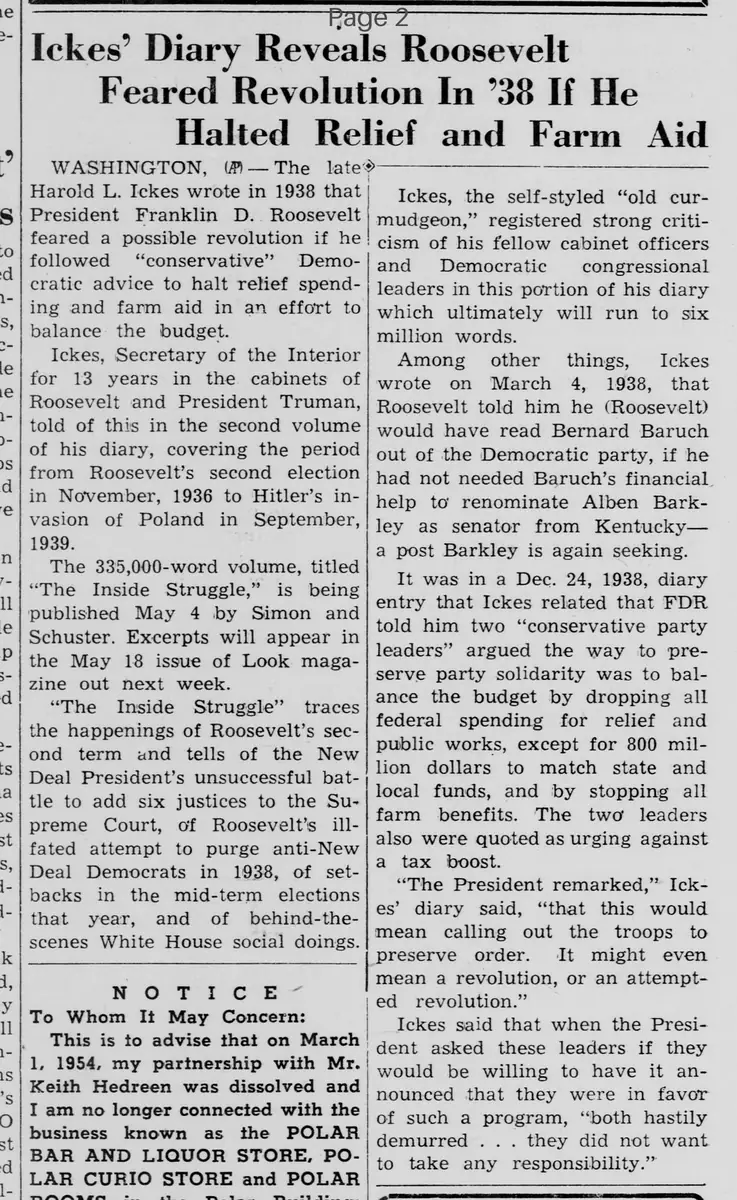
Ickes' Diary Reveals Roosevelt Feared Revolution In 38 If He Halted Relief and Farm Aid
WASHINGTON, (A)-- The late Harold L. Ickes wrote in 1938 that President Franklin D. Roosevelt feared a possible revolution if he followed conservative Democratic advice to halt relief spending and farm aid in an effort to balance the budget.
Ickes, Secretary of the Interior for 13 years in the cabinets of Roosevelt and President Truman, told of this in the second volume of his diary, covering the period from Roosevelt's second election in November, 1936 to Hitler's invasion of Poland in September, 1939.
The 335,000-word volume, titled "The Inside Struggle," is being published May 4 by Simon and Schuster. Excerpts will appear in the May 18 issue of Look magazine out next week.
"The Inside Struggle" traces the happenings of Roosevelt's second term and tells of the New Deal President's unsuccessful battle to add six justices to the Supreme Court, of Roosevelt's ill-fated attempt to purge anti-New Deal Democrats in 1938, of setbacks in the mid-term elections that year, and of behind-the-scenes White House social doings.
Ickes, the self-styled "old curmudgeon," registered strong criticism of his fellow cabinet officers and Democratic congressional leaders in this portion of his diary which ultimately will run to six million words.
Among other things, Ickes wrote on March 4, 1938, that Roosevelt told him he (Roosevelt) would have read Bernard Baruch out of the Democratic party, if he had not needed Baruch's financial help to renominate Alben Barkley as senator from Kentucky-- a post Barkley is again seeking.
It was in a Dec. 24, 1938, diary entry that Ickes related that FDR told him two "conservative party leaders" argued the way to preserve party solidarity was to balance the budget by dropping all federal spending for relief and public works, except for 800 million dollars to match state and local funds, and by stopping all farm benefits. The two leaders also were quoted as urging against a tax boost.
"The President remarked," Ickes' diary said, "that this would mean calling out the troops to preserve order. It might even mean a revolution, or an attempted revolution."
Ickes said that when the President asked these leaders if they would be willing to have it announced that they were in favor of such a program, "both hastily demurred . . . they did not want to take any responsibility."
WASHINGTON, (A)-- The late Harold L. Ickes wrote in 1938 that President Franklin D. Roosevelt feared a possible revolution if he followed conservative Democratic advice to halt relief spending and farm aid in an effort to balance the budget.
Ickes, Secretary of the Interior for 13 years in the cabinets of Roosevelt and President Truman, told of this in the second volume of his diary, covering the period from Roosevelt's second election in November, 1936 to Hitler's invasion of Poland in September, 1939.
The 335,000-word volume, titled "The Inside Struggle," is being published May 4 by Simon and Schuster. Excerpts will appear in the May 18 issue of Look magazine out next week.
"The Inside Struggle" traces the happenings of Roosevelt's second term and tells of the New Deal President's unsuccessful battle to add six justices to the Supreme Court, of Roosevelt's ill-fated attempt to purge anti-New Deal Democrats in 1938, of setbacks in the mid-term elections that year, and of behind-the-scenes White House social doings.
Ickes, the self-styled "old curmudgeon," registered strong criticism of his fellow cabinet officers and Democratic congressional leaders in this portion of his diary which ultimately will run to six million words.
Among other things, Ickes wrote on March 4, 1938, that Roosevelt told him he (Roosevelt) would have read Bernard Baruch out of the Democratic party, if he had not needed Baruch's financial help to renominate Alben Barkley as senator from Kentucky-- a post Barkley is again seeking.
It was in a Dec. 24, 1938, diary entry that Ickes related that FDR told him two "conservative party leaders" argued the way to preserve party solidarity was to balance the budget by dropping all federal spending for relief and public works, except for 800 million dollars to match state and local funds, and by stopping all farm benefits. The two leaders also were quoted as urging against a tax boost.
"The President remarked," Ickes' diary said, "that this would mean calling out the troops to preserve order. It might even mean a revolution, or an attempted revolution."
Ickes said that when the President asked these leaders if they would be willing to have it announced that they were in favor of such a program, "both hastily demurred . . . they did not want to take any responsibility."
What sub-type of article is it?
Historical Event
Biography
What themes does it cover?
Fortune Reversal
Social Manners
What keywords are associated?
Ickes Diary
Roosevelt Fear
New Deal
Revolution Threat
Relief Aid
Farm Benefits
Budget Balance
What entities or persons were involved?
Harold L. Ickes
Franklin D. Roosevelt
Bernard Baruch
Alben Barkley
Where did it happen?
Washington
Story Details
Key Persons
Harold L. Ickes
Franklin D. Roosevelt
Bernard Baruch
Alben Barkley
Location
Washington
Event Date
1936 1939
Story Details
Ickes' diary recounts Roosevelt's fear of revolution if relief and farm aid were cut to balance the budget, as urged by conservative Democrats; covers second term events like Supreme Court packing failure, party purges, and election setbacks.