Thank you for visiting SNEWPapers!
Sign up free
Letter to Editor
May 24, 1792
The New Hampshire Gazette And General Advertiser
Portsmouth, Rockingham County, New Hampshire
What is this article about?
The Boston Marine Society publishes John Foster Williams' experiments on distilling fresh water from salt water using simple onboard apparatus, conducted during his cruise on the Revenue Cutter Massachusetts. The society votes thanks and shares details for seafaring benefit. Dated May 1, 1792.
Clipping
OCR Quality
95%
Excellent
Full Text
From the Columbian Centinel.
Mr. Russell,
Your giving the following a place in THE CENTINEL, while it may add to the safety of our seafaring brethren, will oblige The Marine Society.
At a Meeting of the Boston Marine Society, held at Boston, the first day of May, instant.
Capt. Mungo Mackey, President:
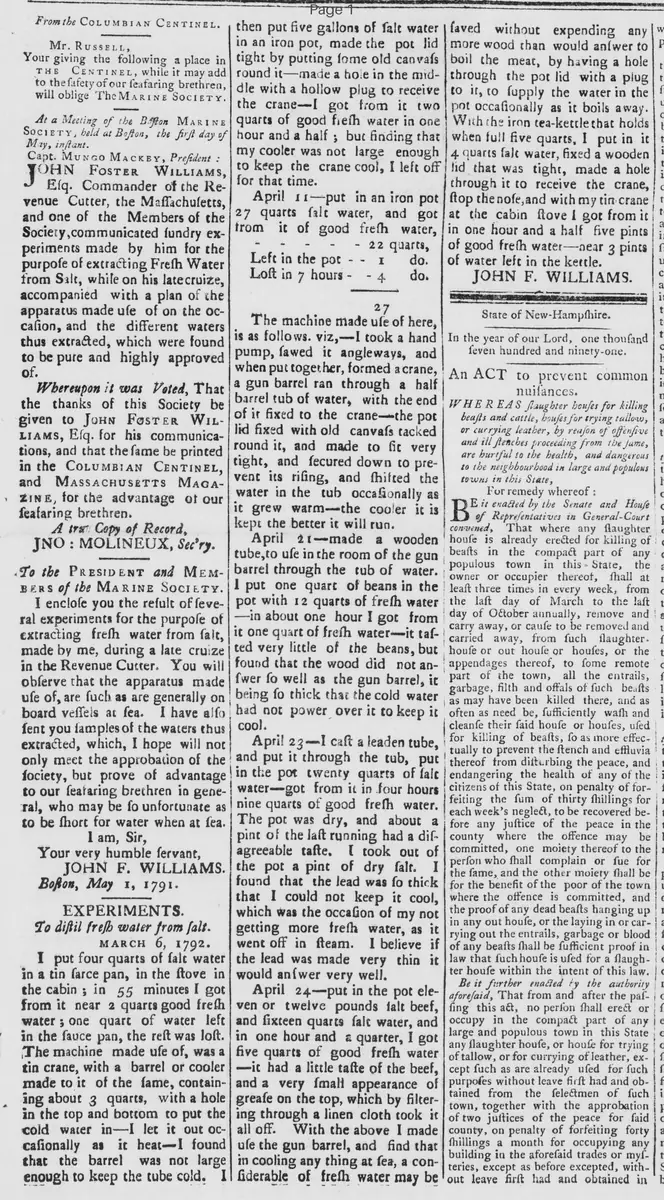
JOHN FOSTER WILLIAMS, Esq. Commander of the Revenue Cutter, the Massachusetts, and one of the Members of the Society, communicated sundry experiments made by him for the purpose of extracting Fresh Water from Salt, while on his late cruise, accompanied with a plan of the apparatus made use of on the occasion, and the different waters thus extracted, which were found to be pure and highly approved of.
Whereupon it was Voted, That the thanks of this Society be given to John Foster Williams, Esq. for his communications, and that the same be printed in the Columbian Centinel, and Massachusetts Magazine, for the advantage of our seafaring brethren.
A true Copy of Record.
JNO. MOLINEUX, Sec'ry.
To the President and Members of the Marine Society.
I enclose you the result of several experiments for the purpose of extracting fresh water from salt, made by me, during a late cruise in the Revenue Cutter. You will observe that the apparatus made use of, are such as are generally on board vessels at sea. I have also sent you samples of the waters thus extracted, which, I hope will not only meet the approbation of the society, but prove of advantage to our seafaring brethren in general, who may be so unfortunate as to be short for water when at sea.
I am, Sir,
Your very humble servant,
JOHN F. WILLIAMS.
Boston, May 1, 1792.
EXPERIMENTS.
To distil fresh water from salt.
MARCH 6, 1792.
I put four quarts of salt water in a tin sauce pan, in the stove in the cabin; in 55 minutes I got from it near 2 quarts good fresh water; one quart of water left in the sauce pan. the rest was lost.
The machine made use of, was a tin crane, with a barrel or cooler made to it of the same, containing about 3 quarts, with a hole in the top and bottom to put the cold water in—I let it out occasionally as it heat—I found that the barrel was not large enough to keep the tube cold. I
then put five gallons of salt water in an iron pot, made the pot lid tight by putting some old canvass round it—made a hole in the middle with a hollow plug to receive the crane—I got from it two quarts of good fresh water in one hour and a half; but finding that my cooler was not large enough to keep the crane cool, I left off for that time.
April 11—put in an iron pot 27 quarts salt water, and got from it of good fresh water,
22 quarts,
Left in the pot 1 do.
Lost in 7 hours 4 do.
27
The machine made use of here, is as follows. viz,—I took a hand pump, sawed it angleways, and when put together, formed a crane, a gun barrel ran through a half barrel tub of water. with the end of it fixed to the crane—the pot lid fixed with old canvass tacked round it, and made to fit very tight, and secured down to prevent its rising, and shifted the water in the tub occasionally as it grew warm—the cooler it is kept the better it will run.
April 21—made a wooden tube, to use in the room of the gun barrel through the tub of water. I put one quart of beans in the pot with 12 quarts of salt water—in about one hour I got from it one quart of fresh water—it tasted very little of the beans, but found that the wood did not answer so well as the gun barrel, it being so thick that the cold water had not power over it to keep it cool.
April 23—I cast a leaden tube, and put it through the tub, put in the pot twenty quarts of salt water—got from it in four hours nine quarts of good fresh water. The pot was dry, and about a pint of the last running had a disagreeable taste. I took out of the pot a pint of dry salt. I found that the lead was so thick that I could not keep it cool, which was the occasion of my not getting more fresh water, as it went off in steam. I believe if the lead was made very thin it would answer very well.
April 24—put in the pot eleven or twelve pounds salt beef, and sixteen quarts salt water, and in one hour and a quarter, I got five quarts of good fresh water—it had a little taste of the beef. and a very small appearance of grease on the top, which by filtering through a linen cloth took it all off. With the above I made use the gun barrel, and find that in cooling any thing at sea, a considerable of fresh water may be
saved without expending any more wood than would answer to boil the meat, by having a hole through the pot lid with a plug to it, to supply the water in the pot occasionally as it boils away.
With the iron tea-kettle that holds when full five quarts, I put in it 4 quarts salt water, fixed a wooden lid that was tight, made a hole through it to receive the crane, stop the nose, and with my tin crane at the cabin stove I got from it in one hour and a half five pints of good fresh water—near 3 pints of water left in the kettle.
JOHN F. WILLIAMS.
Mr. Russell,
Your giving the following a place in THE CENTINEL, while it may add to the safety of our seafaring brethren, will oblige The Marine Society.
At a Meeting of the Boston Marine Society, held at Boston, the first day of May, instant.
Capt. Mungo Mackey, President:
JOHN FOSTER WILLIAMS, Esq. Commander of the Revenue Cutter, the Massachusetts, and one of the Members of the Society, communicated sundry experiments made by him for the purpose of extracting Fresh Water from Salt, while on his late cruise, accompanied with a plan of the apparatus made use of on the occasion, and the different waters thus extracted, which were found to be pure and highly approved of.
Whereupon it was Voted, That the thanks of this Society be given to John Foster Williams, Esq. for his communications, and that the same be printed in the Columbian Centinel, and Massachusetts Magazine, for the advantage of our seafaring brethren.
A true Copy of Record.
JNO. MOLINEUX, Sec'ry.
To the President and Members of the Marine Society.
I enclose you the result of several experiments for the purpose of extracting fresh water from salt, made by me, during a late cruise in the Revenue Cutter. You will observe that the apparatus made use of, are such as are generally on board vessels at sea. I have also sent you samples of the waters thus extracted, which, I hope will not only meet the approbation of the society, but prove of advantage to our seafaring brethren in general, who may be so unfortunate as to be short for water when at sea.
I am, Sir,
Your very humble servant,
JOHN F. WILLIAMS.
Boston, May 1, 1792.
EXPERIMENTS.
To distil fresh water from salt.
MARCH 6, 1792.
I put four quarts of salt water in a tin sauce pan, in the stove in the cabin; in 55 minutes I got from it near 2 quarts good fresh water; one quart of water left in the sauce pan. the rest was lost.
The machine made use of, was a tin crane, with a barrel or cooler made to it of the same, containing about 3 quarts, with a hole in the top and bottom to put the cold water in—I let it out occasionally as it heat—I found that the barrel was not large enough to keep the tube cold. I
then put five gallons of salt water in an iron pot, made the pot lid tight by putting some old canvass round it—made a hole in the middle with a hollow plug to receive the crane—I got from it two quarts of good fresh water in one hour and a half; but finding that my cooler was not large enough to keep the crane cool, I left off for that time.
April 11—put in an iron pot 27 quarts salt water, and got from it of good fresh water,
22 quarts,
Left in the pot 1 do.
Lost in 7 hours 4 do.
27
The machine made use of here, is as follows. viz,—I took a hand pump, sawed it angleways, and when put together, formed a crane, a gun barrel ran through a half barrel tub of water. with the end of it fixed to the crane—the pot lid fixed with old canvass tacked round it, and made to fit very tight, and secured down to prevent its rising, and shifted the water in the tub occasionally as it grew warm—the cooler it is kept the better it will run.
April 21—made a wooden tube, to use in the room of the gun barrel through the tub of water. I put one quart of beans in the pot with 12 quarts of salt water—in about one hour I got from it one quart of fresh water—it tasted very little of the beans, but found that the wood did not answer so well as the gun barrel, it being so thick that the cold water had not power over it to keep it cool.
April 23—I cast a leaden tube, and put it through the tub, put in the pot twenty quarts of salt water—got from it in four hours nine quarts of good fresh water. The pot was dry, and about a pint of the last running had a disagreeable taste. I took out of the pot a pint of dry salt. I found that the lead was so thick that I could not keep it cool, which was the occasion of my not getting more fresh water, as it went off in steam. I believe if the lead was made very thin it would answer very well.
April 24—put in the pot eleven or twelve pounds salt beef, and sixteen quarts salt water, and in one hour and a quarter, I got five quarts of good fresh water—it had a little taste of the beef. and a very small appearance of grease on the top, which by filtering through a linen cloth took it all off. With the above I made use the gun barrel, and find that in cooling any thing at sea, a considerable of fresh water may be
saved without expending any more wood than would answer to boil the meat, by having a hole through the pot lid with a plug to it, to supply the water in the pot occasionally as it boils away.
With the iron tea-kettle that holds when full five quarts, I put in it 4 quarts salt water, fixed a wooden lid that was tight, made a hole through it to receive the crane, stop the nose, and with my tin crane at the cabin stove I got from it in one hour and a half five pints of good fresh water—near 3 pints of water left in the kettle.
JOHN F. WILLIAMS.
What sub-type of article is it?
Informative
Reflective
What themes does it cover?
Science Nature
What keywords are associated?
Fresh Water Distillation
Salt Water Experiments
Marine Society
Revenue Cutter
Seafaring Safety
Distillation Apparatus
What entities or persons were involved?
John F. Williams
To The President And Members Of The Marine Society
Letter to Editor Details
Author
John F. Williams
Recipient
To The President And Members Of The Marine Society
Main Argument
experiments demonstrate methods to distill fresh water from salt water using common shipboard items, providing a practical solution for seafarers facing water shortages at sea.
Notable Details
Samples Of Extracted Waters Sent To Society
Apparatus Includes Tin Crane, Iron Pot, Gun Barrel Cooler
Voted Thanks By Boston Marine Society For Communications