Thank you for visiting SNEWPapers!
Sign up free
Letter to Editor
June 26, 1793
National Gazette
Philadelphia, Philadelphia County, Pennsylvania
What is this article about?
A satirical letter mocks the pro-neutrality arguments in two letters by 'Friend to Peace' responding to 'Veritas,' sarcastically praising their verbosity, self-conceit, and support for the 1793 proclamation amid U.S.-British relations. Signed 'A Brother-Tory' on June 24.
Clipping
OCR Quality
95%
Excellent
Full Text
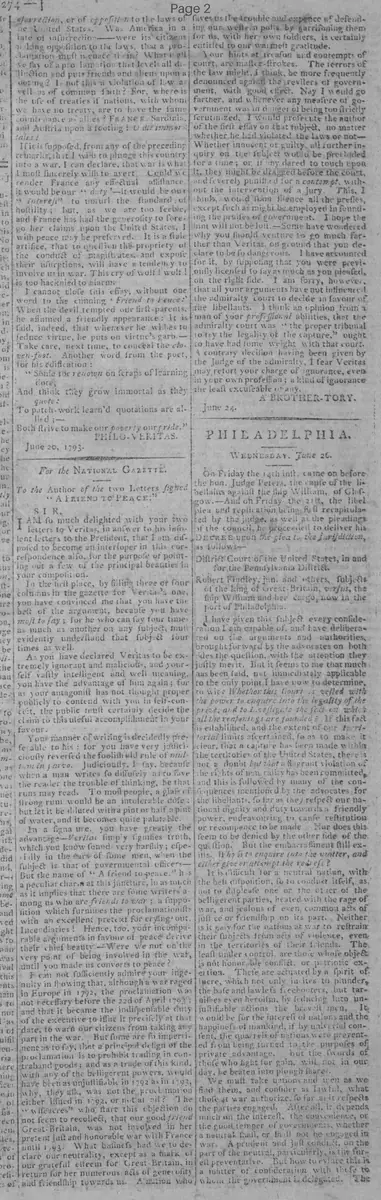
For the NATIONAL GAZETTE.
To the Author of the two Letters signed "FRIEND TO PEACE."
SIR,
I AM so much delighted with your two letters to Veritas, in answer to his insolent letters to the President, that I am disposed to become an interloper in this correspondence also, for the purpose of pointing out a few of the principal beauties in your composition.
In the first place, by filling three or four columns in the gazette for Veritas's one, you have convinced me that you have the best of the argument, because you have most to say; for he who can say four times as much as another on any subject, must evidently understand that subject four times as well.
As you have declared Veritas to be extremely ignorant and malicious, and yourself vastly intelligent and well meaning, you have the advantage of him again; for as your antagonist has not thought proper publicly to contend with you in self-conceit, the public must certainly decide the claim to this useful accomplishment in your favour.
Your manner of writing is decidedly preferable to his: for you have very judiciously reversed the foolish old rule of multum in parvo. Judiciously, I say, because when a man writes so diffusely as to save the reader the trouble of thinking, he that runs may read. To most people, a glass of strong rum would be an intolerable dose: but let it be diluted with a pint or half a pint of water, and it becomes quite palatable.
In a signature, you have greatly the advantage. Veritas simply signifies truth, which you know sounds very harshly; especially in the ears of some men, when the subject is that of governmental officers—But the name of "A friend to peace," has a peculiar charm at this juncture, in as much as it implies that there are other writers among us who are friends to war; a supposition which furnishes the proclamationists with an excellent pretext for crying out, Incendiaries! Hence, too, your incomparable arguments in favour of peace derive their chief beauty. Were we not on the very point of being involved in the war, until you made us converts to peace?
I cannot sufficiently admire your ingenuity in showing that, although a war raged in Europe in 1792, the proclamation was not necessary before the 22d of April 1793; and that it became the indispensable duty of the executive to issue it precisely at that date, to warn our citizens from taking any part in the war. But some are so impertinent as to say, that a principal design of the proclamation is to prohibit trading in contraband goods; and as a trade of this kind, with any of the belligerent powers, would have been as unjustifyable in 1792 as in 1793, why, they ask, was not the proclamation either issued in 1792, or not at all? The "miscreants" who start this objection do not seem to recollect, that our good friend Great-Britain, was not involved in her present just and honorable war with France until 1793. What business had we to declare our neutrality, except as a mark of our grateful esteem for Great-Britain, in return for her numerous acts of generosity and friendship towards us. A nation who saves us the trouble and expense of defending our western posts, by garrisoning them for us, with her own soldiers, is certainly entitled to our warmest gratitude.
Your hints at treason and contempts of court, are master-strokes. The terrors of the law might, I think, be more frequently denounced against the revilers of government, with good effect. Nay I would go farther, and whenever any measure of government was in danger of being too strictly scrutinized, I would prosecute the author of the first essay on that subject, no matter whether he had violated the laws or not—Whether innocent or guilty, all further inquiry on the subject would be precluded for a time; or if any dared to touch upon it, they might be dragged before the court, and severely punished for a contempt, without the intervention of a jury. This, I think, would silence all the press, except such as might be employed in sounding the praises of government. I hope the hint will not be lost.—Some have wondered why you should venture to go much farther than Veritas, on ground that you declare to be so dangerous. I have accounted for it, by supposing that you were previously licensed to say as much as you pleased, on the right side. I am sorry, however, that all your arguments have not influenced the admiralty court to decide in favour of the libellants. I think an opinion from a man of your professional abilities, that the admiralty court was "the proper tribunal to try the legality of the capture," ought to have had some weight with that court. A contrary decision having been given by the judge of the admiralty, I fear Veritas may retort your charge of ignorance, even in your own profession; a kind of ignorance the least excusable of any.
A BROTHER-TORY.
June 24.
To the Author of the two Letters signed "FRIEND TO PEACE."
SIR,
I AM so much delighted with your two letters to Veritas, in answer to his insolent letters to the President, that I am disposed to become an interloper in this correspondence also, for the purpose of pointing out a few of the principal beauties in your composition.
In the first place, by filling three or four columns in the gazette for Veritas's one, you have convinced me that you have the best of the argument, because you have most to say; for he who can say four times as much as another on any subject, must evidently understand that subject four times as well.
As you have declared Veritas to be extremely ignorant and malicious, and yourself vastly intelligent and well meaning, you have the advantage of him again; for as your antagonist has not thought proper publicly to contend with you in self-conceit, the public must certainly decide the claim to this useful accomplishment in your favour.
Your manner of writing is decidedly preferable to his: for you have very judiciously reversed the foolish old rule of multum in parvo. Judiciously, I say, because when a man writes so diffusely as to save the reader the trouble of thinking, he that runs may read. To most people, a glass of strong rum would be an intolerable dose: but let it be diluted with a pint or half a pint of water, and it becomes quite palatable.
In a signature, you have greatly the advantage. Veritas simply signifies truth, which you know sounds very harshly; especially in the ears of some men, when the subject is that of governmental officers—But the name of "A friend to peace," has a peculiar charm at this juncture, in as much as it implies that there are other writers among us who are friends to war; a supposition which furnishes the proclamationists with an excellent pretext for crying out, Incendiaries! Hence, too, your incomparable arguments in favour of peace derive their chief beauty. Were we not on the very point of being involved in the war, until you made us converts to peace?
I cannot sufficiently admire your ingenuity in showing that, although a war raged in Europe in 1792, the proclamation was not necessary before the 22d of April 1793; and that it became the indispensable duty of the executive to issue it precisely at that date, to warn our citizens from taking any part in the war. But some are so impertinent as to say, that a principal design of the proclamation is to prohibit trading in contraband goods; and as a trade of this kind, with any of the belligerent powers, would have been as unjustifyable in 1792 as in 1793, why, they ask, was not the proclamation either issued in 1792, or not at all? The "miscreants" who start this objection do not seem to recollect, that our good friend Great-Britain, was not involved in her present just and honorable war with France until 1793. What business had we to declare our neutrality, except as a mark of our grateful esteem for Great-Britain, in return for her numerous acts of generosity and friendship towards us. A nation who saves us the trouble and expense of defending our western posts, by garrisoning them for us, with her own soldiers, is certainly entitled to our warmest gratitude.
Your hints at treason and contempts of court, are master-strokes. The terrors of the law might, I think, be more frequently denounced against the revilers of government, with good effect. Nay I would go farther, and whenever any measure of government was in danger of being too strictly scrutinized, I would prosecute the author of the first essay on that subject, no matter whether he had violated the laws or not—Whether innocent or guilty, all further inquiry on the subject would be precluded for a time; or if any dared to touch upon it, they might be dragged before the court, and severely punished for a contempt, without the intervention of a jury. This, I think, would silence all the press, except such as might be employed in sounding the praises of government. I hope the hint will not be lost.—Some have wondered why you should venture to go much farther than Veritas, on ground that you declare to be so dangerous. I have accounted for it, by supposing that you were previously licensed to say as much as you pleased, on the right side. I am sorry, however, that all your arguments have not influenced the admiralty court to decide in favour of the libellants. I think an opinion from a man of your professional abilities, that the admiralty court was "the proper tribunal to try the legality of the capture," ought to have had some weight with that court. A contrary decision having been given by the judge of the admiralty, I fear Veritas may retort your charge of ignorance, even in your own profession; a kind of ignorance the least excusable of any.
A BROTHER-TORY.
June 24.
What sub-type of article is it?
Satirical
Provocative
Political
What themes does it cover?
Politics
Press Freedom
What keywords are associated?
Neutrality Proclamation
Friend To Peace
Veritas
British Relations
Press Suppression
Admiralty Court
Political Satire
What entities or persons were involved?
A Brother Tory
To The Author Of The Two Letters Signed "Friend To Peace."
Letter to Editor Details
Author
A Brother Tory
Recipient
To The Author Of The Two Letters Signed "Friend To Peace."
Main Argument
the letter sarcastically praises the verbose, self-congratulatory style and pro-neutrality arguments of 'friend to peace,' mocking their support for the 1793 proclamation as biased toward britain and suggesting suppression of press criticism.
Notable Details
Sarcasm On Argument Length Implying Superiority
Mockery Of Signature 'Friend To Peace' Implying Others Are 'Friends To War'
Irony On Proclamation Timing Tied To Britain's War Entry
Suggestions For Using Law To Silence Government Critics
Reference To Admiralty Court Decision